
Jump to winners | Jump to methodology
The best young HR professionals in Australia stand out for their judgement, AI and ability to shape the future
In 2026, Australia’s best young HR professionals are running a job that’s been rewritten twice in three years – first by a pandemic that put wellbeing on the boardroom agenda, then by AI and a wave of legislation that turned every people team into a compliance function overnight.
It’s what Randstad human resources director Felicity Empson calls a “legislative and technological pressure cooker,” as generative AI adoption accelerates alongside new psychosocial safety and Right to Disconnect obligations.
In addition, most of HRD Australia’s Rising Stars 2026 didn’t set out to work in HR, and Sydney-based Empson explains how they built their commercial judgement only once they’d arrived in the profession. She adds that the standout HR professional is no longer “an enforcer of compliance or an administrative partner, but a commercial problem-solver and architect of the employee experience.”
While Elizabeth Barron, founder and director of MesoWorks in Sydney, adds that it’s no longer enough to be a great HR practitioner. “A Rising Star isn’t someone who has all the answers,” she says. “Strong HR fundamentals remain essential, but what increasingly sets people apart is their curiosity about the business, their commercial awareness and their willingness to think beyond traditional HR.”
Cohort profile
A composite portrait built from all 35 nominees
of nominees still carry a traditional HR or human resources job title, despite the industry-wide rhetoric around rebranding to People & Culture.
Source HRD Australia Rising Stars 2026 nomination data (n=35)
What's on the business card
Despite a decade of "people and culture" rebranding across the industry, a slim majority of this year's Rising Stars still hold a title with HR or human resources in it.
Source HRD Australia Rising Stars 2026 nomination data (n=35)
The most common rung on the ladder
More than half of this year's cohort sits at advisor or business partner level. Only one nominee has reached head or director title, a reminder that this list rewards trajectory over seniority.
Source HRD Australia Rising Stars 2026 nomination data (n=35). Figures rounded to the nearest whole percentage and may not total 100.
What Rising Stars say makes them good at this job
Relationships and composure together account for nearly half of what this cohort names as its defining strength, well ahead of any technical skill.
Source HRD Australia Rising Stars 2026 nomination data. Based on 23 of 35 nominees who gave a distinct answer to this question. Categories reflect an interpretive grouping of open-text responses.
With Gen Z talent increasingly linking job security to continuous learning and employability, Empson says a Rising Star knows how to design roles and career pathways that meet those expectations while still driving commercial outcomes forward.
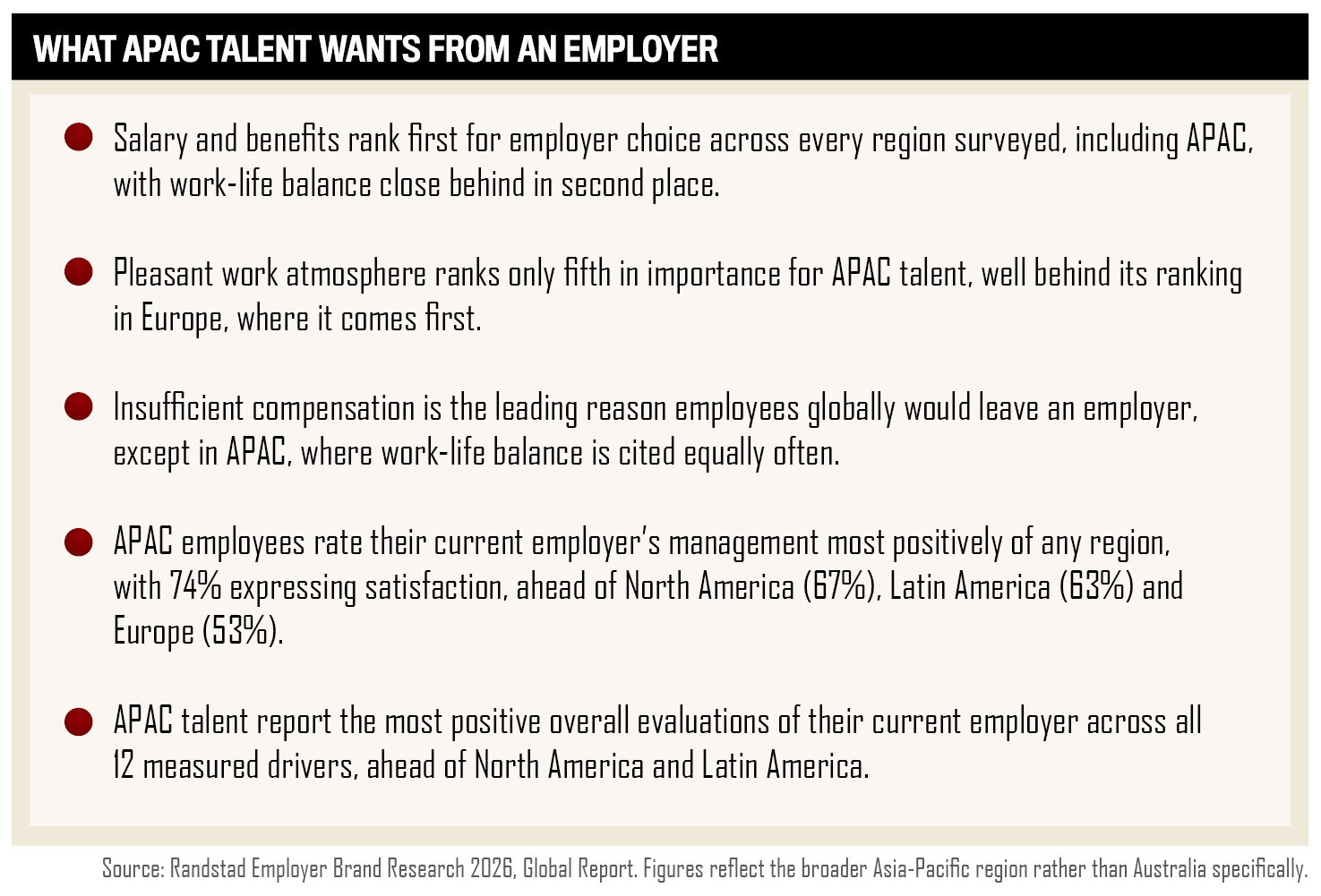
She stated that for Australian talent, work-life balance is the leading driver of employer choice for 61% of Australian talent, ahead of pay or brand reputation, which contrasts with the wider Asia-Pacific region.
Barron says organisations are increasingly looking for HR professionals who can embrace new technology, stay across legislative change and apply sound judgement where there isn’t always a clear answer.
The expectation, she says, has shifted from simply delivering HR services to enabling leaders and supporting business performance without becoming a barrier to progress. That expectation already shows up in this year’s cohort, where just over a quarter of winners describe hands-on work adopting AI or automation inside their own HR function, according to HRD’s 2026 winner data, well ahead of where the profession sat only a few years ago.
Both experts describe a profession where automation is expected to absorb routine administrative work, freeing HR professionals to focus on the judgement, trust and human connection that AI cannot replace. This is playing out against a backdrop of new psychosocial safety regulations, as covered in HRD’s analysis of employer obligations under psychosocial safety law, and the Right to Disconnect, a workplace entitlement outlined in the Fair Work Ombudsman’s guidance on the right to disconnect that allows employees to reasonably refuse contact from an employer outside their working hours. The Fair Work Ombudsman is Australia’s national workplace relations regulator.
Report highlights
The data behind HRD Australia's 2026 Rising Stars cohort
of nominees who addressed the question said their career in human resources (HR) began through opportunity, not a plan, moving across from operations, hospitality, occupational therapy, law and other unrelated fields.
Source HRD Australia Rising Stars 2026 nomination data (n=22 of 35 nominees)
How this year's cohort actually got here
Source HRD Australia Rising Stars 2026 nomination data. The remaining 4% describe their path as a mix of both.
Age and tenure, youngest to oldest
Each row is scaled to its own range, not a share of 100
Nominees span nearly the full eligibility window, from 2 to 10 years of HR experience.
Source HRD Australia Rising Stars 2026 nomination data (n=35)
Where nominees are focusing their energy
Source HRD Australia Rising Stars 2026 nomination data. Theme counts derived from a qualitative read of submissions.
Where this year's nominees are based
Victoria and New South Wales account for 29 of the 35 nominations. Figures are rounded to the nearest whole percentage and may not total 100.
Source HRD Australia Rising Stars 2026 nomination data (n=35)
Ask most senior HR leaders how they started their careers and you’ll likely hear the same answer: a deliberate plan built around psychology or business degrees. The 2026 HRD Rising Stars cohort doesn’t fit that pattern. Of the winners who addressed the question directly, only 41% describe a deliberate, planned entry into the profession.
The scale of this pattern is striking given how central HR has become to organisational strategy. Winners this year moved into the profession from nursing, law, psychology, marketing, hospitality and even an aged care background, several noting explicitly that opportunity rather than intention shaped their path.
One winner who transitioned from law said the decision to pursue HR over a traditional legal career came down to wanting greater influence over real-time business decisions.
Another, originally trained in occupational therapy, found her way into HR through a school role before landing at a major sporting organisation. The pattern suggests Australian employers hiring for HR capability may be better served looking beyond HR qualifications alone to adjacent skill sets such as coaching, advocacy and operational problem-solving.
Cohort profile
Where this year's Rising Stars came from before they arrived in HR
Nominees who named a prior field before moving into HR came from a genuinely wide spread of backgrounds, among them,
Not a single one of these pathways looks like the others, which reinforces the earlier finding that most of this year's cohort entered HR through opportunity rather than a plan mapped out from the start.
Source HRD Australia Rising Stars 2026 nomination data
Nearly half of this year’s submissions, 46%, describe coaching or building the capability of first-time or frontline managers as central to the winner’s impact. This shows up across vastly different sectors, from construction and aged care to professional services and hospitality, and it typically follows the same shape: a supervisor or manager promoted without formal people management training, supported through structured coaching until they can handle performance and employee relations (ER) conversations independently.
Several winners built formal programs around this instead of relying on ad hoc coaching, including leadership training modules, mentoring frameworks and manager toolkits designed to scale beyond one-on-one support. As HRD has separately reported, this shift mirrors a broader move towards data-led, human-centred leadership development across the wider profession.
Just over a quarter of winners, 26%, describe direct, hands-on work adopting AI or automation inside their HR function, ranging from piloting AI recruitment tools and exploring AI-enabled employee query systems, to leading AI literacy programs and acting as an internal subject matter expert on AI use across the business.
Notably, AI shows up on both sides of the ledger this year. Several winners describe it as an opportunity they are actively shaping, while at least two describe growing employee anxiety about AI and job security as one of the harder people challenges they’ve had to manage. This dual framing, AI as both capability and concern, is likely to be a defining tension for HR leaders through 2026 and beyond.
While 23% are managing acquisitions, enterprise agreement renewals or large-scale organisational restructuring as part of their core remit, often while also holding day-to-day advisory responsibilities.
One winner has supported the due diligence and integration of six acquired businesses within a single year, while another led the rollout of two new enterprise agreements across a workforce that hadn’t received a pay increase since 2024. This work rarely makes it into a job title, but it’s shaping how a meaningful share of this year’s cohort spends their time.
More than a third of winners, 37%, contribute to the profession beyond their employer, sitting on industry committees, mentoring university students, presenting at practitioner forums or advising early-stage HR technology founders. This ranges from formal roles such as membership of the Property Council of Australia’s People and Culture Committee, through to informal contributions such as returning to university campuses to mentor the next generation of HR graduates.
Ask this cohort what they’re proudest of, and the answers are polished and specific. Ask what’s been hard, and the tone shifts. Of the winners who answered this question in detail, roughly a third describe some version of the same pressure: leading change or building a function while the ground is still shifting under them, often without the seniority or established structure to match the responsibility they’ve been handed.
A similar number describe having to build credibility fast, walking into rooms with far more experienced leaders and earning trust on the spot rather than being granted it by title or tenure.
AI shows up here again, too, and not just as a technical adjustment. A handful of winners describe managing their own teams’ adaptation to new tools while also fielding growing employee anxiety about what AI means for job security, a dual pressure that echoes the earlier finding on AI as both capability and concern.
A smaller group names something more specific: the sheer pace of regulatory change across modern awards, industrial instruments and psychosocial safety law, and the resourcing gap between what’s expected of HR and what teams are actually equipped to deliver.
It’s a useful corrective to the earlier data on achievement and initiative. This cohort isn’t just accumulating wins; they’re doing it while learning the job in real time, often alone, and mostly without anyone telling them it was supposed to be this hard.
Sarah Thompson is the sole HR contact for a trades workforce approaching 800 employees across a wide range of trade and support roles. Since joining BGIS in 2020, she has built a reputation as a trusted partner to leaders navigating complex employee and industrial relations matters across multiple modern awards and enterprise agreements.
At 29, with eight years in HR, she is currently leading the people integration of six newly acquired trades businesses, many of them family-owned and run, which adds real emotional weight to the change work involved.
A hard week, she says, means balancing reactive HR support against the strategic work that will determine whether the integrations succeed long term. On the reactive side, that includes ER matters, performance concerns, recruitment challenges and questions from recently joined employees who are understandably anxious about what the acquisitions mean for them.
On the strategic side, her integration work spans:
harmonising employment arrangements across the newly acquired businesses
transitioning employees onto new systems
integrating payroll and HR processes
developing change management strategies tailored to each business


That same instinct for solving root problems led Thompson to redesign how BGIS leaders access HR support. She noticed managers weren’t ignoring processes deliberately; they simply didn’t know where to start, with guidance scattered across disparate documents and systems.
Working with her team, she co-created a self-serve HR platform, a suite of interactive Microsoft Forms built with AI assistance, that walks leaders step by step through common people matters and links them directly to templates and decision-making tools.
“Make the right process the easiest process or make it easy for leaders to do the right thing,” is how she describes the guiding principle behind it. The result has been more confident leaders, improved compliance, and stronger consistency and reporting across the business.
Alongside this, Thompson designed and implemented a leadership training module on employment law across Australia and New Zealand, further building the capability of frontline supervisors managing people matters for the first time.
Thompson has also watched the perception of HR shift. “Historically, HR was usually brought in when something went wrong,” she says. “But today, we’re being involved much earlier because leaders are actually starting to see the direct connection between people decisions and business outcomes.”
A partnership with Deakin University, paired with her own analysis of BGIS workforce data, has let her show leaders exactly where productivity gaps, turnover and leadership capability are shaping operational results.
“Instead of hearing HR says we need to do this, the discussion becomes more around how can HR help us improve performance,” she says, describing HR’s shift towards becoming a genuine business performance enabler rather than an administrative function.
Beyond BGIS, Thompson sits on the Property Council of Australia’s People and Culture Committee and contributes to Facilities Management Association of Australia events, including International Women’s Day sessions on leadership and inclusion.
She also volunteers with Habitat for Humanity Australia’s Homes for Hope initiative. Her focus, she says, remains on building leadership capability among frontline supervisors and creating fair, practical people outcomes for a growing, operationally complex workforce.
Q: What would you tell a newer HR professional walking into their first sole-charge HR role tomorrow?
A: Learn the business before trying to change the business. Spend time understanding what the business does, how it generates revenue, what its operational challenges are and what success looks like for the leaders on the ground, because the more commercially aware you are, the more credible your advice becomes. Some of the best HR advice comes from understanding how people decisions impact operational performance, not just understanding HR processes.
When you’re the sole HR contact, there’s often pressure to have all the answers immediately. But in reality, your biggest strengths early on are listening, building relationships and asking good questions. I’d also encourage them not to get stuck purely in the technical side of HR. Employment law and policies are important, but understanding how the business operates is what allows you to translate that advice into something practical and valuable.
And don’t be afraid to say, “I’ll come back to you.” People don’t expect you to know everything on day one, but they do expect you to build trust, be reliable, and genuinely understand the challenges they’re facing.
Q: What’s one leadership initiative you built from scratch that you’re proudest of, and what made you realise it was needed?
A: One of the initiatives I’m proudest of was redesigning our manager-facing HR processes into a kind of guided self-service experience. What we’d noticed was that many leaders weren’t intentionally getting people processes wrong. They just didn’t know where to start. The information existed across our systems, but it was spread across different documents and policies. Managers were spending a lot of time trying to work out what to do next or just reaching out to us directly for support, whether it be by a call or an email.
So, with the support of our HR team, I built a suite of interactive process forms that walk leaders through our common people matters step by step and link them to any of the relevant templates, process maps, and decision-making tools.
The objective from that was simple: make the right process the easiest process or make it easy for leaders to do the right thing. The result of that is that we’ve seen our leaders become more confident. They could get quick advice when they needed it. Compliance improved, and our team could shift away from answering the same procedural questions that pop up repeatedly and spend more time providing that strategic support. More importantly, it helped build our leaders’ capability, which was our goal from the start, as well.
Taylah McCormick is a human resources business partner at SunPork in Queensland, where she partners with operational leaders across multiple sites in a role that closely mirrors that of an HR business partner.
Since joining the business in 2021, McCormick has built a reputation for navigating complex ER matters end-to-end and turning sceptical stakeholders into some of the HR function’s strongest advocates.
Her approach with a new stakeholder or business unit starts the same way every time. “It’s just about first understanding their operations rather than trying to lead them immediately,” she says.
She believes leaders rarely resist HR out of principle; they simply don’t understand the value it can bring them, and taking the time to understand their operations and pressure points is what builds the rapport needed to change that.
At one site, she deliberately gave up the comfort of her own office to walk the floor instead. “I want people to see me, I want to say hello and I want them to know who I am,” she says. Stakeholders were sceptical of the move at first, until they came to understand it was intentional, a way of showing people that HR isn’t something to fear.
Over the past year, McCormick has led the design and rollout of a mentoring and leadership capability program that delivered measurable gains at one site and has since been requested across other parts of the business.
The program was built to address a gap she kept seeing: technically excellent leaders who hadn’t yet developed the people skills to match. “It’s about providing them structure and real practical advice,” she says, rather than leadership theory, working through real situations each month and asking leaders directly what’s working and what isn’t.
She knows the program is succeeding when leaders stop calling her only with problems. “They’re coming to me excited, saying, oh, I did this, and I did that,” she says.
McCormick currently leads eight strategic projects spanning succession planning, psychological injury training and remuneration strategy and has been formally endorsed to take on responsibility for an additional site in recognition of her impact and professionalism.
“It’s about listening to the noise in the business,” she says, weighing people risk, safety risk and operational impact before leaning on the strengths of the HR professionals around her rather than trying to carry every project herself.
McCormick came to HR after building a career in operational management, and that background still shapes how she leads today, favouring coaching and practical structure over leadership theory.

Her current role sits at the centre of a genuinely wide-ranging business. SunPork spans farm operations, an abattoir, value-add and pet food production, and even its own scientific and environmental teams, across sites in both Australia and New Zealand. Sitting between the farm and production sides of the business as a hybrid HR business partner, she says no two conversations look the same depending on which leader she’s talking to.
Her focus, she says, remains on mentoring leaders and building the foundations for stronger, more consistent people practices at scale.
Q: You’ve turned leaders who didn’t see the value of HR into some of its strongest advocates; what did that shift take?
A: It definitely takes a lot of patience. When I go into a new stakeholder or business unit, it’s about understanding their operations first rather than trying to lead them immediately. I do believe leaders don’t truly want to resist HR; they just don’t quite understand the value HR can bring them.
By taking the time to understand them, their operations and their pressure points, you can start to build that rapport and figure out where you’re going to help support them most in their day-to-day. It’s really about becoming the people partner that leaders need, solving real problems for them by coaching them through those processes.
Once leaders start to see they can run their business better through stronger leadership capability, clearer accountability and better people management, they see the shift firsthand. The biggest credit to that is building trust with them. You don’t get credibility from telling them what to do; you build it by helping them find a better solution to protect their people and their business.
Q: You came to HR five years ago. What made you take that leap, and does it change how you approach the mentoring work you do now?
A: Coming into HR has had a lot of benefits for me because you better understand yourself and how you want to lead. I came from a very operational environment where I was a manager, so I understand the importance of good management, and the best part of my role was always being able to develop and coach someone, to trust in them and give them the confidence to grow and unlock their full potential.
As I moved through management, I started to gravitate towards HR, and one day I thought, “Maybe I should study this,” because it was what I was genuinely enjoying. I absolutely love people and being able to help so many different people across different parts of the business is something I feel lucky to do.
Both experts point to the next 12–24 months as decisive for this cohort. Barron says the rising stars “are intentionally developing the judgement, adaptability and commercial thinking that will allow them to influence organisational performance as their careers progress.” Empson identifies workforce transformation as the single biggest growth opportunity, as businesses adopt AI and transition towards greener economies and roles change as a result.
That transformation is already visible in this year’s cohort, where just over a quarter of winners describe hands-on work adopting AI or automation inside their own HR function, according to HRD’s 2026 winner data, a figure both experts expect to climb sharply over the next two years as automation absorbs more routine HR work.
Both Barron and Empson flag the same risk sitting on the other side of that opportunity: professionals who stay reactive and compliance-focused risk being left behind as that automation takes hold. Empson points to workforce transformation forecasts, echoed in Jobs and Skills Australia’s 2026 report on how AI is reshaping jobs and skill needs, as evidence that the shift is already underway across the broader labour market, not just within HR functions. Jobs and Skills Australia is the Australian Government agency responsible for national labour market research.
For a cohort already showing early movement on AI adoption, as outlined in this report’s own findings on AI adoption across the 2026 cohort, the next two years will likely determine which of this year’s Rising Stars become tomorrow’s HR leaders and which get left managing processes that no longer need managing.
What unites this year’s Rising Stars isn’t a shared entry point into HR – most didn’t plan one – but a shared response once they arrived. They’ve built commercial judgement, coaching capability and, increasingly, AI fluency on top of an accidental start.
That pattern holds whether the path ran through law, nursing, hospitality reception or a farm-to-plate supply chain, as it did for featured winners Sarah Thompson and Taylah McCormick, both of whom turned scepticism into advocacy by understanding the business first and leading second. It also holds across the geography, from Victoria and New South Wales through to Queensland and South Australia, and across a cohort that spans nearly a decade of career stages.
As Barron puts it, “The rising stars won’t be those who know the most about HR. They’ll be the ones who are building the capabilities to help organisations perform better through their people.”
To ground the data in day-to-day expert perspective, HRD spoke with two senior HR leaders about what’s changing for early-career professionals right now, from the redefinition of what a “rising star” looks like to the twin pressures of AI adoption and new workplace safety laws.
Barron founded MesoWorks, a people and performance consultancy for scale-ups and founders, after more than 20 years in senior HR and leadership roles at IAG, Luxottica and THE ICONIC. She brings behavioural insight, strategic clarity and a strong bias for action and is known for treating performance as a design problem, focusing on how teams communicate, make decisions and measure success.
Empson leads Randstad Australia’s HR function and is a regular industry voice on workplace equity and the evolving role of HR, previously telling HRD’s Elite Women feature that the profession needs to move beyond functional expertise into genuine strategic partnership, including being the voice of reason in areas like the responsible use of AI.
Q: What new pressures are being placed on early-career HR professionals right now, particularly around AI adoption and changing workplace laws?
Barron says the pace of change has accelerated significantly. “AI, evolving workplace legislation and changing workforce expectations mean early-career HR professionals are entering a profession that’s more complex than ever,” she says. Organisations increasingly need HR professionals who can embrace new technology, stay across legislative change and apply sound judgement where there isn’t always a clear answer, according to Barron.
Empson describes the environment in sharper terms, calling it “a legislative and technological pressure cooker.” She says early-career professionals are tasked with championing rapid AI adoption that drives productivity and automates routine tasks while also navigating a highly complex, evolving legal landscape designed to protect worker wellbeing, including psychosocial safety regulations and the Right to Disconnect. “Young HR professionals are expected to know how to deploy generative AI for talent acquisition or workforce planning, while simultaneously ensuring these tools do not introduce bias,” she says.
Q: How are young HR professionals balancing human skills such as empathy, communication and judgement with growing technical and data demands?
Barron says the strongest professionals treat these as complementary skills that reinforce each other. “Technology and data provide insight and efficiency, while empathy, communication and judgement provide context. AI can support better decisions, but it can’t replace the conversations, trust and nuanced thinking that effective HR requires.”
Empson describes a “digital-first, human-confirmed” approach among top performers, using AI and data analytics to handle transactional work such as spotting flight risks or screening high-volume applications, then applying human judgement to the parts that matter most. “It takes human empathy to sit down with a struggling employee, understand the root cause, and offer genuine support,” she says.
Q: What advice would you give young HR professionals looking to fast-track into strategic or leadership-facing roles?
Barron’s advice is direct: learn the business deeply. “Understand how the organisation makes money, what success looks like, and what challenges leaders are trying to solve.” She points to critical thinking and sound judgement in ambiguous situations as what ultimately builds credibility and earns a seat at the table.
Empson agrees professionals need to understand the commercial realities of their business and adds that ambitious HR professionals shouldn’t wait to be invited to contribute at a strategic level. “Do not wait for a seat at the table; build a business case that proves you belong there.” She points to Randstad’s own research showing 25% of talent are considering external moves compared with only 12% looking to move internally and suggests HR professionals who can turn a data point like that into a cost-of-turnover business case, paired with an internal reskilling proposal, are the ones who get noticed by the executive team.
Q: Where do you see the biggest growth opportunities and risks for young HR talent over the next 12 months?
Barron says the opportunity lies in becoming a genuine performance partner, someone who combines people expertise with commercial thinking to help organisations grow. The risk, she says, is remaining transactional. “As technology automates more administrative work, the value HR brings will increasingly come from critical thinking, leadership enablement, commercial awareness and the ability to navigate complexity,” she says.
Empson identifies workforce transformation as the biggest opportunity, as businesses adopt AI and shift towards greener economies, reshaping roles in the process. The risk, she says, is getting bogged down in reactive compliance at the expense of strategic foresight, particularly with new psychosocial safety laws and Right to Disconnect mandates already competing for attention.
She also points to generational attrition data as a warning sign, noting that Gen Z and Millennial employees are highly likely to leave an employer due to a lack of career growth opportunities, at 34% and 30%, respectively. “HR talent who fail to look past compliance to focus on genuine career mapping, engagement and role design risk losing their organisation’s best people,” she says.

Q: What is HRD Australia’s Rising Stars?
A: It’s an annual recognition program from HRD identifying the country’s most outstanding HR professionals aged 35 or under with 10 years or less of HR experience, selected through nomination and reviewed by the editorial team.
Q: Why did most 2026 winners not plan a career in HR?
A: The pattern reflects how people typically discover HR, not through early planning, but by building transferrable skills in adjacent, people-facing roles first. One winner who moved from law said the switch came down to wanting greater influence over real-time business decisions, while others carried over coaching, advocacy and problem-solving skills from nursing, occupational therapy and hospitality. Most didn’t reject HR as a career choice early on; they simply weren’t looking at it until they were already doing versions of the work elsewhere.
Q: How is AI changing what’s expected of early career HR professionals?
A: The two subject matter experts interviewed for this report say AI is expected to absorb routine administrative HR work, shifting the value of HR professionals towards judgement, commercial thinking and the human skills AI cannot replace.
Q: What industry trends will shape the next generation of HR leaders?
A: Workforce transformation driven by AI adoption, new psychosocial safety and Right to Disconnect obligations, and a growing expectation that HR functions operate as commercial partners rather than administrative ones.
In April, HRD Australia invited HR professionals across the country to nominate their most exceptional young talent for the Rising Stars list.
Nominees had to have HR work experience of 10 years or less, as well as experience in executing progressive HR initiatives, and be committed to a career in HR with a clear passion for the industry. Nominees were asked about their current role, key achievements, career goals and the contributions they had made to shaping the industry.
Recommendations from managers and senior industry professionals were also taken into account. The HRD team reviewed all nominations, narrowing the list down to 35 of the sector’s most outstanding young professionals.