

Jump to winners | Jump to methodology
Meet the HR leaders behind this year’s Elite Women list and
what sets APAC’s top women in the HR industry apart
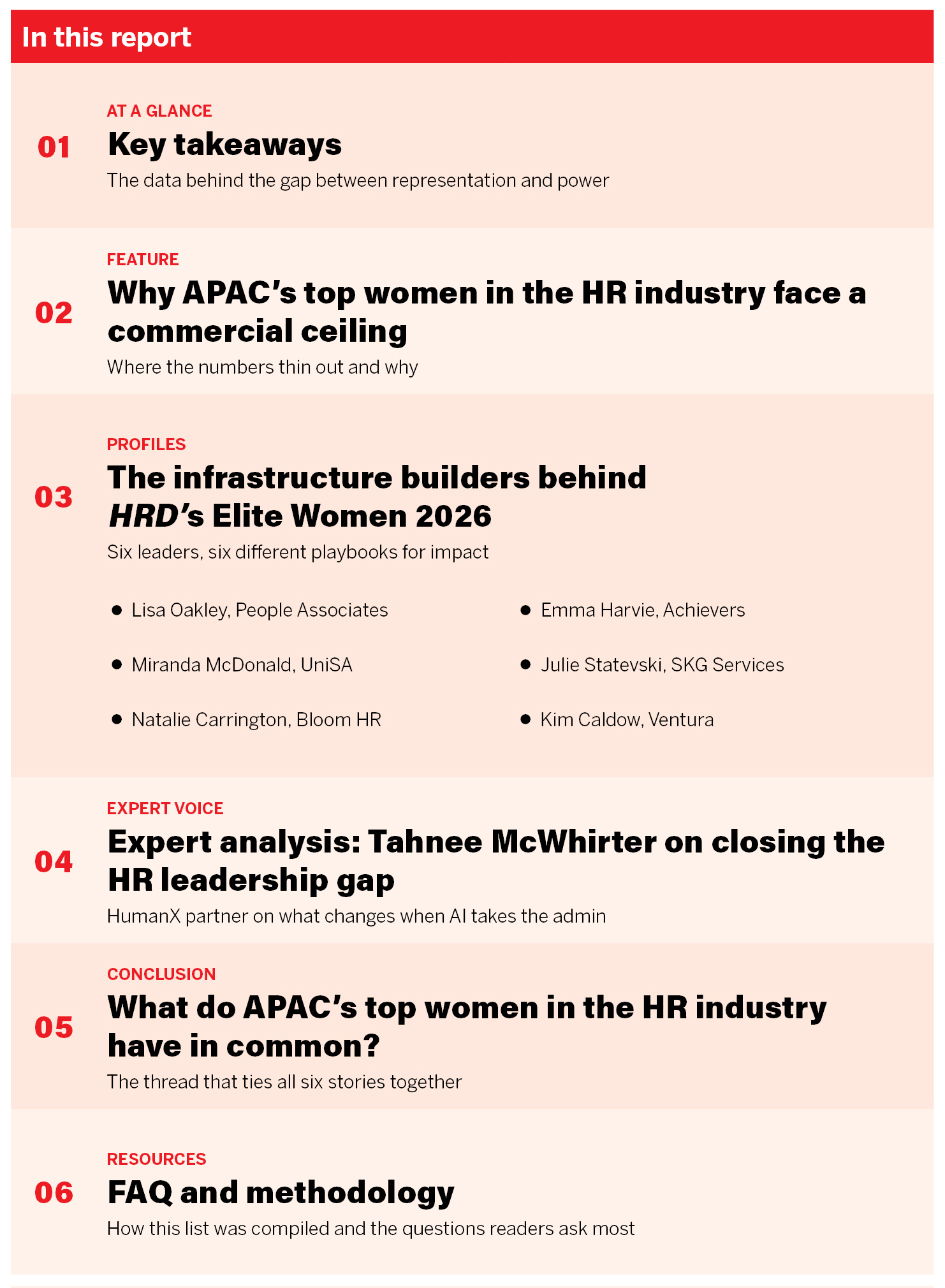
Across Australia, New Zealand and Asia, APAC’s top women in the HR industry aren’t just holding senior titles – they’re rewriting what commercial influence in HR actually looks like. Selected from a competitive field down to a final 70 for the second annual HRD Elite Women list, these leaders prove that scale, resilience and commercial impact count for more than any job title.
“It’s less about having the biggest HR title and more about the impact you’re having on the business and the humans making the impact,” says Tahnee McWhirter, partner at HumanX, an outsourced HR consultancy she opened in Sydney in 2020. “The women who stand out are commercially sharp and courageous enough to say the thing that may not be particularly popular.”
HR is one of the most female-dominated professions in the region. So why does that representation collapse the moment real power is on the table?
Even the most female-led seat in the C-suite is relative. Across Grant Thornton’s global mid-market Women in Business 2026 survey, women hold 43% of top HR roles, still the highest share of any C-suite function, ahead of finance (39%) and the chief executive’s office (23.8%). But APAC’s broader leadership numbers lag: women hold just 31.8% of senior management roles in the region, behind the 32.9% global average.
The old barriers – caregiving loads, thin networks – haven’t gone anywhere. But the newer ones are harder to see and harder to fight:
Access to core strategy: shut out of the early, high-stakes conversations where direction actually gets set
High-risk transformations: handed the safe work, not the high-friction overhauls that build a reputation
Boardroom exposure: rarely invited to present as an operator, only ever as a specialist
“That distinction matters, because it’s harder to be commercially credible from the sidelines,” says McWhirter. “Being excellent at HR is no longer enough at the most senior level. You need to understand how the organisation makes money, where margin is won and lost, what keeps the CEO awake and how people decisions affect the operating model.”
Those barriers compound into pay, too – a gap that HRD’s analysis of the gender pay gap in senior leadership explores in more depth. The maths is not lost on women themselves: HiBob’s 2026 workplace research finds that 35% of Australian women say they are no longer interested in leadership roles at all, not for lack of ambition, but because they have done the sums on effort versus reward.
Gartner projects AI will manage or automate roughly half of all HR activity. Strip out the admin, and what’s left is judgement – exactly the currency that decides who gets taken seriously as a business leader, not just a function head.
This mirrors a broader shift covered in HRD’s coverage of AI adoption strategies in HR.
McWhirter sees the shift as an opening, not a threat. “Women leaders in HR can help make sure organisations don’t adopt technology simply because they can. There are real questions around the interplay of ethics and the effect the change has on the employee experience. We need leaders who know where human judgement still matters,” she says.
“It’s also a genuinely good shift for women in the profession,” she argues. “I actually think that shift is good for women in HR because it broadens the pathway. The conversation becomes less about whether someone has followed a traditional HR career ladder and more about whether they can help run and shape a business.”
FEATURED WINNERS
The winners were not selected for their titles, though most hold senior ones. They were chosen because each has built something that keeps working long after the year-long award cycle moves on.
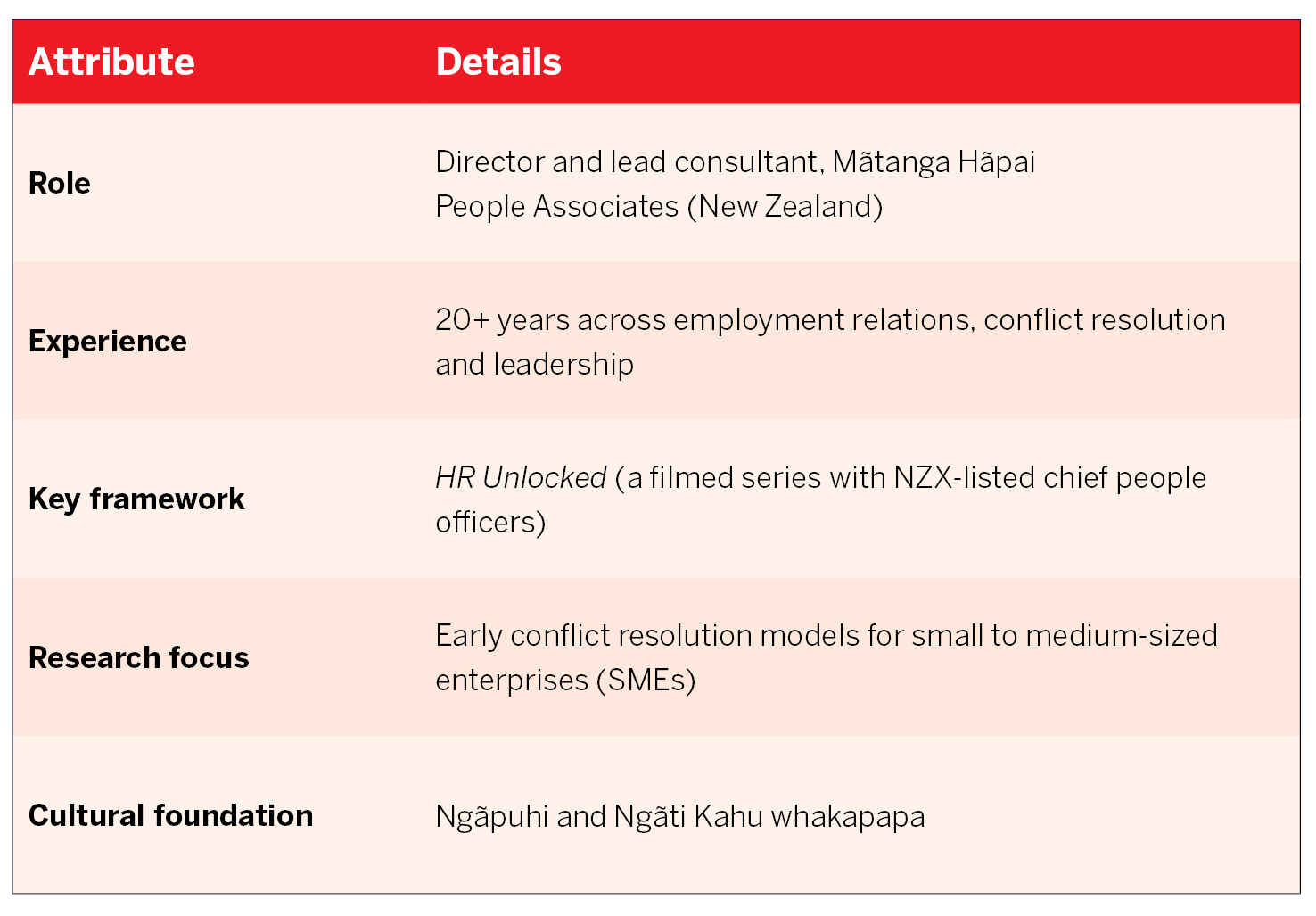
With over two decades of experience, Lisa Oakley helps organisations navigate complex employment relations and organisational change by balancing legal requirements, commercial realities and human dignity. A former national vice president of Human Resources New Zealand, Oakley advocates for proactive, commercially grounded leadership that moves beyond mere compliance to address conflict early.
Key strategic initiatives and impact:
Democratising C-suite insights (HR Unlocked): Oakley created HR Unlocked, a professionally filmed podcast featuring candid conversations with chief people officers across NZX-listed companies. The series explores how senior leaders handle competing legal, commercial and human priorities when operating with imperfect information.
Re-engineering dispute resolution (doctoral research): Her doctoral studies examine how small and medium-sized employers in Aotearoa New Zealand can resolve individual employment conflicts early. The goal is to prevent costly, formal legal disputes before positions harden and relationships deteriorate.
Indigenising practice through whakapapa: Guided by her Ngāpuhi and Ngāti Kahu heritage, Oakley integrates whakarongo (listening), manaakitanga (care and respect) and whanaungatanga (relationship-building) into mediation and investigations. This framework ensures procedural fairness while upholding personal dignity and mana.


Q: HR Unlocked was created as a contribution to the profession rather than as a commercial platform. What made you decide to build it that way?
A: Throughout my career, I have benefited enormously from people who generously shared their knowledge, challenged my thinking and spoke honestly about what working in HR is really like. I wanted to create a space where other practitioners and leaders could benefit from that same generosity.
I want HR Unlocked to explore what actually happens when people are making difficult decisions, working with imperfect information and balancing legal, commercial and human considerations.
Its value lies in making practical insights, honest conversations and the collective wisdom of experienced leaders accessible to the wider profession. It is deliberately built around contribution, learning and connection.
Q: Your doctoral research is focused on employment dispute resolution in Aotearoa New Zealand. What gap in the current system are you hoping to address?
A: My research focuses specifically on how small and medium-sized employers in Aotearoa New Zealand can resolve individual employment relationship conflict more effectively.
Workplace conflict can become formal, adversarial, expensive and slow, sometimes long before anyone reaches mediation or the Employment Relations Authority. By that stage, positions may be entrenched, relationships have often deteriorated and both parties may have incurred considerable financial and emotional costs.
Small and medium-sized employers can be particularly exposed because they may not have specialist employment relations expertise or the resources to navigate a prolonged dispute.
Ultimately, I hope to identify practical approaches that are fair to employers and employees, preserve dignity and mana and lead to outcomes people can genuinely live with.
Q: How does your Ngāpuhi and Ngāti Kahu whakapapa shape the way you approach mediation and workplace investigations?
A: My Ngāpuhi and Ngāti Kahu whakapapa shapes how I understand people, relationships and responsibility.
It reminds me that people do not enter workplace conflict as isolated legal actors. They bring their histories, identities, relationships, responsibilities and experiences with them.
In mediation, that leads me to place real importance on whakarongo, manaakitanga and whanaungatanga. I try to understand not only what happened, but what it meant to the people involved, how their mana may have been affected and what may be needed for them to move forward.
In workplace investigations, I still have an obligation to be independent, evidence-based and procedurally fair. However, fairness does not require the process to be cold or disconnected from context. People can be treated with dignity, listened to carefully and given a genuine opportunity to participate while the investigator remains impartial.
I am also conscious that whakapapa is not the same as claiming expertise in tikanga. I remain committed to learning and to approaching this work with humility, rather than treating te ao Māori as something symbolic or performative.
Q: As someone who has promoted the profession across New Zealand in various roles over a number of years, what change would you most like to see over the next few years?
A: The change I would most like to see is greater professional confidence in addressing difficult issues early, fairly and courageously.
I would like to see a profession that is commercially grounded, evidence informed and genuinely human. That means understanding organisational realities while still being prepared to challenge poor decisions, uphold fairness and protect people’s dignity.
It also means building stronger conflict-resolution capability across the profession, so workplace issues can be addressed constructively before they escalate into formal disputes or cause lasting damage to people and relationships.
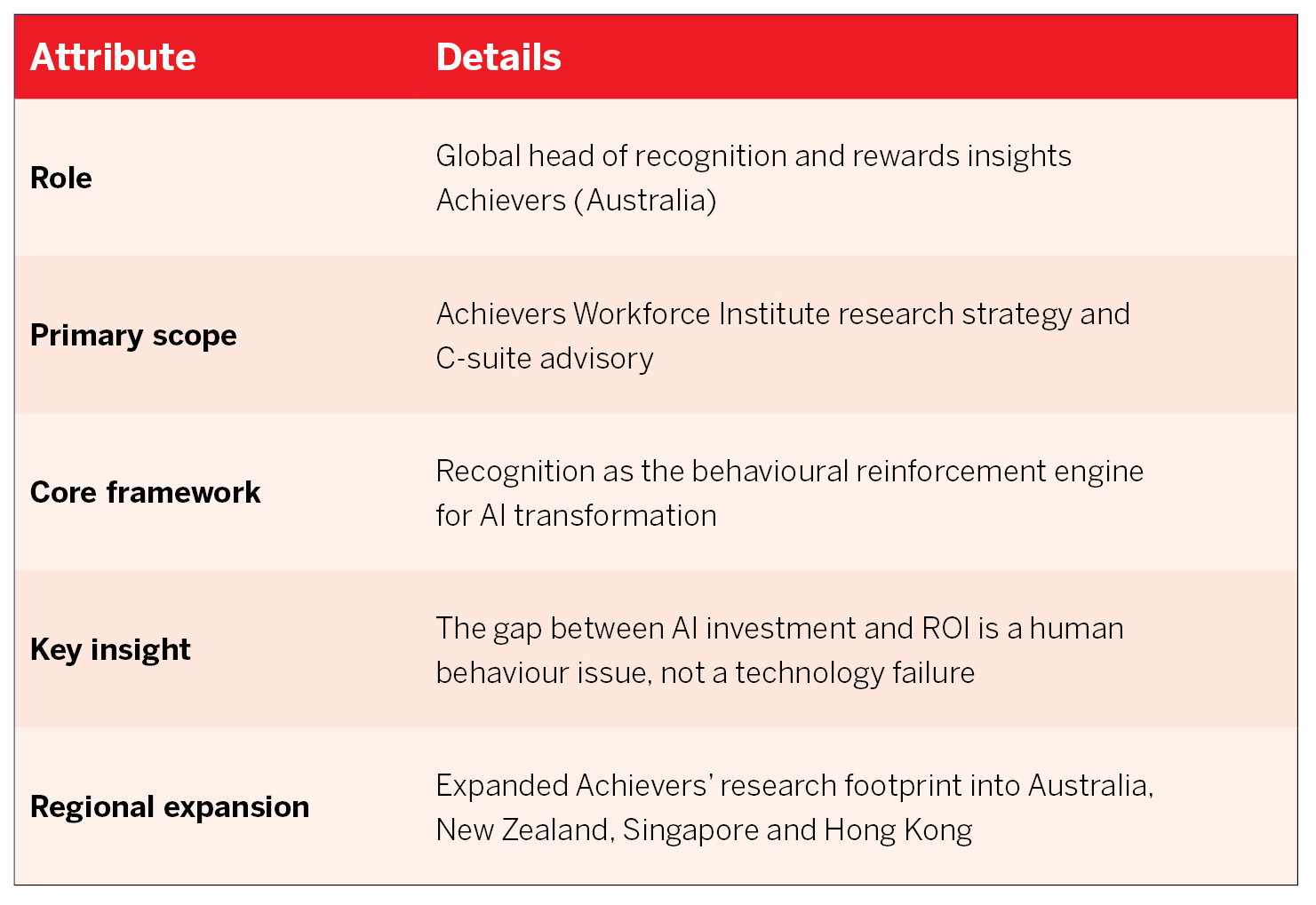
Emma Harvie translates workforce data into actionable strategy for global chief HR officers. Over the past year, Harvie delivered keynotes across Melbourne and Toronto for the 2026 State of Recognition Report, arguing that successful AI adoption depends on human behaviour reinforcement rather than software alone. By framing recognition as a real-time behavioural data source, she helps organisations bridge the disconnect between high AI spend and low ROI.
Key strategic initiatives and impact:
Reframing AI transformation ROI: Harvie highlights the McKinsey research showing that while 92% of companies are increasing AI investment, only 1% achieve clear returns. She demonstrates that behaviours critical for AI adoption – such as experimentation, collaboration and trust – cannot be mandated. They must be continuously recognised and reinforced.
Debunking regional recognition myths: Expanding research across APAC, Harvie identified that 93% of APAC workers report they would put in more effort if recognised. Her regional findings disproved the myth that low recognition delivery in Asia stems from cultural discomfort with praise, revealing that Singapore had the region’s highest appetite for recognition (97%) alongside the lowest delivery rate.
Closing the communication disconnect: Achievers’ data revealed that only 14% of employees feel supported when adapting to new tech and just 10% feel informed when changes impact their job (compared to 18% globally). Harvie positions recognition systems as critical bridges across this change-management gap.
Building global networks via ERGs: As founding leader of the Achievers Women’s Network in Australia, Harvie established cross-regional connectivity across non-overlapping time zones, leveraging employee resource groups (ERGs) to drive lateral global collaboration.

Q: Your keynote argued that recognition, not technology, is the missing piece of AI transformation. What was the moment that crystallised that thesis for you?
A: It was thinking about the question that nobody seemed to have an answer to, which was the gap between AI spend and AI return on investment (ROI). Organisations are investing trillions of dollars and have very little to show for it, and a lot of the explanations were things like the wrong tools or immature data. Some of that is true, but none of it explained the scale of the gap. So, I went looking at it as a behaviour problem, because transformation is actually trying to get people to do things in a different way, and that is a human problem, not a technology one.
Q: You expanded Achievers’ research footprint across Australia, New Zealand, Singapore and Hong Kong this year. What did that regional data reveal that a global, one-size-fits-all view would have missed?
A: We wanted to know, rather than assume, whether cultural difference shows up in recognition behaviour, not necessarily to prove that APAC was different. What we found is that around 93% of employees across APAC say they would put in more effort if they were recognised, similar to the global figure, but only 10% feel informed when change affects their job, against 18% globally. Singapore had the highest appetite for recognition at 97% and the lowest delivery. The usual account is that weaker APAC numbers are cultural, that people are less comfortable with praise, but the research shows people want it. It is how we go about it that needs to change.
Q: As founding leader of the Achievers Women’s Network in Australia, what has surprised you most about the conversations that network has sparked?
A: What surprised me is that bringing the network to Australia was not what gave me the most value. I was reasonably early in my career at Achievers, and it put me in contact with people around the business I would not otherwise come across, which matters in a region with no business hours overlap with the rest of the company. The relationships started with a shared passion for gender equity, but they turned into part of an effective global network. Employee resource groups are usually justified on inclusion grounds, and they should be, but they are also one of the few mechanisms a large company creates for lateral connection across geography and time zones without a business case attached.
Q: What is the one behaviour change you would want every CHRO to walk away with after hearing your research?
A: Before approving the next transformation, really think about what behaviour has to change, and what system you have that lets you see that behaviour happening. Most organisations cannot tell you what is working during the change itself. Engagement surveys happen two to four times a year and are looking backward, often too late to know whether behaviours are taking hold. Recognition data is different. It is behavioural, voluntary, continuous and real time, and a lot of organisations are sitting on it without realising its value. Use it as one of the sources that tells you whether the change is actually taking hold.
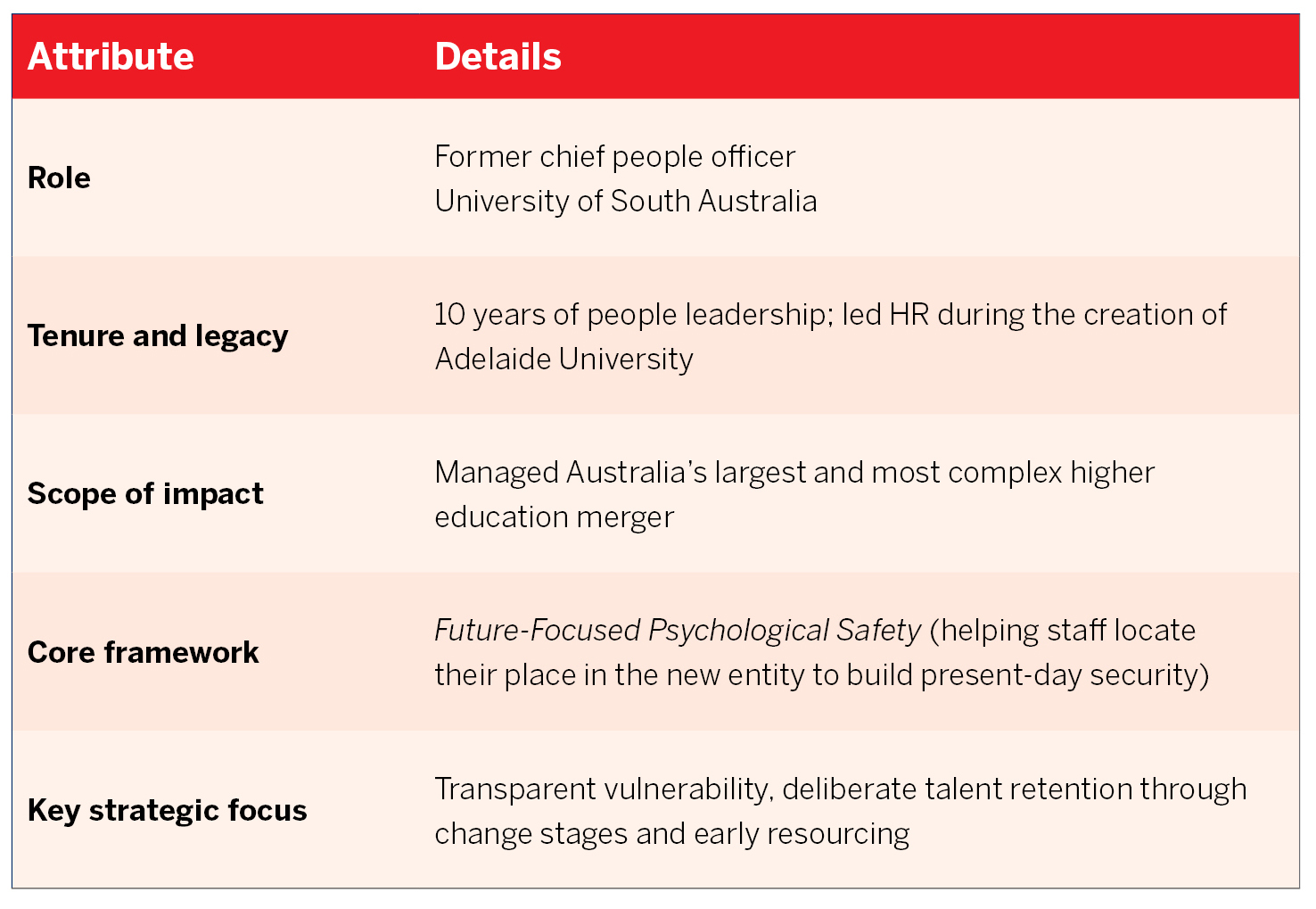
Miranda McDonald led the University of South Australia’s HR function through one of the nation’s most historic transformation projects: merging UniSA and the University of Adelaide to build the new Adelaide University. Operating under a compressed two-and-a-half-year timeline, McDonald guided over 100 HR specialists and thousands of university staff through high-stakes structural decisions, systemic operational changes and deep cultural integration. Her leadership model proves that strategic transformation relies entirely on people-first relational capital, vulnerability and clear communication.
Key strategic initiatives and impact:
Navigating systemic system adoption: When the University of Adelaide’s legacy HR platform was selected for the new institution, McDonald supported her team of more than 100 HR specialists who lost familiarity with daily workflows. She managed the human impact of leaving native procedures behind during peak organisational change.
Building psychological safety via future connection: McDonald established psychological safety by ensuring employees could see themselves and their ideas in the new university’s future. By acknowledging that staff move through change at different speeds, she opened dialogue channels to accommodate both excitement and institutional grief.
Vulnerable and authentic leadership: McDonald prioritised visibility and personal vulnerability, sharing her own professional concerns to give staff permission to voice their uncertainty. This transparent approach built trust during periods of incomplete data and tight deadlines.
Strategic transformation advisory: Based on her tenure leading higher-education transformation, McDonald advises C-suite leaders undertaking major mergers to resource up early, design targeted retention strategies for stage-specific expertise and continuously re-ground teams in the core purpose of the change.

Q: Leading HR through a university merger is a significant undertaking. What was the hardest moment to navigate, and how did you work through it?
A: The hardest moments were when decisions had to be made that we knew large groups of people would not be happy with, but they had to be made. When we decided which HR system the merged university would use, suddenly I had a team of 100 HR specialists who felt they had “lost” so much as they were not native to the systems or new ways of working. It left them feeling very vulnerable and having to trust an as yet unknown leadership structure and at a time when many were unsure what their role in the new people team would be.
Q: How did you go about creating a psychologically safe environment for staff during a period of such major disruption?
A: The first stage of feeling psychologically safe is building a sense of belonging, so first you had to make sure people still felt connected and could see themselves in the change and the way the future was shaping up. If people can’t locate their place in the future, they can’t feel safe in the present. Then it is about recognising that everyone was moving through the transition at a different pace. I deliberately created space for questions, uncertainty and exploration, and made it clear that not having all the answers was normal in a period of transformation.
Recognising people’s strengths and experience and where they could contribute, for me meant opening up multiple channels for dialogue and encouraging different perspectives on the changes to be shared openly.
Finally, I worked to build trust and authenticity by being transparent and vulnerable in my own leadership experience. I shared what the change meant for me personally and professionally, which gave others permission to voice their concerns, challenge assumptions and acknowledge the emotional impact of such a significant shift. That honesty helped people feel safe to engage fully and share their perspective openly, even when the environment was uncertain.
Q: What has this experience taught you about the relationship between strategic delivery and genuine care for people?
A: It’s taught me that people-first thinking isn’t a slogan; it’s the foundation of strategic delivery in organisations. Genuine care for people and relational capital looks different in each different context, but it always requires intention, presence and energy. When you lead with that, people stay engaged, connected and feel better able to navigate change, even through unprecedented complexity. Without a resolute people-first approach, strategy might be well designed, but it never truly lands or delivers the return you expect.
Q: What advice would you give another HR leader about to lead a team through a similarly complex transformation?
A: Resource up early, not just with people, but by preparing yourself and your wider leadership team for the intensity of the work ahead. Invest deeply in relationships with your executive colleagues, because those connections become critical when you’re in the thick of the transformation.
Be deliberate about retention for the expertise you’ll need at each stage of transition. Complex change always brings surprises, and losing key capability at the wrong moment can set you back as you lose valuable corporate knowledge, skills and team cohesion.
In long, difficult transformations, it’s easy for people to lose sight of the purpose, especially when the work is hard and the personal toll is real. Re‑grounding the team in the reason behind the change is what sustains momentum.
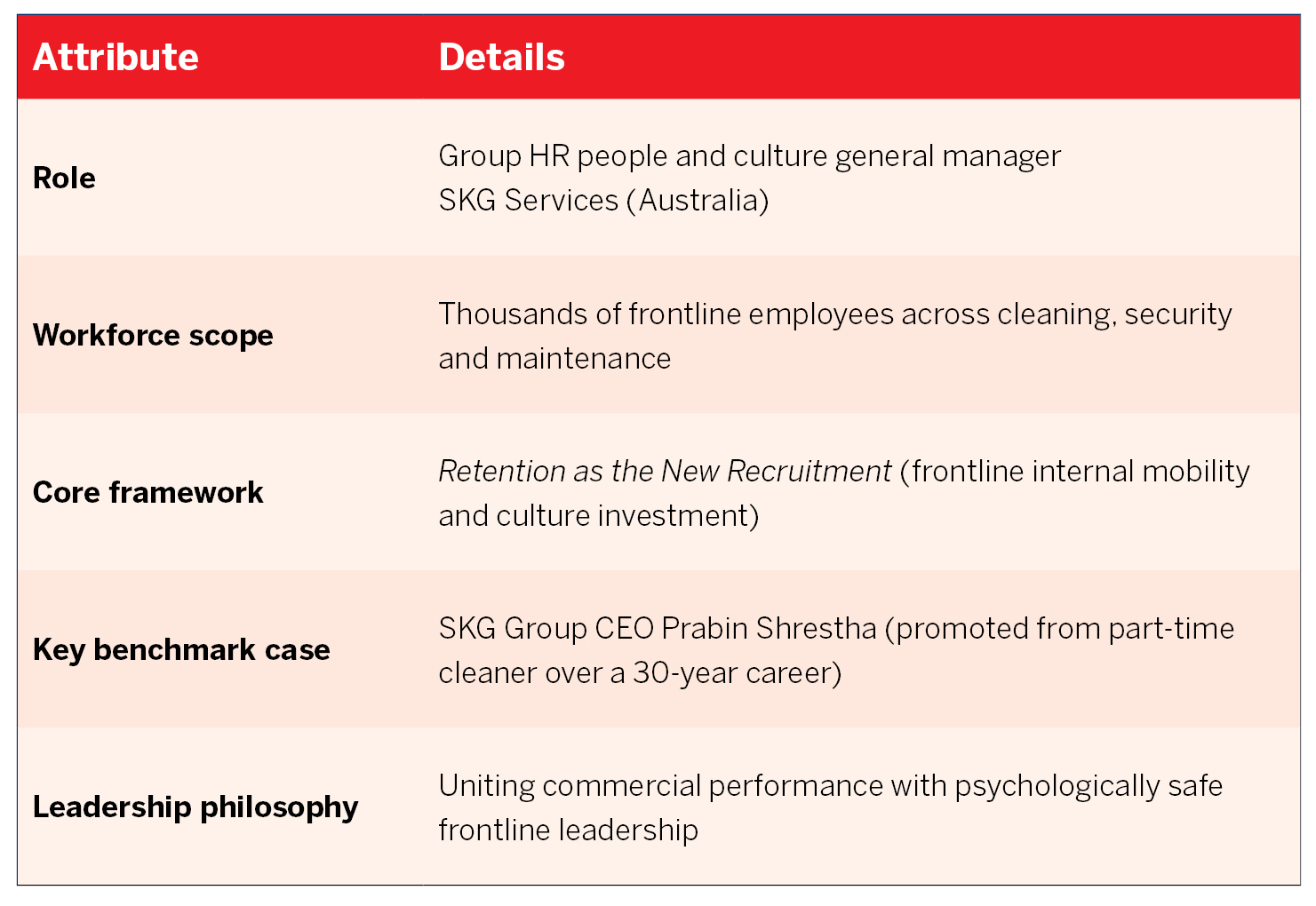
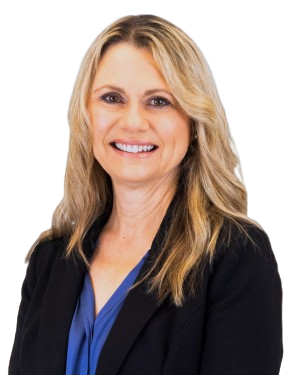
Julie Statevski manages the people strategy for thousands of decentralised frontline workers in Australia’s cleaning, security and facilities maintenance sectors. Over the past year, Statevski has reframed employee retention as a core commercial strategy, demonstrating that investing in internal pathways yields higher returns than continuous recruitment. By pairing structured frontline development with psychologically safe operational management, she connects employee belonging directly to client outcomes.
Key strategic initiatives and impact:
Reframing “retention as the new recruitment”: Statevski addresses the hidden cost of employee turnover by encouraging executives to treat retention as a core business discipline. While traditional recruitment carries a visible budget line item, turnover costs remain hidden until exit. Statevski shifts accountability directly to managers to build an environment where employees can progress.
Operationalising frontline pathways: To demonstrate mobility in a frontline industry, Statevski highlights the 30-year trajectory of SKG Group CEO Prabin Shrestha, who began as a part-time cleaner while studying. SKG structures clear training and supervisory pathways so site workers can systematically advance into management.
Building frontline belonging: Recognising that site-based cleaning and security teams can feel disconnected from head office, Statevski prioritises consistent communication, structured recognition and regular site check-ins to build psychological safety.
Linking psychological safety to business outcomes: Statevski bridges team safety and commercial results, demonstrating that employees who feel safe to raise risks or share process improvements reduce operational hazards and deliver stronger client outcomes.
Q: Your commentary reframed retention as the new recruitment. What response has that idea generated from other leaders in your industry?
A: The response has been overwhelmingly positive. Many leaders are recognising that retaining and developing great people delivers stronger long-term results than constantly replacing talent. One challenge is that recruitment has a visible budget, while the cost of turnover often stays hidden until people leave. The most encouraging shift is seeing leaders take ownership of retention as a core leadership responsibility, not just an HR initiative. When managers focus on creating an environment where people can grow and succeed, people are far more likely to stay.
Q: SKG Services employs thousands of people across cleaning, security and maintenance. What does building genuine career pathways look like in an industry like this?
A: Building genuine career pathways means ensuring every employee can see a future with us, regardless of where they start. Through training, development and internal opportunities, we help people progress from frontline roles into supervision, management and leadership positions. Our group CEO, Prabin Shrestha, is a great example. He joined SKG over 30 years ago as a part-time cleaner while studying and progressed through operational and leadership roles to become group CEO. His journey demonstrates that career growth at SKG is based on opportunity, development and performance. What matters most is making pathways clear and achievable, so people understand the next step, the skills required and how we will support them to get there.
Q: What has been the most effective way you have found to create belonging for frontline employees who might otherwise feel overlooked?
A: Making people feel seen, heard and valued. Consistent communication, meaningful recognition and acting on employee feedback help create a stronger sense of connection and belonging, particularly for employees working on sites. Regular check-ins matter, too.
Q: How do you balance commercial outcomes with the transparent, psychologically safe leadership you advocate for?
A: I believe they go hand in hand. When people feel respected, trusted and safe to speak up, they are more engaged, accountable and willing to contribute ideas that strengthen the way we work. When our people feel confident to raise concerns, share ideas and have open conversations without fear, we create a safer workplace, stronger teams and better outcomes for our people, our clients and the business as a whole.
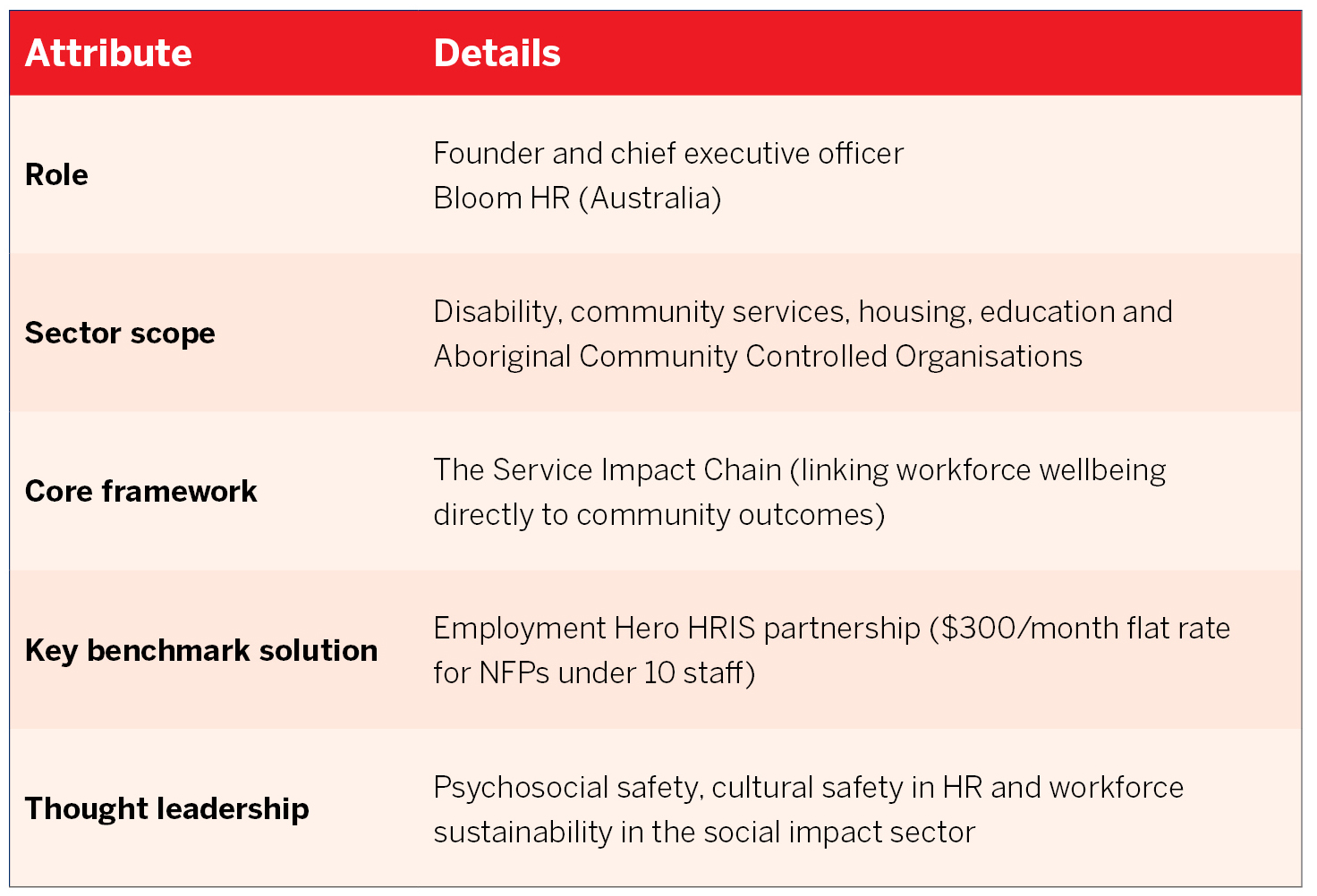
Natalie Carrington founded Bloom HR in 2011 to provide tailored HR infrastructure to purpose-driven and non-profit organisations across Australia. Through her proprietary Service Impact Chain framework, Carrington demonstrates that employee wellbeing, fair remuneration and proper HR foundations directly drive positive social outcomes for participants, housing tenants and local communities. She also actively advocates for funding reform around psychosocial safety obligations and embedding cultural safety across community-sector workplaces.
Key strategic initiatives and impact:
Operationalising the Service Impact Chain: Adapted from the traditional service impact chain, Carrington’s framework shows that when non-profit staff are properly supported, paid fairly and provided clear role design, service quality improves – resulting in better outcomes such as clients securing employment, escaping unsafe relationships or children attending school consistently.
Democratising HR technology for small NFPs: Carrington brokered a milestone partnership with Employment Hero, negotiating a flat-rate HRIS package of $300 per month for non-profits with fewer than 10 employees. By removing standard corporate minimum payment thresholds, small community providers can automate compliance and redirect staff hours towards organisational development.
Embedding culturally safe practices: Working with Aboriginal Community Controlled Organisations and Land Councils, Bloom HR embeds direct Indigenous cultural oversight into project teams (such as onboarding and career pathway design) and ensures staff hold accreditation through Evolve Communities’ Registered Indigenous Ally Program.
Reframing psychosocial safety and addressing funding deficits: Carrington educates sector leaders on psychosocial hazards beyond bullying, highlighting how excessive workloads, poor job design and inadequate leadership support fuel psychological injury claims – the fastest-growing workers’ compensation category. She campaigns to bridge the gap between government compliance demands and rigid funding models that fail to cover retention or safety costs.

Q: Your pay equity work with Aboriginal Community Controlled Organisations and Land Councils sits at a genuinely complex intersection. What does culturally safe HR infrastructure look like in practice?
A: Anything we write or prepare normally has Indigenous cultural oversight built into the project team to make sure the language is clear and inclusive. I am currently working with Burke and Districts Children’s Services designing onboarding, training and career pathways, and an Indigenous person sits on that project team as cultural oversight.
Our staff who work with Indigenous clients are also accredited through the Registered Indigenous Ally Program, run by a company called Evolve Communities, which involves training and ongoing accreditation. That helps ensure everything we do has a cultural safety lens on it.
Q: What led you to broker the Employment Hero partnership, and what difference has it made for smaller community providers?
A: This is something I am most proud of. I am always advocating for our charities and not-for-profits because they often have minimal budgets, and Employment Hero had a minimum monthly payment that made it not worthwhile for smaller organisations to even use the platform.
I advocated for a better price, so organisations with under 10 staff could get the benefit of an HR information system, too, at a flat rate of $300 a month. It automates a lot of what used to be manual compliance work, so we can spend our hours on employee engagement, capacity building and organisational development instead.
One of our philosophies is that if you get the basics right for employees, so they know they are paid correctly and understand their role, they are mentally freed up to focus on the communities they are there to support.
Q: You have spent 15 years building your Service Impact Chain framework. How has your thinking about the link between HR practice and community outcomes evolved?
A: That was really the whole driver behind founding Bloom HR in 2011, and it comes back to our catchphrase: supporting those who support the community. I designed the framework from the old service profit chain and renamed it the Service Impact Chain because we are mainly working with not-for-profits.
If employees are feeling valued, supported and paid fairly, they provide a better service, and that results in better outcomes for a tenant or a participant, whether it is getting back into employment, leaving an unsafe relationship or a child attending school. All of that results in better communities in the end.
Q: As a keynote speaker on psychosocial safety, what is the biggest misconception you encounter about what that term means for organisations in practice?
A: The biggest misconception is that psychosocial safety is linked mainly to bullying and harassment. It is a lot more than that. It is around how work is designed, not just the obvious behaviours.
Psychological injury claims are the fastest-growing area in workers’ compensation at the moment, and a lot of my clients are fully funded by government, whether that is social housing or disability, where the funding covers a basic award wage but not leadership training, better leave policies or the cost of implementing the government’s own strict injury prevention rules. The funding does not match the requirements, and we are always trying to bridge that gap.
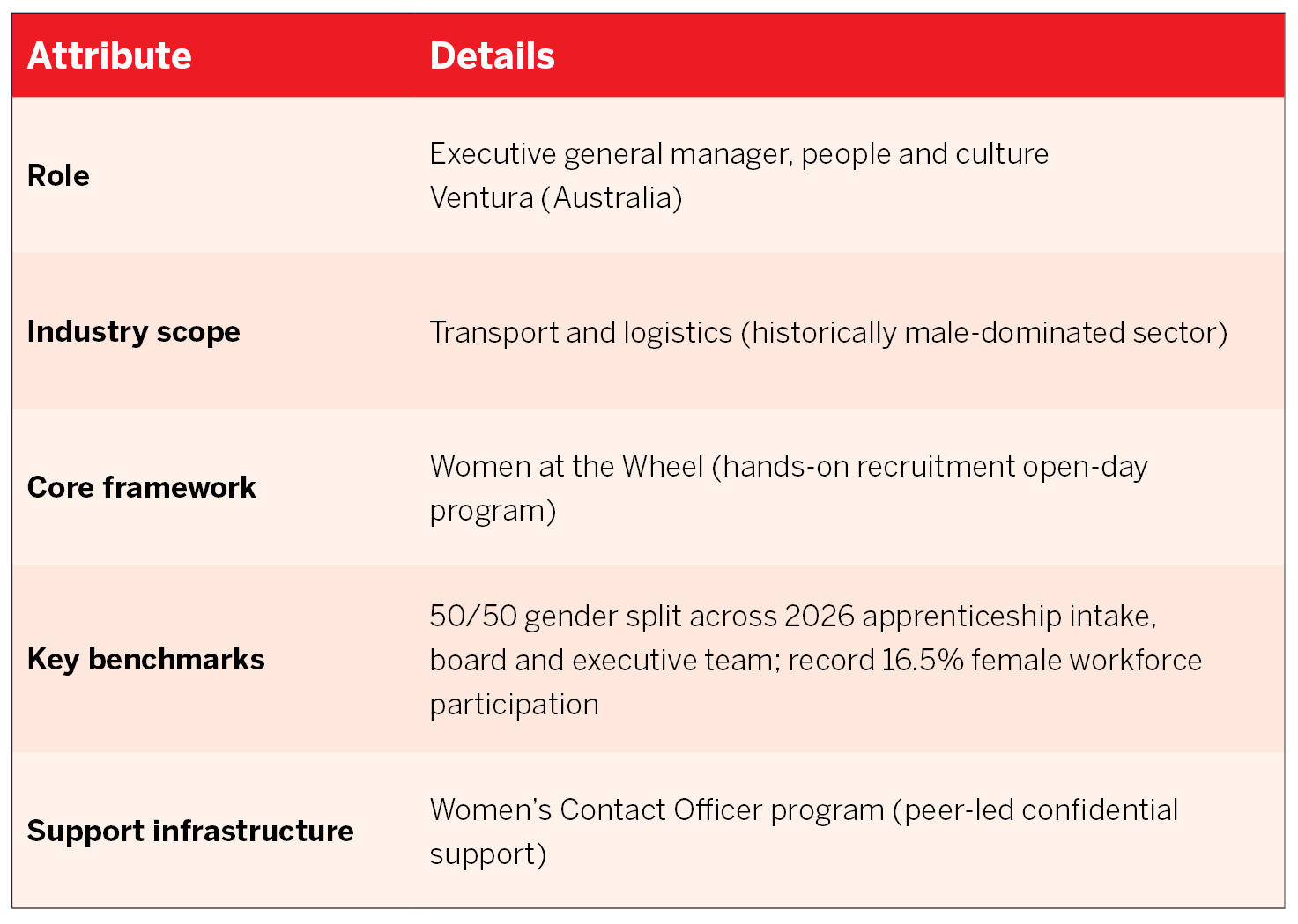
Kim Caldow leads people strategy at Ventura, one of Australia’s largest transport organisations, driving industry-leading gender equity metrics in a traditionally male-dominated industry. Caldow treats inclusion as a practical business discipline rather than a slogan, systematically removing barriers across recruitment and workplace culture. Under her leadership, Ventura achieved equal gender representation at the executive level and across its 2026 apprenticeship intake, alongside record-high employee engagement scores.
Key strategic initiatives and impact:
Achieving 50/50 gender parity: Ventura’s board, executive team and 2026 apprenticeship intake achieved a true 50/50 gender split, contributing to a record 16.5% overall female workforce participation and the hiring of 75 women across operational, trade and corporate roles in 2025 alone.
Systemic recruitment overhaul: Rather than enforcing rigid quotas, Caldow’s team re-engineered every step of the candidate journey – updating job advertisements, imagery, interview structures and workshop culture to eliminate bias and ensure female applicants could see long-term career pathways.
Scaling Women at the Wheel: Launched by Caldow in 2018, this evolving open-day program has guided more than 300 women into transport careers by providing hands-on driving experiences, peer interaction and practical entry points into trade roles.
Peer-led safety and support systems: Caldow established the Women’s Contact Officer program, deploying four trained internal officers to offer confidential advice – creating a trusted avenue for women navigating a historically male-dominated work environment.
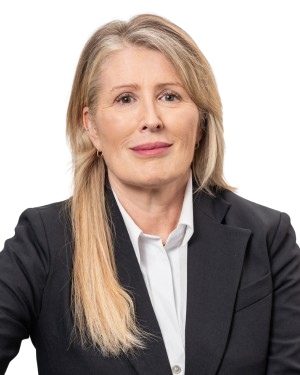
Q: Ventura’s 2026 apprenticeship intake achieved a true 50/50 gender split in a historically male-dominated industry. What changed to make that possible?
A: Achieving a 50/50 gender split in our 2026 apprenticeship intake was a significant milestone because it showed what can happen when inclusion is approached deliberately and practically, treated as a business discipline, not a slogan.
We became much more intentional about how we attract, recruit and support women into roles where they have traditionally been underrepresented, and we looked carefully and challenged each step of the process to make sure capable candidates were not being unintentionally screened out.
That meant reviewing the entire recruitment experience, how we advertise roles, where we find candidates, the language and imagery we use, how interviews are conducted and whether women can genuinely see a future for themselves in our workshops before they even apply.
Importantly, it’s not about filling a quota. It’s about removing unnecessary barriers and making sure talented people have an equal opportunity to build a career with us. Seeing more women entering our workshops is a great outcome, but the real measure of success is whether they feel welcomed, respected, supported and able to stay, develop and progress.
Q: Women at the Wheel has been running since 2018. What has kept the program relevant and effective for nearly a decade?
A: Women at the Wheel has remained successful because it addresses a very real barrier. Many women simply haven’t considered bus driving as a career or had the opportunity to experience it in a supportive environment.
Since 2018, we’ve continued to evolve the program based on what we learn from participants and our workforce. Rather than simply telling women there are opportunities in transport, we give them the chance to experience the role, meet our people, get behind the wheel and see what a career at Ventura could look like.
More than 300 women have participated in the program, and it continues to create genuine employment pathways by helping participants move from curiosity to confidence. Its longevity comes from keeping it practical, listening to feedback and continually improving the experience. For me, that’s an important part of inclusion, not assuming we have the answer, but listening, learning and adapting.
Q: How did you approach building the Women’s Contact Officer program, and what impact has it had on how people feel supported at Ventura?
A: We wanted to create another trusted and approachable avenue for women to seek support, particularly in a workforce and industry that has traditionally been male-dominated.
The Women’s Contact Officer program provides employees with trained people they can speak to confidentially when they need guidance, support or simply someone who will listen. We currently have four Women’s Contact Officers across the business, and they have already provided support on more than 16 occasions, which shows both the need for the program and the trust employees are placing in it.
The numbers are important, but the greater impact is cultural. It sends a clear message that people should feel safe speaking up, that support is available when they need it, and that inclusion is measured by everyday experiences as much as headline initiatives. Building an inclusive workplace isn’t just about who we recruit, it’s about how people are supported once they’re here.
Q: What would you say to another transport or logistics leader who thinks meaningful gender equity change is out of reach in their sector?
A: Look at your recruitment processes, workplace culture, facilities, leadership representation, development opportunities and the everyday experiences of your people. Then listen to the women already in your organisation and be prepared to change the processes, assumptions or behaviours that may unintentionally create barriers.
At Ventura, we now have a 50/50 gender split across our board and executive team, have achieved a 50/50 split in our 2026 apprenticeship intake and continue to grow programs such as Women at the Wheel. There is still more work to do, but those outcomes show that traditionally male-dominated industries can change.
My advice would be to start somewhere, measure what works and keep improving. Gender equity becomes much more achievable when it moves from being an aspiration to becoming part of everyday decisions, how leadership accountability is held, and how people experience the workplace.
EXPERT INSIGHT
Tahnee McWhirter is a partner at HumanX, an outsourced HR consultancy she launched in 2020 alongside Kirbie McWhirter and Hich Nasr. She brings more than 12 years of commercial management experience to her work, advising organisations across Australia on people strategy, workforce transformation and forward-thinking approaches to HR delivery.
Q: What roles do mentorship and sponsorship play in women’s
progression in HR, and where do you see the biggest gaps between the two?
A: Mentorship is valuable, but sponsorship accelerates careers. We have become reasonably good at encouraging women to seek mentors and invest in their development. Where I think we still have work to do is making sure women have senior people actively creating opportunities for them.
Women don’t just need more advice. Sometimes, they need someone with influence to open the door. That means giving them visibility, recommending them for difficult assignments, putting them in front of the board and backing them when they stretch into something they haven’t done before.
Q: What concrete steps should organisations take to build
a stronger pipeline of women into senior HR roles?
A: Start much earlier than succession planning. Give emerging women leaders commercial exposure, not just increasingly complicated HR portfolios. Let them work on restructures, acquisitions, technology implementation, workforce productivity, budgets and business strategy from the ground up. Make board and executive exposure tangible. Look at who gets the stretch assignments and who is repeatedly asked to do the reliable work behind the scenes. Take a harder look at how senior roles are designed.
Most importantly, stop treating the pipeline as a women’s development problem. You can run all the leadership programs you like, but if the organisation keeps sponsoring, promoting and rewarding the same profile of leader, you will keep getting the same answer.
Forget the titles and the cookie-cutter career paths. APAC’s top women in the HR industry on this year’s Elite Women list span tech, academia, consultancies and massive frontline operations. What sets them apart isn't the prestige; it's the permanence.
They don't just clear tasks; they build platforms and pathways that outlive the hype. That’s the difference between doing solid HR and being a legit commercial leader.
The Elite Women of 2026 aren't just managing the workforce; they're steering the enterprise.




Q: What is the HRD Elite Women APAC award?
A: HRD Elite Women APAC is an annual recognition program spotlighting APAC’s top women in the HR industry across Australia, New Zealand and Asia who have demonstrated significant influence in the HR profession over the preceding 12 months, whether through strategic leadership, industry advocacy or measurable impact on their organisation and community.
Q: Which countries and industries are represented in this year’s Elite Women list?
A: The list spans five countries: Australia, New Zealand, Singapore, Hong Kong and Malaysia, with Australia accounting for 61% of winners and New Zealand second at 23%. Just three sectors, HR consulting, manufacturing and technology, account for 51% of the list, with HR consulting the single largest industry represented at 21%.
Q: What barriers do women in HR still face in reaching senior or executive roles?
A: According to Tahnee McWhirter, partner at HumanX, the most persistent barriers have become less visible than in the past, questions of who gets invited into commercial conversations, who is handed a difficult transformation project and who is given exposure to the board, rather than formal exclusion.
Q: How is AI changing the skills women in HR leadership need?
A: HR leaders are increasingly expected to guide AI adoption responsibly rather than simply implement it, weighing ethical questions and the effect of new technology on employee experience alongside efficiency gains. Gartner projects AI will automate or manage roughly half of all HR activities by 2026, shifting the function’s value towards judgement, strategy and change leadership.
Q: What is the difference between mentorship and sponsorship in HR careers?
A: Mentorship provides advice and development, while sponsorship uses a senior person’s influence to actively create opportunities, recommending someone for a stretch assignment or a board presentation rather than simply offering guidance from the sidelines.
For a deeper look at both approaches, see HRD’s guide to mentorship versus sponsorship in HR careers.
Q: Why does the gender pay gap widen at senior HR and executive levels?
A: Research from the Workplace Gender Equality Agency shows the gap increases with seniority, with women chief executives in Australia earning an average of $83,493 less in base salary than male counterparts, a trend attributed partly to differences in how senior leadership behaviours are perceived and rewarded across genders.

HRD invited industry professionals from across Australia, Asia and New Zealand to nominate exceptional female role models for the second annual Elite Women list. Nominees had to be working in a role that related to, interacted with or in some way impacted the industry and should have demonstrated a clear passion for their work.
Nominators were asked to describe the nominee’s standout professional achievements over the past 12 months, initiatives and innovations and contributions to the industry.
After a thorough review of all the nominations, the HRD Australia, Asia and New Zealand team narrowed down the list to the final 70 Elite Women who have made their mark in the industry.