Private employers added 90,000 jobs, Hartford, Connecticut leads in pay inflation

Private employers picked up the pace in September. For the people already working for them, the news wasn't as good.
Companies added 90,000 jobs last month, according to the ADP National Employment Report released Wednesday. Economists had expected about 70,000, and the total was more than double August's gain, which ADP revised down to 36,000. It was the first month since May that hiring sped up.
The pay numbers are useful, especially for anyone setting 2027 budgets. Median base pay for employees who stayed with the same employer rose 3.0% from a year earlier. Inflation ran at 3.4% in the 12 months through August, according to the Bureau of Labor Statistics. People who switched jobs did better, with base pay up 4.8%, a tick above August's 4.7%.
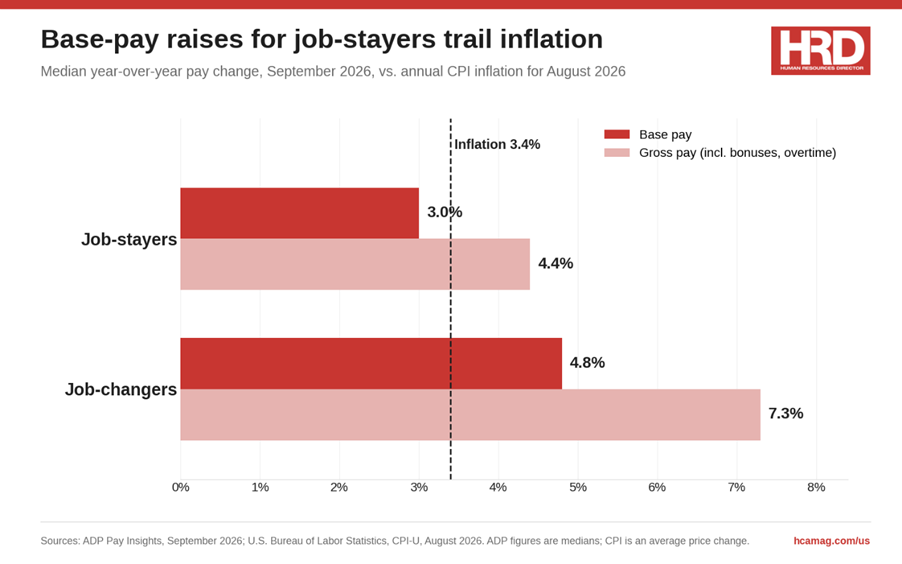
The comparison isn't exact. ADP measures the median pay change for the same workers over 12 months, while the consumer price index tracks average price changes across a basket of goods. But for a typical employee who stays put, a base-pay raise on its own is falling short of inflation.
Gross pay, which adds in overtime, bonuses and commissions, looks better: it rose 4.4% for stayers and 7.3% for job-changers, according to ADP Pay Insights.
"It's a strong report," said Nela Richardson, ADP's chief economist. "After a three-month slowdown, job creation rebounded and pay growth remained solid."
Loyal workers have been losing ground for a while
This isn't a new problem. In a paper published through the National Bureau of Economic Research, Richardson worked with ADP data scientist Liv Wang and University of Chicago Booth School of Business professors Erik Hurst and Christina Patterson. They studied payroll records for 16 million private-sector workers. Of the people who stayed with the same employer from 2021 through 2024, 43% ended up with lower real wages. Even after counting job-changers, 37% were worse off in real terms by the end of 2024.
Part of the reason is that pay practices rarely change. Most employers review pay once a year. When inflation topped 7% in 2022, many kept giving the kind of raises built for low-inflation years, Richardson explained in an ADP Research post.
"Workers care less about the direction of inflation and more about the size of their paychecks," she wrote. "Many still feel like they've fallen behind."
Where the jobs came from
Education and health services led again, adding 55,000 jobs, or about six of every 10 created in September. Leisure and hospitality added 22,000, manufacturing 17,000 and construction 15,000. Financial activities lost 16,000 jobs and professional and business services lost 11,000. Trade, transportation and utilities didn't move.
Most of the growth happened in one region. The Northeast added 56,000 jobs, 47,000 of them in the Mid-Atlantic states. The South Atlantic and East North Central regions each lost 10,000.
Mid-sized employers did the most hiring. Establishments with 250 to 499 employees added 36,000 jobs. Those with 500 or more added 14,000.
The industries hiring the most aren't giving the biggest raises. Education and health services and leisure and hospitality both had median base-pay growth of 3.0%, tied for the lowest of any sector. Construction led at 4.0%, with manufacturing and financial activities at 3.5%.
Local pay isn't much better
ADP recently started publishing pay data for 56 metro areas, and even the strongest markets only just beat inflation. In August, Hartford, Connecticut, had the fastest base-pay growth at 3.6%. Ten other metros, including Seattle, San Jose, Miami, Kansas City and St. Louis, came in at 3.5%. That puts even the top of the list no more than two-tenths of a point ahead of inflation.
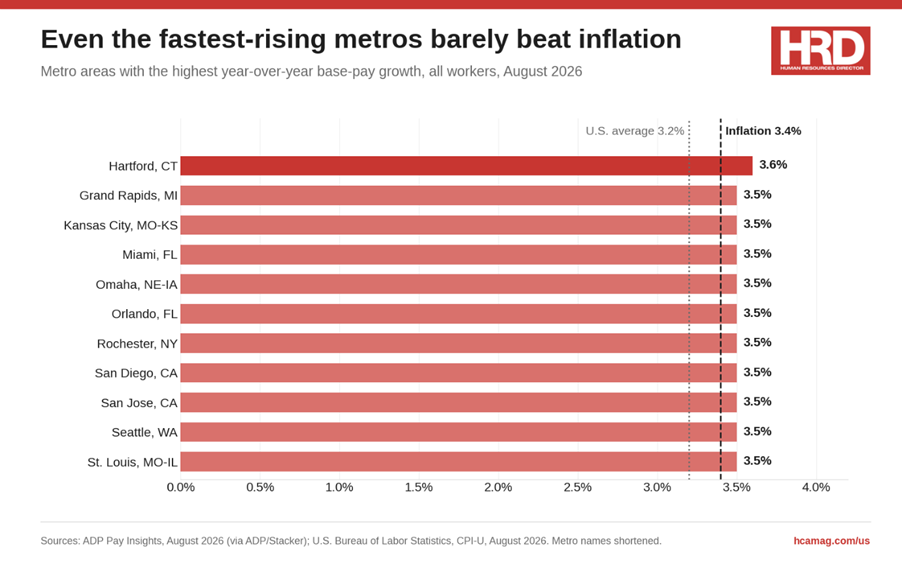
In metros further down the list, base pay is growing more slowly, so the gap between raises and living costs is probably wider.
One good month
A single ADP report doesn't settle much, its numbers often differ from the government's official count, and the BLS releases its September jobs report on Friday. Economists polled by Reuters expect nonfarm payrolls to rise by about 90,000. That would follow August, when employers added 162,000 jobs, well above forecasts.
Other data shows a job market that's steady but not moving much. Job openings dipped to 7.1 million in August, hires held at about 5.2 million, and quits stayed at 3.1 million, according to the BLS Job Openings and Labor Turnover Survey. On Sept. 16, the Federal Reserve raised its benchmark rate by a quarter point to a range of 3.75% to 4%, its first increase since 2023. Higher borrowing costs could make companies more careful about hiring, even as a long-running labor supply squeeze keeps skilled candidates hard to find.
What this means for 2027 raises
Most employers plan to give about what they gave this year. WTW expects average 2027 salary increase budgets of 3.4%, just under the 3.5% employers actually gave in 2026. WorldatWork's survey projects 3.6%.
"Employers will continue to experience salary increases in the 'land of 3%' for the foreseeable future given these dynamics," said Lori Wisper, senior managing director of Work & Rewards at WTW.
With budgets in the mid-3s and inflation at 3.4%, an average raise barely keeps pace with prices. Many employers are also steering more money toward top performers and in-demand skills, so a lot of employees will get less than the average. Meanwhile, people who change jobs are getting base-pay increases nearly two points higher.
Switching doesn't always pay. In a MyPerfectResume poll, 43% of workers said their last job change brought little or even negative financial improvement, a sign that job hopping may not be as lucrative as it once was. But the pay gap in ADP's data has lasted long enough that employees are likely to notice it.
Waiting until someone resigns is an expensive fix. In Robert Half's 2026 Salary Guide, 32% of employers who made counteroffers said the employee left within a year anyway, which raises the question of whether counteroffers still work. Ignoring pay concerns doesn't help either. A survey by Remote found about 56% of professionals would look for another job if they raised a pay issue and weren't happy with the response, which shows how unanswered pay concerns push workers out.
There isn't much extra money to work with. The Conference Board found the median "other" increase budget, which covers promotions, pay equity fixes, market adjustments and retention, is just 0.5% for 2027.
"Employers have to make tougher choices about where limited compensation dollars will have the greatest impact," said Diana Scott, U.S. Human Capital Center leader at The Conference Board.
ADP's October report comes out Nov. 4.