Indeed Hiring Lab scored 386 metros on generative AI exposure, and the results carry workforce planning implications for employers

The city where someone works may help determine how much generative AI (GenAI) reshapes their job. It comes down to what a local economy is built on, whether that’s software and data work or hands-on jobs in manufacturing, healthcare and retail.
That’s according to a new ranking from Indeed Hiring Lab, the economic research arm of job site Indeed, which scored 386 U.S. metro areas by AI exposure. The analysis, published in August, ranked San Jose, Calif., Seattle and Washington, D.C., as the three most exposed. Whether AI changes a worker’s job, analysts An Nguyen and Laura Ullrich said in the analysis, “depends on what you do and, perhaps surprisingly, where you do it.”
Which metros rank highest for AI exposure
San Jose scored 59, making it the most exposed metro in the country. Seattle followed at 57, then Washington, D.C., at 54, San Francisco at 53 and Austin, Texas, at 52. Lexington Park, Md., and Los Angeles each scored about 50, while New York City, San Diego and Huntsville, Ala., each landed near 49.
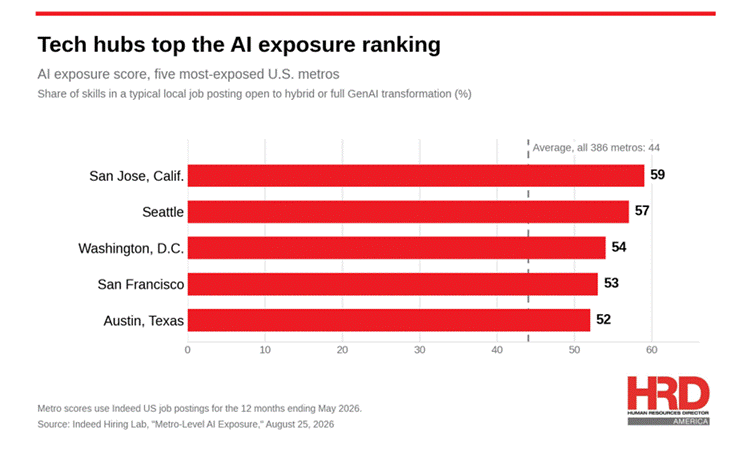
Software and data work drives the top five, Indeed said. Software development is among the occupations most exposed to GenAI, so metros where those jobs dominate postings score highest. The result is a ranking that mirrors the map of the country’s tech and knowledge hubs.
Two entries stand out. Lexington Park is home to Patuxent River Naval Air Station, and Huntsville is known as Rocket City for its aerospace research. Hiring Lab said advertised jobs in both areas skew heavily toward technical and scientific roles that GenAI is best positioned to transform.
Hands-on metros sit at the bottom
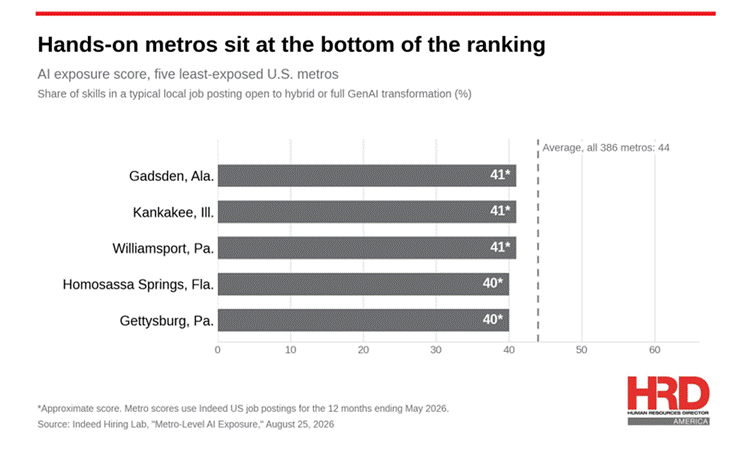
Homosassa Springs, Fla., and Gettysburg, Pa., each scored about 40. Gadsden, Ala., Kankakee, Ill., and Williamsport, Pa., each scored about 41. Hiring Lab said a sizable share of postings in these metros are in manufacturing, healthcare and retail, the work it described as furthest from GenAI transformation.
How Indeed measures AI exposure by metro
Scores run from about 40 to 60 across the metros, with an average near 44, according to Indeed Hiring Lab’s metro-level analysis of generative AI exposure. A higher score means more of the skills in a typical local job posting are ones GenAI could largely handle, with people checking its work, or do on its own.
Indeed built the scores from its September 2025 AI at Work Report on how GenAI is changing jobs, which rated almost 2,900 workplace skills, then looked at the mix of jobs each metro advertises. A metro heavy on software work scores high, while one built on caregiving and logistics scores low.
What exposure means for employers in top-ranked metros
The authors said it’s unclear whether exposure will prove a net positive or negative for communities. Job postings are somewhat lower overall in highly exposed metros for now, they said, though that could change depending on whether AI ends up replacing or augmenting labor. They said high-exposure metros will likely see the biggest adjustments as GenAI spreads through their dominant industries, while low-exposure metros may be more insulated in the near term but could miss longer-term productivity gains.
The analysis doesn’t prescribe steps for employers, so the practical questions fall to local HR teams. Hiring Lab said exposure becomes real change only as quickly as employers adopt the technology, which puts adoption timelines and workforce planning at the center of the decision, as HRD America has covered in its look at AI tools creating workforce imbalance risk for employers.
Early-career hiring is one pressure point. Updated Stanford Digital Economy Lab research, using payroll data through June 2026, found employment among workers ages 22 to 25 in highly AI-exposed occupations stood 19% below where it would have been had it kept pace with less-exposed occupations, as HRD America reported in August 2026 on employers weighing which AI capabilities to hire or develop internally. The authors stressed their findings are descriptive and don’t establish that AI caused the gap.
PwC’s 2026 AI Jobs Barometer, published June 15, 2026, also found the most AI-exposed junior roles are seven times more likely than the least-exposed ones to demand senior skills such as leadership, according to HRD America’s coverage of how AI is squeezing entry-level jobs and future leaders.
In metros where software and data work dominate postings, employers may feel those pressures first, though Hiring Lab stressed the scores measure potential and don’t capture realized change.