‘Teaching employees how to work alongside AI tools simply isn't enough’

Most senior human resources (HR) leaders now believe artificial intelligence (AI) is putting the next generation of executives at risk, according to new research from talent management firm Talogy.
Now, 78% are concerned about the long-term loss of critical leadership skills as AI takes over tasks once used to train junior staff, according to the company’s survey of 207 senior HR leaders, talent acquisition managers and learning and development specialists.
Entry-level jobs have traditionally doubled as training grounds, giving junior employees low-stakes tasks that build judgment over time. As AI absorbs more of that work, Talogy warns those learning opportunities may not develop the way they once did.
The shift is measurable elsewhere. PwC's 2026 AI Jobs Barometer, published June 15, 2026, found the most AI-exposed junior roles are seven times more likely than the least-exposed ones to demand senior skills such as leadership.
Entry-level postings have flatlined in AI-exposed sectors even as "seniorised" junior roles have grown 35% since 2019, echoing earlier findings on Gen Z workers losing entry-level roles to AI.
"As organizations rethink employee development, teaching employees how to work alongside AI tools simply isn't enough," said Ali Shalfrooshan, Talogy's Pittsburgh-based director of science strategy.
"We must be far more intentional about cultivating core human capabilities, such as critical thinking, adaptability and collaboration if we are to enable people to take on complex responsibilities over time. Leadership development needs to begin at the early career stage and evolve dynamically throughout the entire career journey."
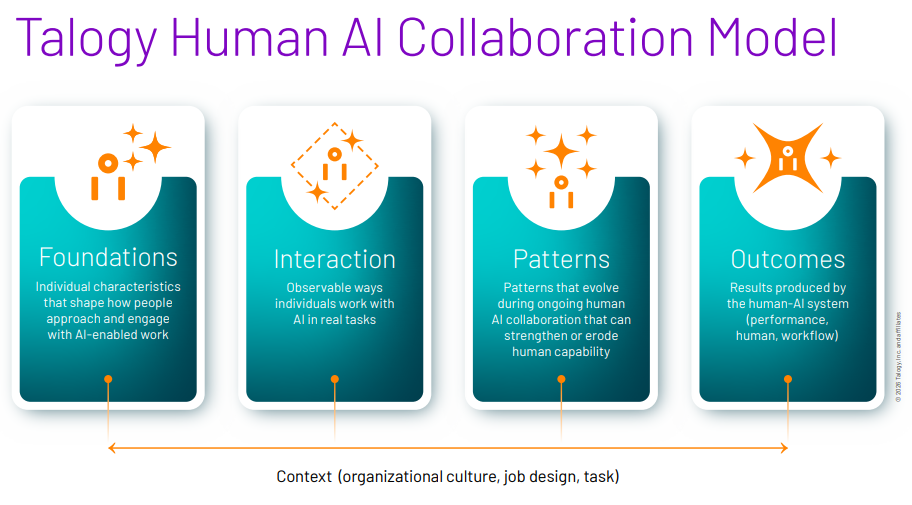
Drawing on research involving more than 6,000 employees, managers and talent professionals worldwide, Talogy groups the skills organizations need to protect into four categories, called RISE:
-
responsiveness — the openness to adapt
-
insight — the ability to think critically
-
sustainability — the capacity to stay resilient through change
-
effectiveness — the ability to turn ideas into results through collaboration.
The pattern shows up in broader research, too
Gartner's Global Labor Market Survey, run by the Stamford, Connecticut-based research firm, polled 12,004 employees and managers across 40 countries in early 2026 and found many organizations are confusing basic AI access with real transformation. A companion December 2025 Gartner survey of 197 executives found only 27% have a comprehensive AI strategy, and just 20% believe their workforce is genuinely AI-ready.
"Most leaders are mistaking basic access or adoption metrics for transformation," said Swagatam Basu, senior director analyst at Gartner's HR practice. "This 'enablement illusion' is hiding risks and draining ROI [return on investment]."
Gartner also found 73% of the employees using AI most productively are managers or executives, leaving individual contributors, who handle most automatable tasks, underserved by training.
Deloitte, cited by Talogy in its own materials on human-AI collaboration, found organizations taking a purely tech-focused approach to AI are 1.6 times more likely to fall short of expected returns than those taking a human-centric approach, a point echoed in recent reporting on salary premiums paid to AI-skilled staff.
For HR leaders managing a tight skilled-labour market, the takeaway is less about slowing AI adoption than about deliberate development, and closing the gap Gartner identifies between managers and individual contributors.
The warning lands alongside other pressures employers are managing this year, from the operational strain created by an unrelenting cycle of software patching to recent findings on systemic workplace reporting failures.