Only 57,000 jobs added, and a labor supply problem that goes well beyond one soft month

The June jobs report landed with a thud on Thursday. Just 57,000 jobs were added, well below expectations, and the labor force participation rate dropped to 61.5%, its lowest point since March 2021. But for labor economists watching the longer arc, the monthly numbers tell only part of the story. The deeper issue isn't how many jobs were added in June. It's who's available to fill them, and that pool has been shrinking for years.
Three forces driving the decline
Three structural forces are reshaping the U.S. labor supply, and employers are only beginning to feel their effects. An aging population, reduced immigration, and decades of low birth rates have been building pressure on the workforce for years. Thursday's report is the latest data point in a much longer trend.
Net immigration tells part of the story. According to a Federal Reserve Bank of Kansas City analysis published in February 2026, net immigration is projected to fall to 574,000 in 2026, down from a peak of more than 3.5 million in 2023. For years, immigration flows helped offset the effects of an aging domestic workforce. With that buffer shrinking, the strain on the labor pool is becoming harder to absorb.
The same analysis found that when the first baby boomers reached age 65 in 2011, just 13% of the U.S. population was 65 or older. By 2025, that share had risen to 19% and is expected to keep climbing.
Indeed Hiring Lab's April 2026 analysis of Bureau of Labor Statistics (BLS) labor force projections puts a number on what that means: the overall labor force participation rate is expected to decline from 62.6% in 2024 to 61.1% by 2034, representing roughly 4.3 million fewer people either working or actively seeking work.
U.S. labor force participation rate, January 2020–June 2026
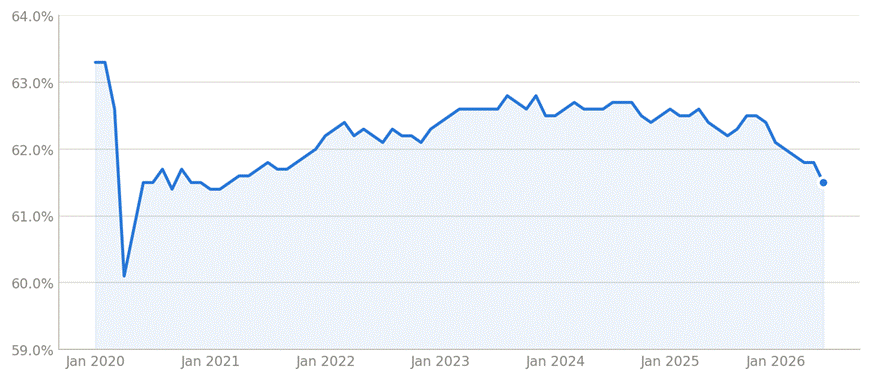
Source: U.S. Bureau of Labor Statistics, Current Population Survey. Seasonally adjusted. June 2026 from BLS Employment Situation Summary, July 3, 2026. November 2025 data unavailable due to lapse in appropriations.
The monthly breakeven rate (the number of jobs needed each month just to keep unemployment stable) has also fallen sharply as a result. The Kansas City Fed analysis found it dropped from 150,000 in early projections to significantly lower figures as immigration and birth rate assumptions were revised down. That's why an economy adding just 57,000 jobs in June can still see the unemployment rate tick down.
"For the last several decades, we've had pretty low birth rates in the U.S., so the replacement ratio has not been where it needs to be," said Nicole Bachaud, a labor economist at ZipRecruiter in Seattle, Washington. "We were really relying on immigration to come in and produce a lot of workers to keep things moving along. Now that we're losing out on that segment as well, that's really changing who is available to work."
What it means for talent acquisition
Even in a soft jobs market, finding the right candidate for a specialized role is going to get harder, not easier, as the pool of available workers continues to thin. The headline unemployment rate doesn't capture this. It measures who's looking for work, not the underlying erosion of how many people are in the labor market at all.
HRD America has reported on the widening disconnect between job openings and actual hires, a structural mismatch that demographic pressures are set to deepen. When there are simply fewer people of working age in the economy, matching the right candidate to the right role takes longer, even when demand is soft.
Additionally, healthcare demand rises as the population ages, which explains why that sector has remained one of the few consistent sources of job growth even in weak months like June. The pressure runs in both directions, with fewer workers available to fill roles and greater demand for the services an aging population needs.
"Even in a market where there's low job growth, there are few people who are working and who are available to work," Bachaud said. "So matching between what an employer is looking for and what a job seeker has to offer could take longer and be more difficult to find."
Staying ready in a slow market
Many employers' instinct in a soft hiring environment is to scale back talent acquisition activity. Bachaud says that may be the wrong instinct.
HRD America has previously reported on why workforce planning can't wait for the market to recover, as the demographic wave is moving toward employers whether they're ready or not. Approximately 14% of the U.S. workforce is currently over the age of 60, and the retirement wave that economists have been anticipating for years has yet to fully crest.
Cory Stahle, senior economist at the Indeed Hiring Lab in Salt Lake City, Utah, noted that in a market where most employers are pulling back, those willing to hire strategically now will find less competition for available talent.
"Right now, if you're a business looking to hire, you're going to have a very different pick of candidates than you'll have when hiring starts to really heat back up," he said. "If it makes sense for your business to invest in hiring even amid uncertainty, right now could be a really good time."
The monthly numbers will swing again. But the forces reshaping the U.S. labor supply are not going anywhere.