The U.S. economy added 115,000 jobs in April, but economists warn of a shrinking labor pool and looming retirement cliff.

America's employers added a stronger-than-expected 115,000 jobs in April, beating forecasts by nearly double, but economists say the real workforce reckoning is still to come. Beneath the steady 4.3 percent unemployment rate, a shrinking labor pool and an approaching retirement wave are quietly setting the stage for a far more difficult hiring environment ahead.
The result follows a revised 185,000 jobs in March, though that figure was boosted by the resolution of large labor strikes and favorable weather. Smoothing out that volatility, the three-month average sits at roughly 48,000 jobs per month, a more honest reflection of where the momentum actually stands. The war in Iran and persistently high gas prices had raised fears of a sharper pullback; for now, those fears have not materialized.
Read more: Research finds AI-triggered layoffs not translating to ROI
But two leading labor economists say the headline optimism only tells part of the story. A set of structural forces are quietly tightening the labor market in ways that will demand employers' attention long after this month's numbers are forgotten.
"The ongoing surprise is how resilient the U.S. labor market continues to be in the face of numerous obstacles," said Mitchell Barnes, Economist for the Labor Markets Institute within the Economy, Strategy, and Finance Center of The Conference Board. "Unfortunately, there are more mixed signals kind of within this report than I think the headline might show."
Nicole Bachaud, Labor Economist at ZipRecruiter, echoed that measured tone.
“This jobs report shows that the labor market is kind of rebalancing and figuring out what a new level of normal is going to look like,” she said. “And this really helps to solidify what direction that’s going in.”
That direction points toward tighter labor supply, more competition for talent, and a structural workforce challenge that is already unfolding, even if it has not yet fully shown up in the numbers.
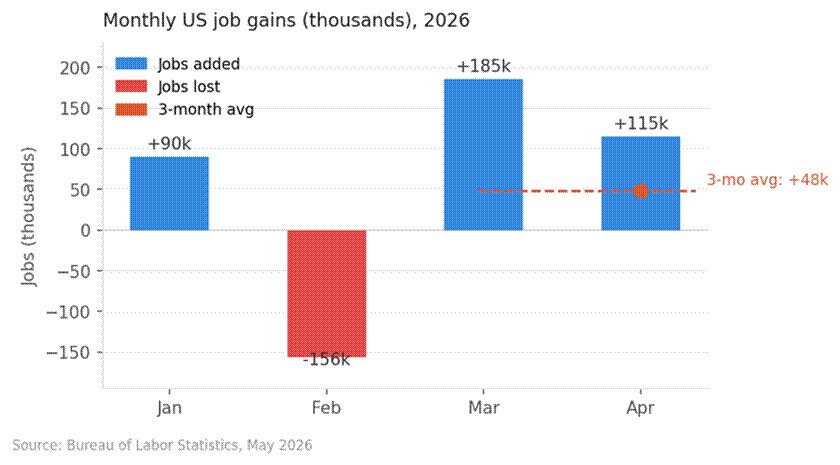
Monthly US job gains (thousands), Jan–Apr 2026. Source: Bureau of Labor Statistics.
The shrinking labor pool
One of the most striking insights from both economists is that the labor force itself is getting smaller, and not for reasons that will easily reverse. Bachaud pointed to a convergence of long-term structural forces: an aging population, reduced immigration, low birth rates, and a growing share of discouraged workers who have simply stopped looking for jobs altogether.
“We’re seeing the labor pool shrinking, and with that, we need fewer jobs to maintain a stable level of unemployment,” she said. “And so we’re getting into trying to figure out, now, what do those numbers look like? And is a 4.3% or a stable level of unemployment... is that measure enough to signal that we’re in a healthy place now?”
Barnes raised a related concern around data accuracy, noting that the Bureau of Labour Statistics' methodology for capturing net employment from new businesses, particularly those born out of AI-driven sectors, has introduced volatility into the monthly figures. “I would hate for us to be kind of breezing over sort of some fragility that might still be there,” he said.
Beneath the steady headline unemployment rate of 4.3%, Bachaud flagged several warning signs. Unemployment among teenagers and Black workers has begun to tick upward; both are historically reliable leading indicators of broader labor market direction, she explained. The share of workers employed part-time for economic reasons, meaning they cannot find full-time work, is also rising.
“All of these measures show that while headline unemployment is stable, there are a lot of difficulties and challenges for people who find themselves unemployed,” she said.
The retirement cliff most employers aren’t talking about
Perhaps the most urgent message from Bachaud was about a demographic wave that is moving toward employers whether they are prepared for it or not. Approximately 14% of the U.S. workforce is currently over the age of 60, and a large-scale wave of retirements has yet to materialize. When it does, the impact on organizations could be significant.
“As they see older workers begin to exit the market, there will be a big gap in employment where employers are going to be looking to fill those oftentimes senior-level roles that somebody has filled for many, many years and has all this institutional knowledge,” Bachaud said. “That gap could be pretty wide and difficult to fill.”
Her advice to employers is simple: don’t wait.
“Getting ahead of the pack and looking to increase hiring now can definitely put employers in a better position, instead of scrambling when all of a sudden there’s this massive gap in available workers, and employers are all trying to navigate that at the same time,” she said.
Phased retirements, mentoring programs, and proactive succession pipelines were among the strategies she pointed to as ways organizations can begin managing the risk of an aging workforce now, rather than in a crisis.
AI is reshaping jobs, not just eliminating them
Both economists addressed artificial intelligence, though neither framed it as a simple story of job destruction. Barnes noted that demand for AI-related skills, particularly in agentic processes and orchestration, is rising sharply across finance, legal, and STEM fields. But he also acknowledged that the technology is giving many businesses reason to pause on broader hiring decisions as they recalibrate their workforce strategies. His counsel to companies in that position is to use the pause productively.
“I think it is a good time to focus internally,” he said. “Unless your data processes, your workforce plan, and all of these things are really tied up, then you are not going to be ready to jump in and kind of hit that acceleration button when the time comes.”
Read more: The workforce solution employers keep overlooking
Bachaud added that AI is also affecting how job descriptions are framed.
“Over the last three years, we’ve seen these quote-unquote AI jobs shifting from being really tech-focused, looking at doing programming and network architecture and software engineering and really technical skills to where now the other top skills that we’re seeing are things like communication and collaboration and documentation,” she said.
Looking ahead to the second half of 2026, Bachaud anticipates a gradual warming of the market, more turnover as workers grow more willing to switch jobs, and a widening gap between wage growth for job switchers versus those who stay put; a signal she read as cautiously optimistic. Barnes described the outlook as “very much a mixed bag,” though he acknowledged that demand for specialized technical talent continues to build even as the broader picture remains uncertain.
The April jobs report, in other words, is not quite the clean signal it might appear to be at first glance. For employers, the real question is not whether the labor market is healthy today; it is whether they will be ready for what comes next.