The headline number grabbed the attention, but 4.9 million underemployed Americans represent an opportunity most employers are missing.

When the Bureau of Labor Statistics released April’s jobs report on Friday, most attention landed on the 115,000 new positions added and an unemployment rate holding steady at 4.3 percent. Fewer people noticed the figure buried deeper in the data: the number of Americans employed part-time for economic reasons jumped by 445,000 to 4.9 million in April, people who would have preferred full-time work but whose hours had been cut or who simply could not find full-time jobs.
Read more: Strong April jobs report masks a looming workforce crisis
It is a number that deserves far more attention than it gets. And for employers navigating a tightening labor pool, it represents something specific: a large, motivated, and immediately available pool of talent that most hiring strategies are not designed to reach.
The numbers beneath the numbers
The headline unemployment rate of 4.3 percent, known as U-3, tells one story. The broader measure, known as U-6, tells another. Unlike the official U-3 rate, which only counts people actively looking for work, U-6 casts a wider net; it includes discouraged workers who have given up searching, and those stuck in part-time roles who want full-time work but can’t find it. That broader rate rose to 8.2 percent in April, up 0.2 percentage points, nearly double what the headline figure suggests.
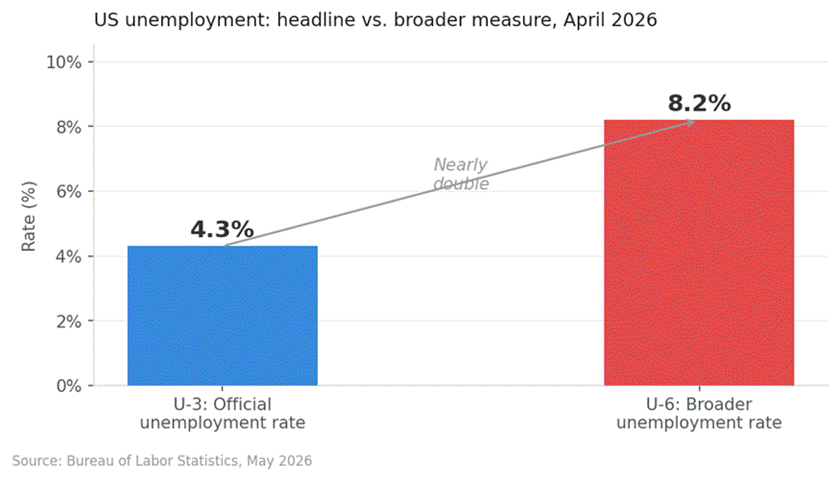
US unemployment: official U-3 rate vs. broader U-6 measure, April 2026. Source: Bureau of Labor Statistics.
Nicole Bachaud, Labor Economist at ZipRecruiter, put it plainly.
“All of these measures show that while headline unemployment is stable, there are a lot of difficulties and challenges for people who find themselves unemployed,” she said.
The April spike in part-time-for-economic-reasons workers was, she noted, one of several indicators pointing to stress beneath the surface of an otherwise steady report.
Five million workers hiding in plain sight
The practical implication for employers is significant. Nearly five million people are currently working fewer hours than they want, in roles that may be below their skill level, simply because full-time opportunities have not materialized. Many will have strong track records, transferable skills, and a compelling reason to commit fully to the right opportunity.
Underemployment, such as being stuck in multiple part-time jobs or stepping out of the labor force after encountering repeated barriers, can have serious negative economic effects on workers and families. That frustration, however, also translates into motivation; underemployed workers are often among the most engaged new hires precisely because a full-time role represents a genuine step forward.
Read more: The workforce solution employers keep overlooking
Mitchell Barnes, Economist for the Labor Markets Institute at The Conference Board, pointed to an emerging shift in how businesses are approaching talent acquisition. Rather than committing to full-time headcount, some employers are already reaching beyond traditional hiring channels.
"I think one way this actually might play out is that they are going to go reach for some of that talent from contractor pools, from outsourced pools and other," he said.
For the nearly five million Americans stuck in involuntary part-time work, that shift in employer behaviour could represent a genuine opening.
What employers should do differently
Tapping into the underemployed talent pool requires some deliberate adjustments to standard recruitment practice. Most job postings are written for candidates who are actively unemployed or looking to switch from a comparable full-time role; they rarely speak directly to someone who is currently working part-time and looking for more.
Organizations with flexible work arrangements report less trouble recruiting than those without, according to SHRM’s 2025 Talent Trends report, which found that nearly 70% of organizations still face challenges recruiting full-time positions. That finding suggests that the way a role is structured and communicated matters as much as the role itself.
A few practical shifts can make a real difference. Advertising roles with clear pathways to full-time status, rather than treating part-time as a permanent category, signals to underemployed candidates that the organization is a genuine opportunity rather than a lateral move. Screening processes that prioritize demonstrated skills over continuous employment history will also broaden the candidate pool, particularly as skills-based hiring gains momentum, with 55% of employers already moving to a skills-based model and another 23% planning to do so within the next year, according to a Workday Global Study.
The April jobs report, read carefully, is not just a story about how many jobs were added. It's also a story about how many people are working below their potential, waiting for an employer to notice. In a labor market where the supply of available workers is gradually shrinking, that is an opportunity worth taking seriously.