Britain's prime minister is resigning. A leadership expert says the forces behind his downfall are surprisingly familiar inside organizations
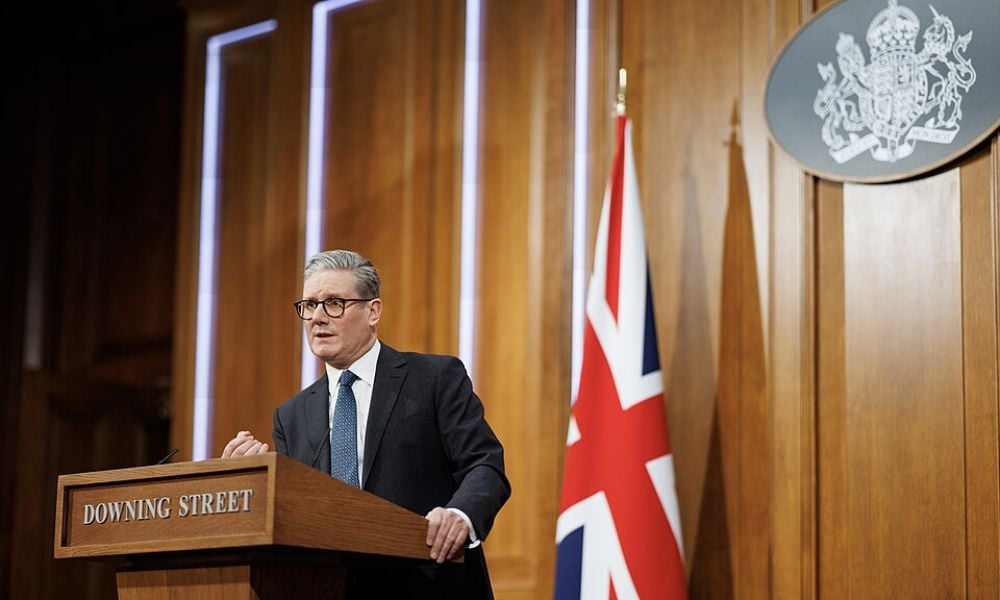
British Prime Minister Keir Starmer gives a statement to the press in London on Jan. 21, 2025. (Simon Dawson / No 10 Downing Street, OGL 3 http://www.nationalarchives.gov.uk/doc/open-government-licence/version/3, via Wikimedia Commons)
When Keir Starmer announced Monday that he would resign as U.K. prime minister, forced out by his own party after missteps and broken promises soured voters who had handed Labour a landslide victory just two years earlier, the immediate conversation turned to his successor.
Starmer will remain caretaker prime minister while Labour chooses a new leader, with expectations growing that it will be former Greater Manchester Mayor Andy Burnham. But for anyone leading an organization through a trust crisis, the more pressing question isn’t who comes next. It’s what that new leader actually has to do.
Robert Hurley, a professor of management at Fordham University’s Gabelli School of Business in New York and one of the world’s leading researchers on organizational trust, said Starmer’s downfall followed a pattern he’s seen play out in corporations, banks, and institutions around the world.
Polling by Ipsos in May 2026 found that 66% of Britons thought he should not lead Labour into the next general election, and that 74% believed it was unlikely he would win one. A separate Ipsos survey from February 2026 found that 53% of Britons believed Starmer told the truth “not very often or never.” Hurley said the honesty figures were telling.
“When people make a decision to trust, they have to try and predict what you’re going to do in situations where there’s ambiguity,” Hurley said. “When people say A and do B, they lose the ability to predict. And that erodes trust.”
For Starmer, Hurley said, the honesty problem was only part of the story.
Why leadership trust fails on multiple fronts
Hurley’s research identifies three pillars of trustworthiness: integrity, ability, and benevolence. In Starmer’s case, he said, all three were damaged.
On integrity, the honesty figures cited earlier pointed to a leader many voters had simply stopped believing.
Ability is competence, the sense that a leader can deliver on what they promise. Polling from Ipsos in April 2026 found that 66% of Britons lacked confidence that the government was running the country with integrity or competency. Benevolence, Hurley explained, is whether a leader genuinely cares enough about the people they serve to act in their interests even at personal cost. On that measure, Ipsos polling from the May 2026 local elections found that more than six in ten voters said the cost of living was the single biggest issue shaping their vote, a pressure many felt the government had failed to address.
“You get it in both ways,” Hurley said. “You get low scores on integrity and low scores on benevolence. And both of those two things are critical to trustworthiness.”
He was careful not to declare the situation irreversible, however. Bill Clinton repaired trust after the Monica Lewinsky scandal, he noted. But there’s a variable that political environments make especially brutal.
“Sometimes what happens is the clock runs out,” Hurley said. “And that’s particularly true in politics because it’s very hard to control the narrative.”
Trust violations that go unacknowledged accumulate, and eventually the debt comes due. The question then becomes what happens next.
What a new leader actually has to do
Attention now shifts to Andy Burnham, the Manchester mayor widely expected to succeed Starmer, who has been described in media coverage as charismatic, optimistic, and popular. On the charisma front, Hurley offered a word of caution.
“Beware of charisma,” he said. “Do you need somebody to come in and give a good narrative? Yes. But if that’s the only thing they’re good at, it’s not going to work. It’s going to sound great, people are going to buy it, and then they’re going to be betrayed again.”
That warning translates directly to the corporate world, where incoming leaders often face pressure to signal change through tone, communication style, and culture language before anything structural has shifted. Hurley’s research, first published in the Harvard Business Review in September 2006, suggests that sequence matters more than most leaders acknowledge.
The first step, he said, is diagnosis. A new leader coming into a low-trust organization must understand precisely why trust was lost before attempting to repair it.
“You have to be brutally clear about what went wrong,” he said. “What caused this organization to cross a line where the violations of expectations that stakeholders had were so severe that they decided they couldn’t trust this company anymore.”
The Siemens bribery scandal offers one of the clearest corporate case studies. When Siemens chief executive Klaus Kleinfeld stepped down in 2007 amid a global bribery investigation, the company’s board brought in Peter Loscher, then president of Merck, as the first outsider ever to lead the 160-year-old firm. Hurley held up Loscher’s response as a model, noting that he acknowledged the scandal publicly, described it as systemic rather than the fault of a few bad actors, and moved to change the organizational routines and incentive structures that had made the bribery possible in the first place.
“When you hear your salespeople say, ‘You want us to do what?’ that’s when you know you’ve made real change,” Hurley said. “That’s a lot more than window dressing.”
Don’t start with culture
One of the most common mistakes Hurley sees in post-crisis leadership transitions is the impulse to declare a culture transformation before anything structural has actually changed. Culture is tangible enough to talk about, broad enough to sound ambitious, and vague enough to sidestep accountability. The appeal is understandable, but it gets the sequence wrong.
“You change the behavior, then the culture,” he said. “You don’t change the culture, then the behavior.”
In practice, that means identifying the specific behaviors that produced the trust failure, engineering new behaviors into the organization through incentives, goals, and accountability systems, and giving those new behaviors time to take hold. After two or three years of consistent reinforcement, Hurley said, the culture changes on its own. Organizations navigating difficult executive transitions and hostile leadership handovers will find that words without structural backing tend to make things worse, not better.
“You also change the metrics, the goals and how people get paid that are aligned with those new organizational routines,” Hurley said. Once incentives are realigned and people are held accountable for new behaviors, he said, the culture follows.
The cost of repeated turnover
The challenge becomes harder still when an organization has cycled through multiple leaders in a short period, as both the U.K. government and many corporations have done in recent years. Research on how trust in leadership erodes amid widespread disruption consistently shows that employees who have been repeatedly let down become harder to win back.
“Think of it this way,” Hurley said. “A leader like that is coming into a system that’s sick. Not sick just because of the most recent leader, but fundamentally flawed. And you’re coming into that system, and you want to survive and fix it. That’s very hard.”
He added: “That’s why leaders who can do that are invaluable. Because it’s such a scarce set of players who understand how to do it.”
The value of those leaders, he suggested, lies not in charisma but in their ability to diagnose what went wrong, change the underlying systems, and give new behaviors time to take hold before claiming the culture has changed. Senior HR executives advising incoming leaders on why trust is easy to lose and hard to rebuild are often in the best position to see that distinction clearly, and to push for the harder, slower work real trust repair requires.
“Sometimes we shouldn’t be electing the best speaker,” Hurley said. “We should be electing somebody who can communicate, but more importantly, can get things done. That’s follow-through. That’s strategic leadership. That’s understanding systems. It goes way beyond charisma.”