A single-week record is masking a labor market that's harder to read than the headline number suggests

New unemployment claims fell to their lowest weekly level since 1969 last week, a genuinely startling number on its face. But a closer read of the U.S. Department of Labor's release, and the data around it, tells a more complicated story than the headline figure suggests, one that HR leaders planning workforce strategy for the second half of the year will want to understand.
The Department of Labor reported Thursday that seasonally adjusted initial claims fell to 187,000 for the week ending July 18, a drop of 22,000 from the prior week's revised level of 209,000. That's not just a good number, it's the lowest weekly reading since September 1969, in a series that the department has tracked since 1967, according to the department's data.
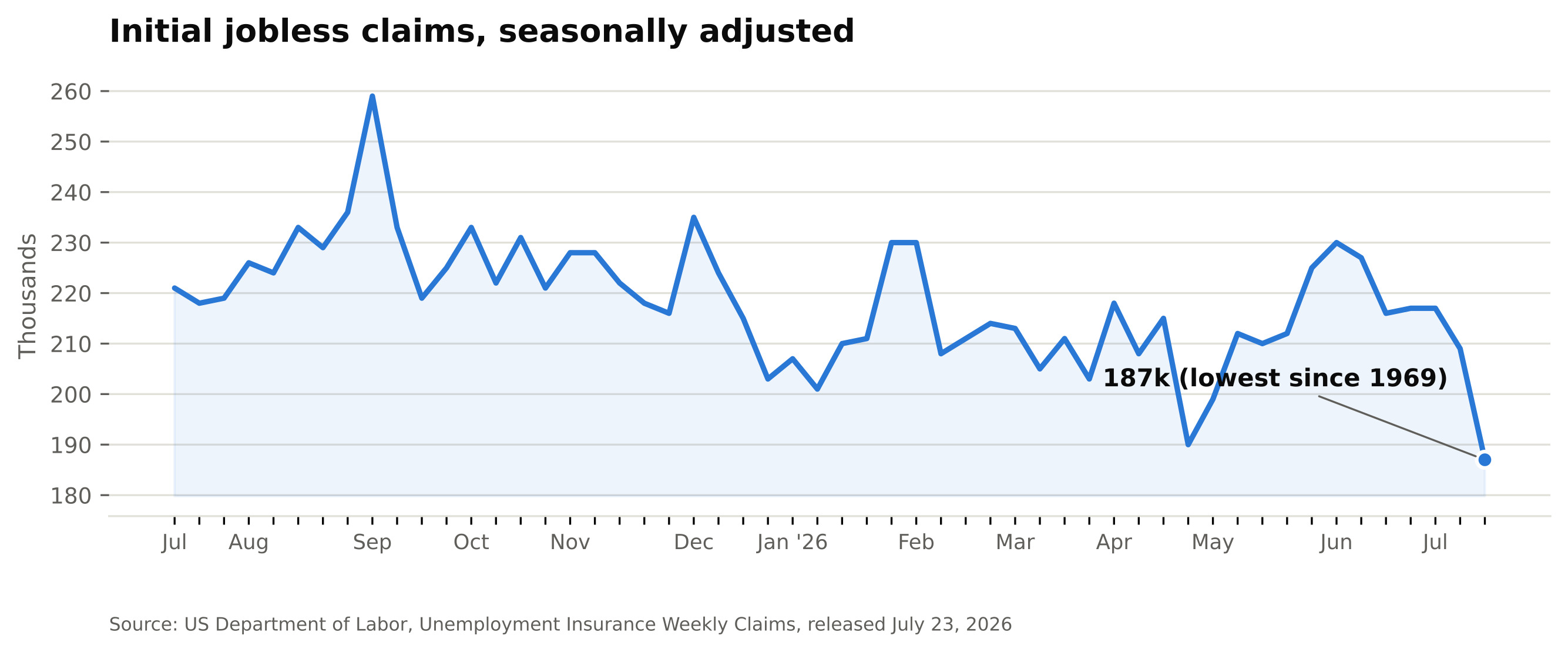
Economists polled by Reuters had forecast claims would edge up to around 212,000, making the miss even more striking. The four-week moving average, which smooths out weekly noise, fell to 207,500, its lowest point in nine weeks. It's worth noting that the department's own technical notes describe initial claims as weekly administrative data that are inherently difficult to seasonally adjust, meaning a single week's figure, however dramatic, is more volatile and more likely to be revised than the four-week average.
On the surface, that looks like an unambiguous signal of a rock-solid labor market. Underneath it, several other numbers in the same release, and in the data other agencies published around it this month, point somewhere more complicated.
A shrinking workforce, not a hiring boom
The unemployment rate has also been falling, dipping to 4.2% in June. But as several outlets covering the report noted, that drop had more to do with fewer people actively looking for work than a burst of new hiring. When people stop searching for jobs, they fall out of the official unemployment count entirely, which can push the rate down even while the underlying hiring picture stays flat. It's a distinction that matters for HR teams trying to read the state of the external talent market: a falling unemployment rate right now says less about labour demand than it might in a normal cycle.
People who lose their jobs are struggling to find new ones
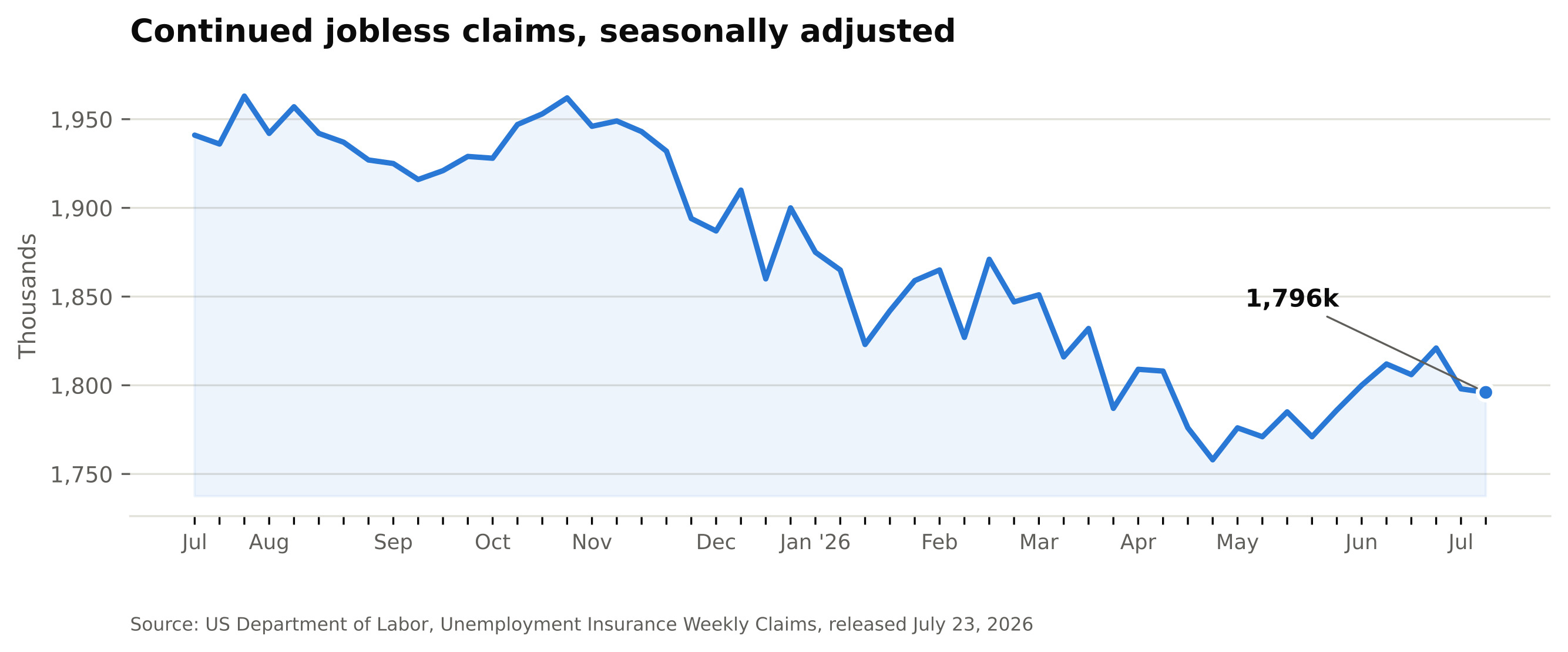
The clearest sign of that is buried further down in the DOL release itself. While fewer people are filing new claims, the total number of continued weeks claimed for benefits, a measure of how many people are still searching after their initial claim, actually rose by 64,843 to 1,864,638 in the week ending July 4. Regular state continued claims alone were up 66,256 on the week. In other words, fewer people are losing their jobs, but the ones who do are taking longer to land somewhere new.
That pattern lines up with what The Conference Board's Employment Trends Index has been showing for months: an economy stuck in what former Fed Chair Jerome Powell dubbed a "low-hire, low-fire" equilibrium, where employers aren't cutting headcount aggressively but they're also not hiring at anything like the pace of the last few years. Separate ADP data cited alongside this week's report showed private employers adding an average of just 16,500 jobs a week in the four weeks to July 4, down from 19,250 in the prior four-week stretch. Low churn can look calm from a distance. For anyone actually job-hunting right now, or for HR teams trying to backfill a role, it can feel like something closer to a standstill.
Big companies are still cutting, quietly, even as the headline number looks strong
The other tension worth naming: this week's tiny claims number arrives in the middle of a stretch of high-profile corporate layoffs. Just weeks before this release, Microsoft cut 4,800 roles, about 2.1% of its global workforce, hitting its Xbox division especially hard as part of a broader restructuring. Verizon, UPS, Amazon, Disney, Starbucks and Walmart have all trimmed staff in recent months too. Those cuts simply haven't shown up yet in a single week's claims data, whether because of notice periods, severance arrangements, or because higher earners often take longer to file or don't file at all. HRD's own reporting has explored why the aggregate labour data doesn't yet show the scale of disruption many expected from AI-driven job cuts, a gap this week's numbers only widen rather than close.
A manufacturing cluster is the one sector flag worth watching
State-level detail in the release shows manufacturing layoffs cited by name in six states with the largest week-on-week increases in claims: Michigan, Florida, Pennsylvania, Georgia, Illinois and Alabama. It's a small sample in a single week, but it's a consistent enough thread across otherwise unrelated states to be worth tracking if you're in an industrial or manufacturing-adjacent business.
Federal employment is still a slow bleed
Claims from former federal civilian employees ticked up again this week, to 470, continuing a trend that has run for well over a year as agencies have shed staff under successive workforce-reduction directives. It's a small number next to the headline total, but a reminder that public-sector hiring pain hasn't fully worked its way through the system yet.
What it means for the Fed, and for hiring budgets
The numbers are also feeding into a live debate at the Federal Reserve about where interest rates go next, which matters for anyone planning a hiring budget around borrowing costs. Thomas Mertens, senior vice president at the Federal Reserve Bank of San Francisco, wrote in a July 16 paper that the labor market appears broadly in balance for now, but cautioned that the risk of "a sharper rise in unemployment" remains.
Traders were pricing a quarter-point rate hike as their base case heading into the Fed's policy meeting next week, according to CME FedWatch data, with the bond market signalling the possibility of further hikes over the coming year. That's a notable detail in itself: a strong jobs number is being read here as supporting the case for higher rates, not lower ones, given inflation remains elevated. None of that is settled, and rate paths can shift quickly, but it underlines that this week's claims number is being read by markets as one data point in a still-uncertain picture rather than confirmation that the labour market has turned a corner.
None of this means the headline number is wrong, or that the labour market is secretly weak. It genuinely is a remarkable reading. But for HR leaders using this kind of data to calibrate hiring plans, retention strategy or workforce risk, the more useful story this week isn't the 1969 comparison. It's that fewer people are losing jobs, the ones who do are struggling more to replace them, and several of the biggest employers in the country are still quietly cutting anyway.