Model base salary rose just $803 while actual hiring costs surged 16% ahead
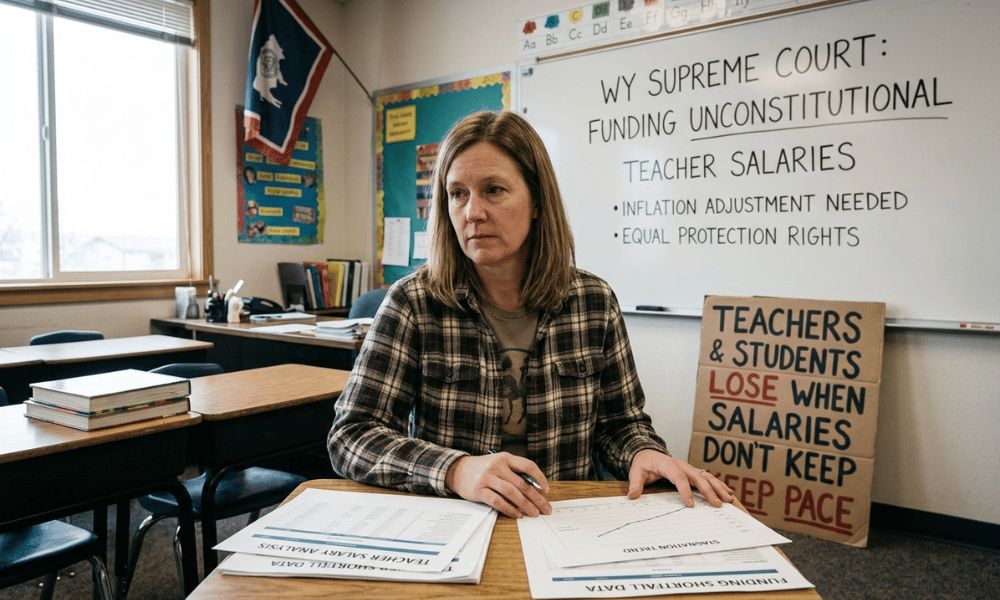
Wyoming teachers saw their model base salary rise $803 over twelve years. The state's supreme court said that is not good enough.
In a split decision issued September 17, 2026, the Wyoming Supreme Court ruled the legislature had violated students' constitutional rights by letting teacher pay in its school funding model stagnate while the real cost of hiring and keeping educators climbed steadily away. The case, State of Wyoming v. Wyoming Education Association (2026 WY 99), affirmed in part and reversed in part a lower court ruling on the state's approach to school funding.
The Wyoming Education Association and eight school districts brought the suit in 2022. Their core claim: the legislative model that determines how much each district receives was no longer grounded in cost. Personnel salaries account for 80 to 85 percent of total school funding, and the model's salary figures had barely moved. The base salary sat at $37,017 in 2010. By 2022, it was $37,820. Weighted averages told the same story - $53,046 to $53,506 across twelve school years.
Districts, meanwhile, were paying well above those figures just to keep classrooms staffed. By 2022-23, actual average salaries exceeded model salaries by about 16 percent - the largest gap since the funding model existed. Model pay had dropped to roughly 75 percent of what comparable professional workers earned.
The court held that every component of the funding model must reflect true costs individually. One underfunded component is enough to make the whole model unconstitutional. It also found the legislature had ignored its own statutory obligation to make cumulative annual inflation adjustments, repeatedly skipping or time-limiting those adjustments between 2010 and 2022.
Not everything went the plaintiffs' way. The court reversed orders requiring statewide funding for school resource officers and nutrition programs, finding the evidence fell short of proving these were constitutionally required. A mandate for one-to-one student-to-device technology ratios was reversed on procedural grounds. And the court upheld the state's administrative process for assessing school facility suitability.
Two findings the state chose not to appeal: that elementary mental health counselors must be funded, and that unequal and inadequate school facilities had persisted too long.
The court released jurisdiction, expressing confidence the legislature would act in good faith.
For public-sector HR teams, the decision puts teeth behind a familiar frustration - when funding models fall out of step with the actual labor market, the consequences eventually land in a courtroom.