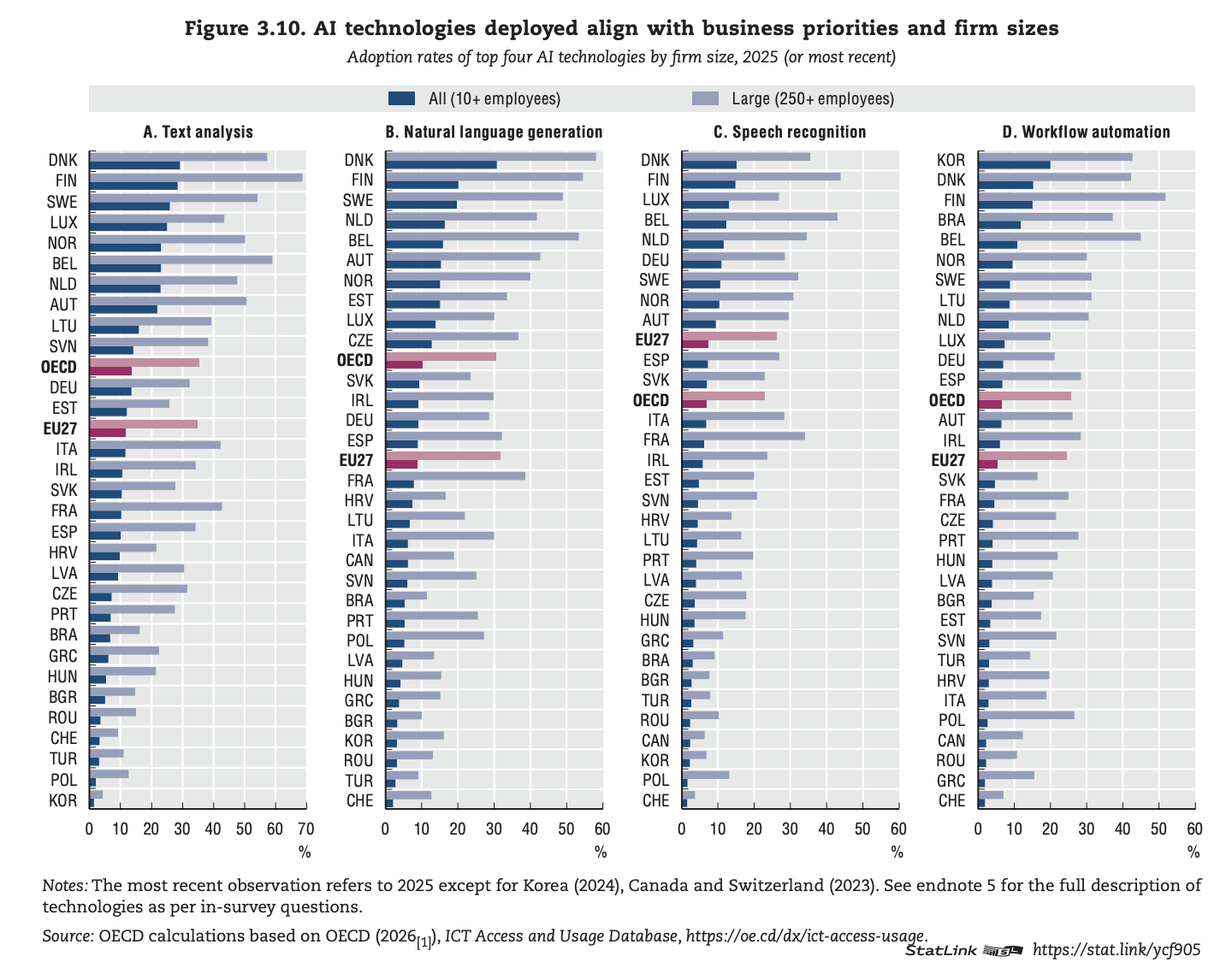
Text analysis and natural language generation lead firms' AI use, with workflow automation widely deployed

The adoption of artificial intelligence (AI) tools among member states of the Organisation for Economic Co-operation and Development (OECD) is maturing, but remains uneven across enterprises, according to a new report.
The OECD Digital Economy and Society Outlook 2026 shows that AI uptake has reached 20% for all firms, rising to 52% for large firms with 250 or more employees.
The wider adoption of AI tools for larger firms reflects their greater resources and capacity to integrate the technology across business functions, according to the findings.
It warned, however, that the AI adoption divide between small and large firms could persist without targeted support. According to the OECD, AI uptake among large firms could become nearly 80% higher than the average across all firms by the end of the decade.
"AI adoption among firms continues to expand. But to make the most of AI's potential for productivity and competitiveness, we need to make sure adoption spreads to firms of every size," said OECD Secretary-General Mathias Cormann in a statement.
"Our Outlook points to the levers to get there – wider access to cloud services, targeted support for AI and big data analytics, and stronger interoperability and open standards."
Drivers of AI adoption
AI adoption among firms can reflect and be driven by a combination of operational efficiency, strategic decision making, and customer engagement objectives, according to the report.
For OECD member countries, the top four reasons for AI deployment include:
- Marketing and sales
- Business administration and management
- Accounting, controlling, or finance management
- Information and communication technology (ICT) security
Marketing and sales applications are the most widespread, particularly among large firms, according to the report. Applications include activities such as customer profiling, price optimisation, personalised marketing offers, and market analysis based on machine learning and chatbots.
"Business administration and management applications support strategic decision making, document drafting, forecasting, human resources management, and planning," the report added.
Larger firms are shown to have consistently higher uptake across all of these purposes, and are also reporting higher usage rates across all technologies.
Among the different AI technologies deployed, the report found that text analysis and natural language generation are the most widely adopted.
Workflow automation technologies are also being widely used, according to the report.
"These patterns suggest that firms are not only meeting current operational needs but are also investing in scalable AI solutions that can transform multiple business functions," it added.
Moderation of AI adoption
Despite the growing adoption of AI tools, the report noted that its growth has slowed in 2025 in several sectors, such as information and communication.
AI uptake moderation is also happening in administrative and support service activities, retail trade, as well as professional, scientific, and technical activities.
"Overall, these patterns indicate that while AI adoption continues to expand across the economy, the pace increasingly reflects sector-specific maturity, operational readiness, and the scope for further integration," the report read.
Currently, some factors that slow down AI adoption include the lack of in-house expertise, as well as implementation costs and difficulties in integrating AI systems into existing infrastructure.
There are also persistent concerns about data protection and privacy, as well as uncertainty about the legal and regulatory implications of AI use.
"These findings suggest that policies to promote AI diffusion need to address a broad set of constraints simultaneously, combining skills development, clarity on legal and data protection frameworks, and support for integration costs, particularly for firms with limited digital capabilities," the report read.