Output per worker is climbing fast in a few AI-heavy U.S. industries while their payrolls shrink. Goldman Sachs research suggests the wider shakeout tends to wait for a recession

For three years, the argument that AI would remake the workforce ran mostly on forecasts. Over the past fortnight, real numbers have started coming in from the United States. The gains they show are genuine, but they are bunched into a handful of industries, and in those industries they are arriving alongside shrinking payrolls.
Outside the U.S., the gains are much harder to find. For HR leaders everywhere, the harder question sits a little further out: what happens to AI-exposed roles when the economy turns?
Output is up. Headcount isn't
Eric Basmajian, founder of EPB Research, grouped the three U.S. industries generally counted as the heaviest AI users: information, professional services and finance. Using Bureau of Economic Analysis output data and Bureau of Labor Statistics payroll counts, he found output per worker in that group has grown about 5% a year since the end of 2022, compared with a 2.2% trend from 2005 to 2022. Across the rest of the U.S. private economy the trend barely moved, from 0.9% to 1.4%.
"AI productivity gains are showing up, but only in ~15% of jobs," Basmajian wrote on X. Those three sectors produce roughly a quarter of U.S. private output.
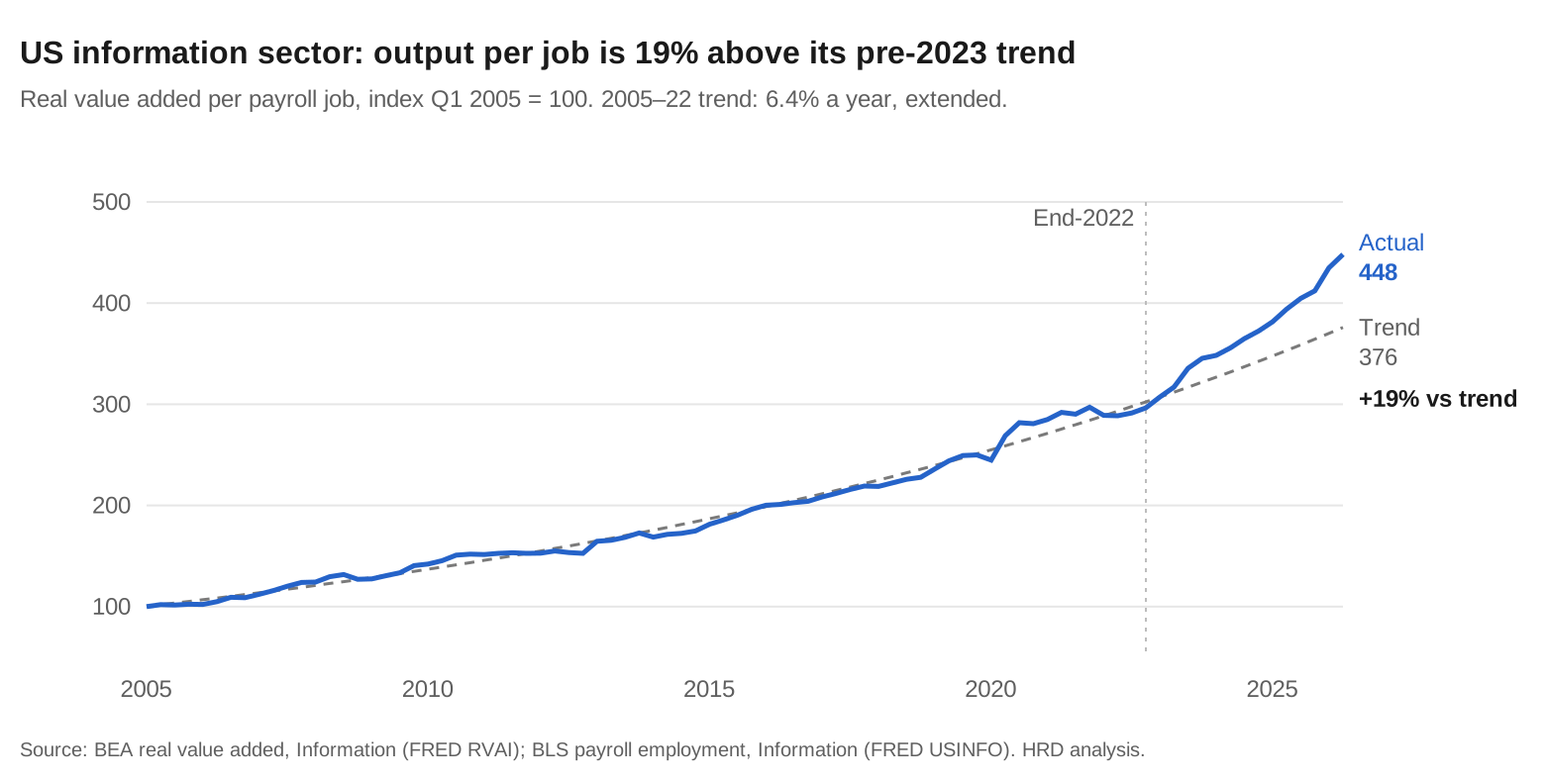
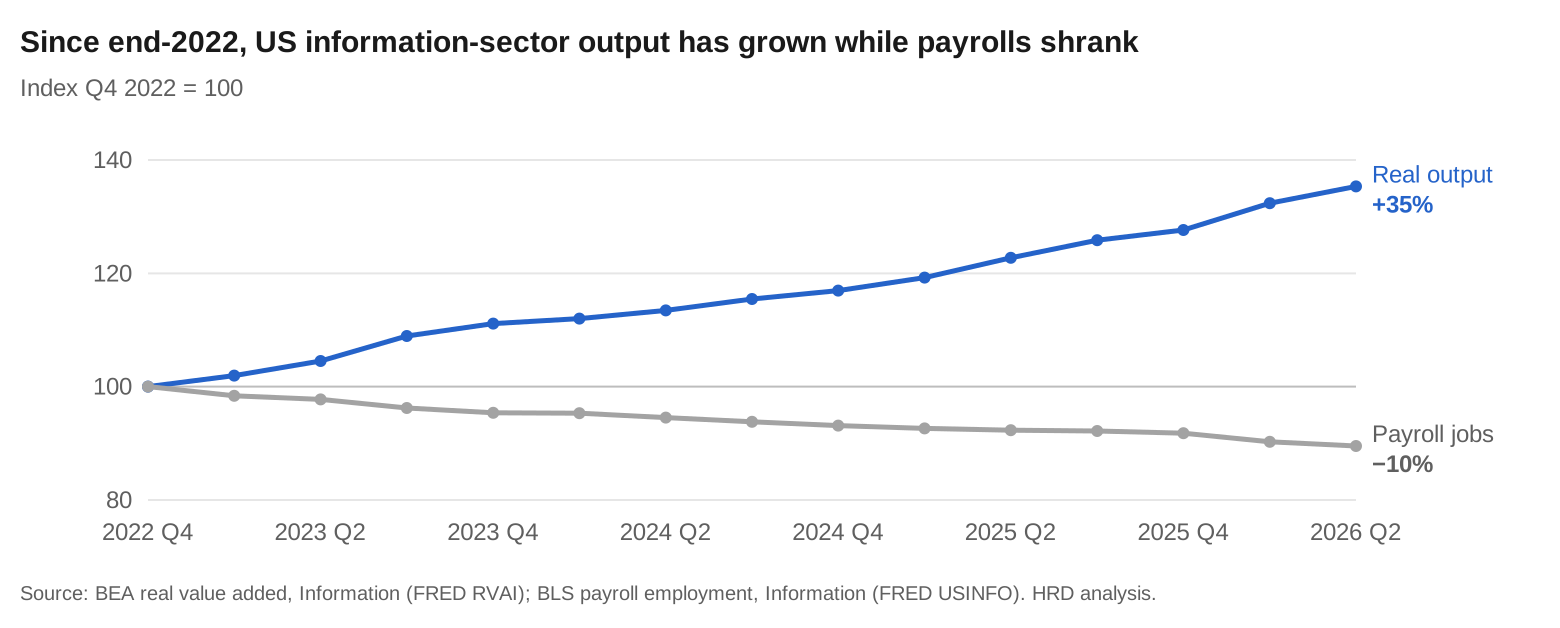
The information sector, which takes in software publishing, telecoms and data processing, shows the pattern most sharply. An HRD analysis of the same public BEA and BLS data finds the sector's real output rose 35% between the fourth quarter of 2022 and the second quarter of 2026, while its payroll employment fell 10%. Output per job now sits about 19% above where its 2005–22 trend would have put it. The Federal Reserve Bank of St. Louis reached a similar conclusion this month, calculating that US information-sector productivity grew 13.7% in the year to the second quarter of 2026, against 2.2% for the economy as a whole.
Readers outside the U.S. should note where this doesn't show up.
A Financial Times analysis this week by chief data reporter John Burn-Murdoch found the productivity rise barely registers in the U.K., Canada or continental Europe. In the U.S., he argued, it is largely a tech story built on flat or shrinking payrolls, and the turn came in 2022, as interest rates rose and well before today's AI agents. Productivity is a ratio, so it climbs when output grows and also when headcount falls.
Some of the apparent AI dividend may be companies working off pandemic-era over-hiring.
A faint signal in the jobs data
Goldman Sachs economists found in a client note dated 26 October that among U.S. non-manufacturing industries, those leaning harder on AI in day-to-day operations show weaker employment growth and higher unemployment, with both links statistically significant. A correlation of that kind can't show that AI caused the weakness.
Goldman economist Joseph Briggs had already sized the drag in a 22 October note. Employment in the most AI-exposed U.S. industries ran about 10,000 jobs below its long-run trend over three months, a gap that hiring for AI-related construction roughly filled.
Layoff announcements make a lot more noise. U.S. employers cited AI in 120,136 announced job cuts through September, about 21% of all cuts and more than any other stated reason, according to outplacement firm Challenger, Gray & Christmas. Those tallies capture what companies say, though, and labour economists doubt they reflect what is actually driving decisions.
"Simply put, we are not seeing that in the labor data," Lightcast economist Elena Magrini told HRD when Challenger's count passed 112,000.
Read next: Workforce design is the AI-era gap that most organisations are missing
Is this the calm before a storm?
"Historically automation-related labor disruption is quite cyclical," Briggs wrote. Companies tend to automate and cut staff as the economy slows, not in good times. The share of Americans in routine jobs such as clerks, machine operators and secretaries held steady through expansions and dropped in steps during the recessions of the early 1980s, 2001, 2008 and 2020. It never recovered.
Assuming AI eventually lifts productivity by 15% in the U.S. and other developed economies, Briggs estimates that up to 9% of workers, roughly one in 11, could be displaced during the transition, with slower hiring trimming employment by another 3%. He gave two reasons the effect has stayed small so far. Only 23% of U.S. establishments have built AI into regular workflows, and a resilient 2026 economy has given companies little reason to cut labour costs hard.
So the risk for employers is mostly about timing. Restructuring put off during a strong market could get squeezed into a few months once growth slows, and cuts made under cost pressure tend to be cruder than changes made by design. Outside the U.S., the law slows that squeeze but doesn't remove it. In the UK, employers proposing 20 or more redundancies at one establishment within 90 days must start collective consultation at least 30 days before the first dismissal, or 45 days for 100 or more.
In Australia, an employer considering 15 or more redundancies must notify Services Australia in writing before the dismissals happen. Canadian provinces set their own group-termination notice rules.
Read next: The entry-level job is disappearing
Older workers take longer to recover
The first evidence on who bears the cost is pointed. In a note dated 29 October, Goldman economist Pierfrancesco Mei found that U.S. workers displaced from AI-exposed jobs since 2025 took about a month longer to find work than other displaced workers and were roughly 10 percentage points more likely to still be unemployed a year on. Workers aged 35 and older needed about five extra weeks to get back to full-time work; those under 35 needed about three.
U.S. government data shows the same age gap across all job losers. The Bureau of Labor Statistics counted 7.4 million displaced workers between 2023 and 2025, up from 6.3 million in the previous three-year survey. Among long-tenured workers, 72.9% of those aged 25 to 54 had jobs again by January 2026, compared with 57.3% of those aged 55 to 64 and 38.6% of those 65 and older. About 49% of long-tenured workers who found new full-time work were earning as much as before, down from about 62% in the prior survey.
Read next: Most employers plan to create new entry-level AI roles within 2 years: report
Young workers are stuck at the door
Mei wrote that younger workers "may be able to adapt more flexibly to AI disruption." Their problem is getting hired. Stanford Digital Economy Lab researchers, working from ADP payroll records, reported in their August 2026 update that employment among 22- to 25-year-olds in the most AI-exposed U.S. occupations is about 19% below where it would be had it tracked less-exposed jobs. A year earlier the gap was 13%. Most of the shortfall has come through fewer hires rather than more dismissals.
The evidence elsewhere is not as clear - yet. Jobs and Skills Australia has found no clear sign so far that generative AI is reducing entry-level roles, HRD reported in August. Employers also say they still want junior talent. In research from AMS, a Korn Ferry company, 81% of organisations said they plan to increase early-career hiring over the next two years. The same report urged them to "redesign entry-level roles deliberately now, before automation removes important learning experiences by default."
Read next: Is AI replacing entry level Gen Z workers?
Before the next downturn, an HR checklist
- Map exposure by task. List what AI already handles in each role and note which roles finance would target first in a cost-cutting round.
- Build redeployment routes now. Work out where people in exposed roles could move and what training that would take. Pay particular attention to employees over 35, who take longest to land new work.
- Know your consultation obligations. Check collective consultation, notification and notice rules in each country you operate in, so a rushed restructure doesn't breach them.
- Be straight about the reason. If a redundancy is driven by cost or past over-hiring, don't present it as an AI decision. The people who stay will know the difference.
- Protect the junior pipeline. Redesign entry-level roles around review and judgement work, so there is still a bench of future managers in five years.
So far, AI is changing work in a narrow band of the U.S. economy, mainly by letting output grow without new hires, and the effect is harder to see elsewhere. If Goldman's history holds, the broader adjustment will come when budgets tighten, on a timetable set by the business cycle. The months before that are the cheapest time for HR to decide which roles get redesigned and where people go.