Employers keep citing AI for layoffs. Challenger, Gray & Christmas and Lightcast say the plan must name the work AI changes

Employers are pointing the finger at AI for layoffs but the labor data isn’t convinced.
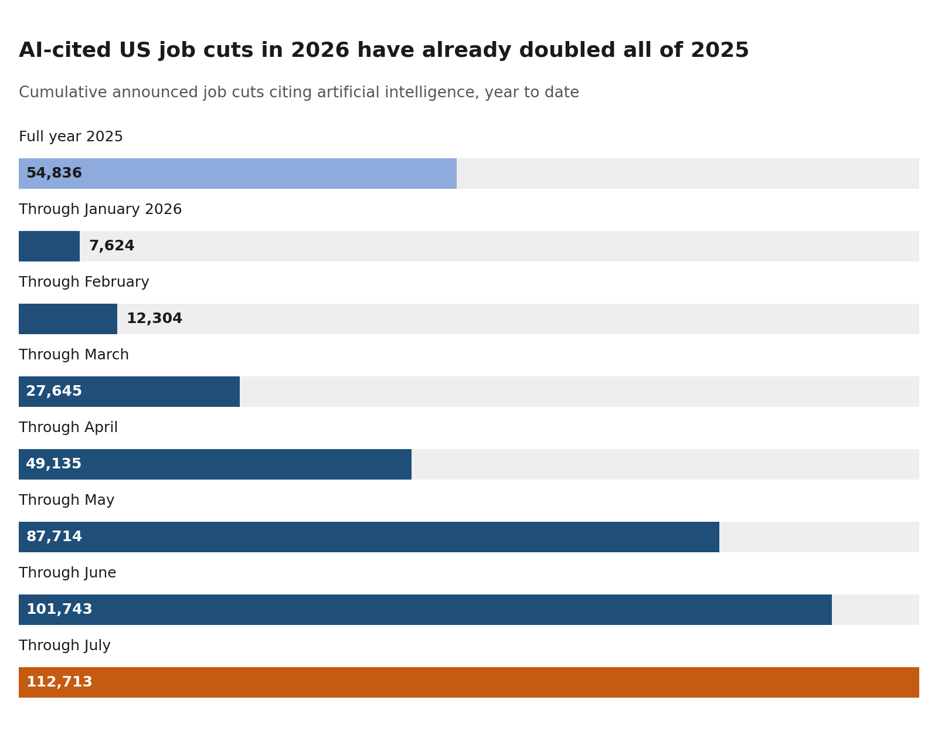
Companies cited artificial intelligence (AI) in 112,713 announced US job cuts through July 2026, more than double the 54,836 they pinned on AI in all of 2025, according to Chicago-based outplacement firm Challenger, Gray & Christmas. “There are narratives currently that note AI is "replacing" workers en masse. Simply put, we are not seeing that in the labor data,” Elena Magrini, an economist at labor market analytics firm Lightcast, said in a written statement to Human Resources Director (HRD) America.
Challenger’s own report puts AI at approximately 24 percent of the 477,033 cuts announced through July. Total announced cuts are down 41 percent from the same period in 2025. The count reflects the reasons employers give in their announcements and is not an independent measure of what drove each cut. The picture may also differ by region, as HRD America explored in asking whether California is a preview of what AI does to every state’s job market.
The trouble starts long before any layoff: AI rollouts that never define the work they are meant to change. “Workplace AI initiatives fail because they start from the wrong question, ‘what can be automated’ or ‘what do we need to know about AI,’ rather than starting from business problems and trying to see whether AI could help solve that problem faster or better,” Magrini said. A plan that cannot name the work it redesigns or the skills it builds looks a lot like plain cost cutting
Pick a problem you can actually measure
Magrini’s fix takes two steps. Define the specific problem where AI might help and the outcome leaders want to see. Then set key performance indicators (KPIs) that describe success and test them against the status quo to see whether AI gets the business there faster, better or more efficiently.
Andy Challenger, chief revenue officer at Challenger, Gray & Christmas in Chicago, says the narrowest use cases pay off first. One large company he heard from built AI systems on top of its employee handbook and the benefits data tied to each worker’s profile in its human resources information system (HRIS). “And so they’re having AI answer those questions to employees, and that’s really freeing up the HR business partners to have those longer one-on-one conversations with people about their career and upward mobility in the company,” he said.
The tools are already familiar. Many of the companies Challenger works with run on Microsoft and approve Copilot for internal use, he said, while IT staff and personal users lean on Claude and ChatGPT. Large HRIS platforms such as Workday and ADP keep adding AI capabilities of their own.
Don’t ignore how staff feel
Productivity is the first test most employers apply, Challenger said, but he adds two more: whether AI makes jobs better by removing repetitive work such as data entry and simple questions, and whether it eliminates the human error that creeps into manual, multi-step tasks. “So I think the quality of work, the quantity of work and productivity, and the quality of people’s lives can all be improved with tools on different measurements,” he said.
Engagement belongs on that list. “If they come about because of AI, is the company suffering on engagement? Are people feeling less connected to the company or to their jobs?” Challenger said, adding that the question belongs at the table with other executives. Email and Slack data can show it, he said, but direct feedback is more reliable. “I think the gold standard is asking employees directly with quick, short surveys to get their direct feedback,” he said. AI can help there too, designing sharper questions and timing them for when employees are most likely to respond. “Using technology as a way to be able to listen to your employees in a more effective way is actually a great way to use artificial intelligence today,” Challenger said.
Put together, Challenger’s and Magrini’s advice points to early proof that can be measured now, such as engagement, error rates and response times, rather than waiting on revenue gains that may take longer to surface. Activity metrics alone invite gaming, as when Amazon workers started gaming an internal AI leaderboard.
Watch for shadow AI and the hours it hands back
Unsanctioned tools, often called shadow AI, add a security risk. Many companies bar staff from feeding company data into outside models and limit them to approved tools such as Copilot, Challenger said, with each employer still writing its own rules. “It depends who’s driving those policies within a company. Sometimes they’re coming from the legal team. Sometimes they’re coming from IT teams. Sometimes they’re coming from HR. Hopefully, all three are involved,” he said.
The harder call comes once the rollout works. Challenger’s firm estimated in March 2026 that March Madness could cost employers more than $12 billion in lost productivity, while urging them to embrace the camaraderie the tournament builds. AI poses the reverse question: what happens to the hours it gives back. Employers could simply pile on more work, Challenger said, or reserve an hour a day for building skills the business expects to need, or for creative concepting that brings new ideas forward. That choice bears directly on the AI training gap that dulls a company’s transformation edge.
“I think there’s all sorts of ways companies can start to reallocate that time, but if they don’t intentionally plan it, it’ll just get sucked up,” Challenger said.
Three questions to ask before the cuts
What specific problem is the AI meant to solve, and what is the baseline? Are engagement and error rates tracked alongside output? Who decides how the freed-up time is used? Without answers to all three, the plan is hard to tell apart from a headcount decision.