From Visa to Disney, the country's top HR executives are pulling in eight-figure packages. Here's what the data says about who's earning what and why

America's highest-paid HR executives are commanding C-suite level pay packages, with the 50 top-earning CHROs at the country's largest public companies reaching a median of $3.7 million in 2025, according to a new Equilar study. The figures reflect what was awarded in 2025 and include salary, cash bonuses, stock and options awards valued at grant date, and other compensation, drawn from proxy filings through April 30, 2026.
At the top of the list, Kelly Tullier of Visa earned $14.5 million, making her the highest-paid HR executive in the study. Tracy Skeans of Yum! Brands followed as the second-highest paid at $12.1 million, and Timothy Massa of The Kroger Co. rounded out the top 10 with $6.4 million in total compensation.
"Today, CHROs are deeply involved in shaping business strategy, as talent management, workforce planning and organizational transformation have become critical drivers of long-term success," said Amit Batish, senior director of content and communications at Equilar in Redwood City, California.
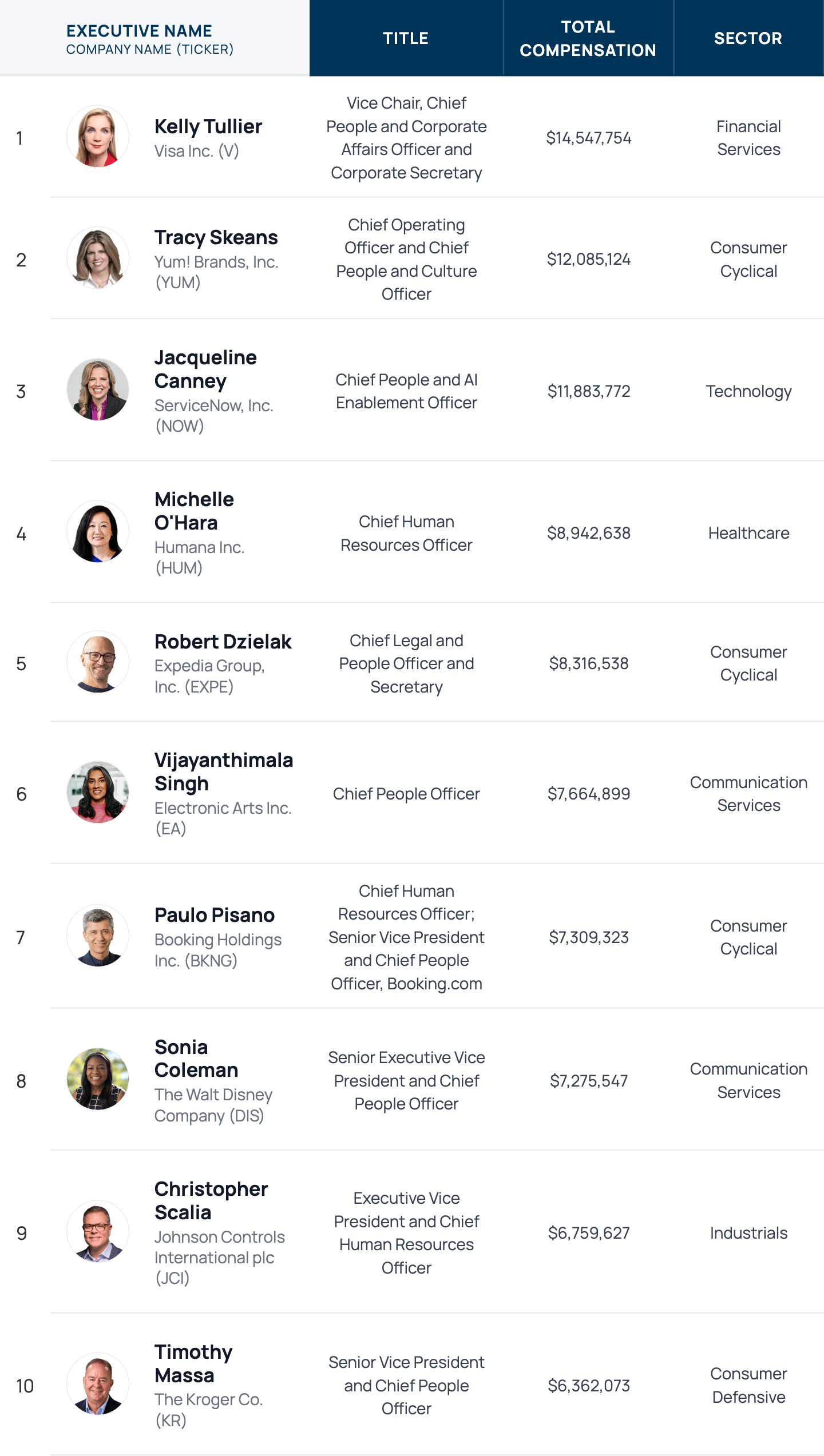
Graphic courtesy of Equilar
Download the full list of the 50 highest-paid CHROs from Equilar.
The equity story
An analysis of pay structures shows that corporate boards heavily tie HR compensation to company performance. Stock awards represent the largest component of total pay at a median of $2 million, while cash bonuses came in at a median of $864,610 and base salaries at a median of $674,688.
Equilar notes that the equity-heavy structure "ensures that human resources leaders are directly invested in long-term shareholder value and organizational health."
"Since the passage of Dodd-Frank, companies have placed greater emphasis on aligning executive pay with long-term performance," Batish said. "Equity awards help reinforce that alignment by tying a significant portion of compensation to sustained company performance and shareholder value."
A gender gap inside a female-dominated field
Women represent 32 of the 50 executives analyzed, yet their median pay stood at $3.5 million compared to $5 million for the 18 male HR executives on the list. According to data from the U.S. Bureau of Labor Statistics, women make up roughly 76% of HR managers across the broader workforce. Equilar describes the $1.5 million gap as "significant at the highest levels of the profession, even in a discipline where women are well represented."
It's a tension HRD has tracked across the C-suite more broadly: as our reporting on how long it will take to close the gender pay gap shows, the gap persists even in fields where women hold the majority of senior roles.
"It's difficult to pinpoint a single reason behind this trend, but a few factors are worth considering," Batish said. "Women have historically held a larger share of CHRO positions, while the smaller number of male CHROs can cause the median for that group to fluctuate more. Even so, it's a trend worth monitoring."
What the titles reveal
Several of the highest-paid executives on the list carry portfolios that extend well beyond traditional HR, into legal, corporate affairs, compliance, and, increasingly, AI. Canney's title at ServiceNow, Chief People and AI Enablement Officer, is one example, but she's not alone. Expedia's Robert Dzielak is Chief Legal and People Officer. Rockwell Automation's Rebecca House holds a combined People and Legal portfolio. Yum! Brands' Tracy Skeans is both COO and Chief People and Culture Officer.
These aren't honorary additions. They reflect a consolidation of strategic functions, and they likely help explain some of the compensation premium at the top of the list. It also aligns with a broader shift: a recent survey found that 88% of CHROs say their influence in the workplace is at an all-time high, with most describing themselves as trusted senior advisers to their CEOs.
"Beyond overseeing traditional HR functions, they're helping organizations navigate workforce transformation, AI adoption and leadership development," Batish said. "As the role broadens, its strategic importance will likely continue to grow."
The numbers bear that out. Research from the Conference Board and ESGauge, in partnership with FW Cook and Ropes & Gray, found that the number of CHROs designated as named executive officers at Russell 3000 companies rose from 148 in 2021 to 230 in 2025. Median CHRO compensation grew 14.7% between 2024 and 2025, compared to 8.1% for all named executive officers.
At S&P 500 companies, the gap was even wider: CHRO pay grew 30.4% in the same period. U.S. Bancorp's Elcio Barcelos, who appears at number 18 on the full Equilar list, is one example of that expanding remit: HRD profiled Barcelos on his unconventional path from sales into HR leadership and the human-centric philosophy he brought to one of the country's largest financial institutions.
According to Equilar, "managing the intersection of new technology and human workers has pushed human resources from a traditional administrative function into a core driver of corporate strategy." When boards are pricing a CHRO's pay package, they appear to be pricing the full scope of what these executives are actually managing.
"While it's impossible to predict exactly where compensation will go, CHRO pay will likely continue to trend upward alongside other C-suite roles," Batish said. "As organizations navigate ongoing changes in the workforce and business environment, companies will likely continue emphasizing long-term, performance-based compensation that aligns executive incentives with sustained results."