Employers are routing AI pay premiums through bonuses and performance pools as pay bands lag, Randstad and Lightcast data show

The AI skills premium looks good on paper but many employers are holding the line on base pay anyway.
Jobs advertising at least one artificial intelligence (AI) skill carried salaries 28 percent above similar roles with none, according to Lightcast job postings data presented at staffing firm Randstad’s 2027 salary trends webinar on Sept. 29, 2026. Lightcast first reported that premium, worth roughly $18,000 a year in advertised pay, in its July 2025 report, Beyond the Buzz, which analyzed more than 1.3 billion job postings.
Employers can pay it in the labor market or find another way to compete for the same talent. Many haven’t paid it. More than 63 percent of employees said their pay remains tied strictly to traditional job titles and pay bands, the fixed salary ranges attached to each role, according to a Randstad survey.
“There’s a lot of hesitation, especially from the organizations I talk to, to integrate any type of skill component into their pay framework,” said Elizabeth Crofoot, principal economist at labor market analytics firm Lightcast. “So I think that’s just a continuation of that trend with AI specifically.”
The same report found human resources led all career areas with 66 percent growth in AI-skill postings, driven by talent acquisition roles, as Lightcast detailed in its July 2025 press release on the report.
The second AI skill is where the premium jumps
Crofoot said many employers sprinkle “artificial intelligence” into postings to draw applicants, which blurs the signal. When a posting names two or more AI skills, Lightcast’s analysis shows, the skills get more specific and the advertised premium climbs as high as 43 percent over similar roles with no AI skill mentioned [confirm whether this figure is updated for 2026 or carried over from the July 2025 report.
“Oftentimes that second mention is not just the generic artificial intelligence, or some of the tools such as ChatGPT or Claude,” Crofoot said, describing what a first AI skill often looks like. Typically, the second AI skill is a “much more bespoke, niche AI skills where that application and the salary premium start to really differentiate job postings, especially across different sectors.”
The biggest premiums sit where AI skills are rarest. Lightcast flags customer and client support, sales, and manufacturing and production as carrying the largest advertised premiums of any career area, yet about 1 percent of postings or fewer in each ask for AI skills.
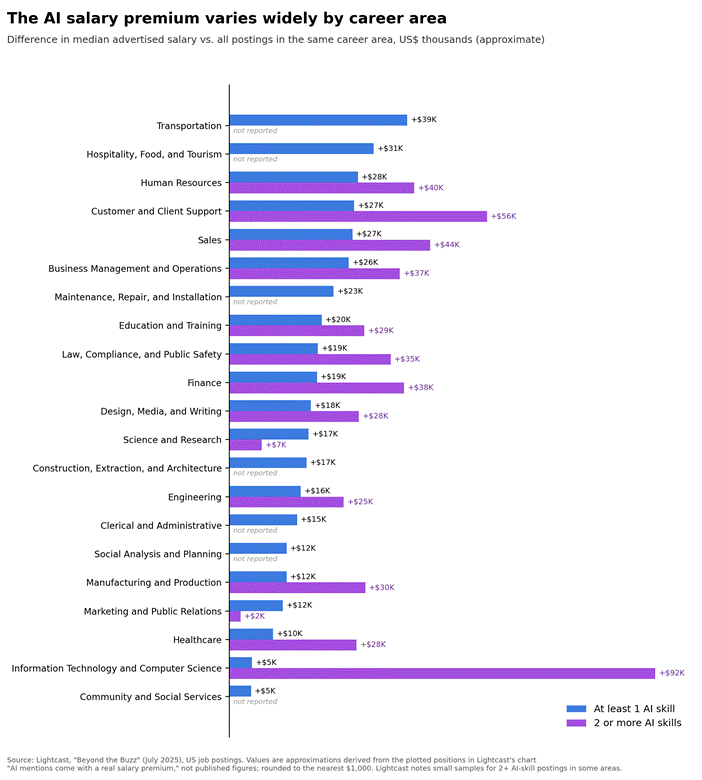
The gap is not uniform. In healthcare, postings asking for two or more AI skills advertise roughly $28,000 more a year, by a reading of Lightcast’s chart. In marketing and in science and research, the gap for two or more skills is smaller than for one. Lightcast notes small samples for some of these areas.
Build the skills when buying costs too much
Many employers aren’t refusing the premium outright. They are routing it through variable pay, meaning bonuses and performance pools that can be scaled back.
In the US digital sector, base salary growth has normalized at 2.5 percent to 3.8 percent, but employers steer variable bonuses and performance pools toward specialists in AI automation, cloud architecture and data pipelines. In Canada, base adjustments hold at 2.6 percent to 3.9 percent, and Randstad reports that specialized AI base pay growth has matured, with employers shifting toward discretionary bonuses tied to measurable enterprise productivity.
Crofoot pointed to internal development when the market’s skills premium outpaces the budget. “When you can’t buy the talent on the market, employers need to think about developing that talent internally,” she said. “That’s when we see employers are investing in training programs, in coaching and mentoring, in developing some of those AI capabilities, and in identifying adjacent roles that could more easily move into those AI occupations or AI-adjacent occupations.”
Candidates expect that investment. According to Randstad research, 49 percent of tech candidates in the US and Canada reject job offers that lack funded certifications or continuous development.
Marie-Noëlle Morency, head of brand, content and communications at Randstad North America, said candidates now link AI expectations directly to pay and training. “[An employer] will ask for AI and [one] will expect to have some AI skills,” she said, describing candidates’ expectations. “But it will need to reflect in the comp plan, and it will need to reflect in the training offer and upskilling.”
Crofoot pointed to an underused retention lever: showing AI-skilled employees where the skill takes them next. Career pathing is a “huge tool for retention” in the AI era, she said, and like a bonus, it doesn’t lock in a permanent raise. “It’s definitely underused today across employers.”
Job architecture is the bottleneck
Crofoot said job architecture, the structure of roles, levels and pay grades that compensation teams often own, moves too slowly to price fast-changing skills.
“We are not seeing that job architecture is keeping up with the pace of skill change,” she said. “Job architectures, I think by design, are very static and it takes a long time to make any adjustments because you have so many parts of the organization that have a stake.”
Rather than wait for a redesign, organizations are defining each job as a basket of skills and flagging critical skills across a job family, Crofoot said. “It’s marrying the two and working within the constraints of slow-moving job architecture changes,” she said.
The data points to a narrower spend than a blanket premium: pay for specific, verified skills, use variable pay where base budgets can’t stretch, and fund the internal pipeline for skills too expensive to buy. That also speaks to the AI skills gap facing Canadian employers and the rising bar of AI fluency as a baseline hiring requirement.
“Look at pairing AI adoption with funded in-house training, to prevent top candidates from going elsewhere with other job offers,” said Jeff Johnson, head of marketing at Randstad North America.