New report finds AI training on the rise as more firms lay off staff due to AI
Job protection strategies are being deployed in more than half of organisations across the world amid widespread redundancies in workplaces globally, according to a new report from Gallagher.
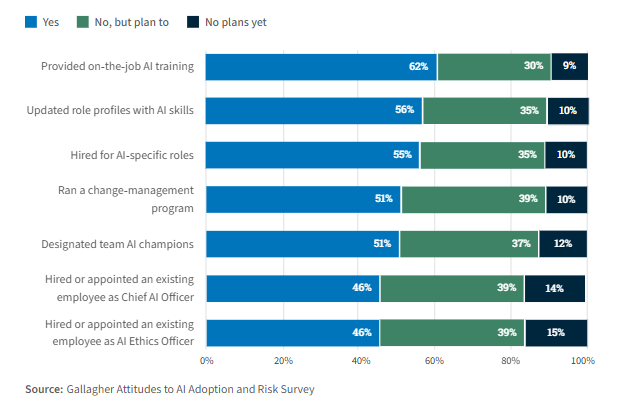
Its 2026 AI Adoption and Risk Survey, which polled 1,250 global businesses, found that measures such as AI training, AI hiring, and change management programmes are being rolled out in the wake of AI adoption.
The majority of employers (62%) in the report revealed that they provided employees on-the-job AI training to prepare their workforce for AI adoption.
More than half of employers also said they updated role profiles with AI skills (56%), hired for AI-specific roles (55%), ran a change-management programme (51%), and designated team AI champions as part of their job protection measures.
Widespread redundancies
These measures come in the wake of widespread layoffs as a result of AI adoption, according to the report.
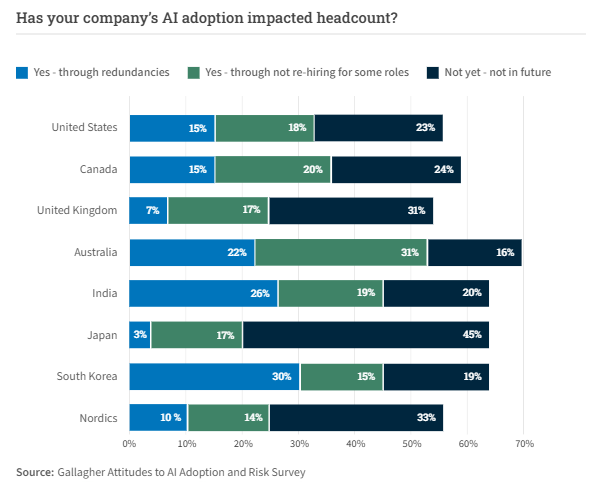
Some 59% of employers said their organisation has either reduced overall numbers already or plans to do so in the future.
Based on the findings, employers in South Korea are more likely to say their company has made headcount reductions through redundancies (30%).
In the United States and Canada, 15% of employers in both countries said they made employees redundant because of AI adoption.
This is also the case for 22% of employers in Australia, and three per cent of employers in Japan.
"By sector, the combined impact of AI adoption on headcount is deemed to be more significant in telecoms, technology, energy, and financial services," the Gallagher report said.
"In terms of impact on future jobs, the biggest impacts are anticipated in sectors such as manufacturing and IT/computing."
The need for humans
Job protection strategies come despite widespread layoffs because of the need to still retain humans in the workplace.
According to the report, employers still want to retain and promote creativity, retain human touch for client interactions, and carry out complex problem-solving and high-stakes decision making.
"For many global companies, AI is no longer in the test phase. It's in the workplace, shaping strategy, and powering productivity," said Ben Warren, Managing Director of People Data, AI and Innovation at Gallagher, in a statement.
"We know what AI can do, and the potential is undeniable. It can handle repetitive and manual tasks, freeing employees to spend less on menial work and more on what really matters: creative ideation and meeting clients."
AI governance yet to catch up
Overall, one in five businesses globally have fully operationalised AI adoption in 2025, up from the 16% in the year prior.
Nearly half of employers (43%) also said they are implementing parts of the technology in their business, while 17% said they are pilot testing the technology.
"Currently, the most popular uses for AI are in IT operations management, client-facing functions such as chatbots and personal assistants, and research and analytics," the report read.
Gains are being reported from AI adoption, with 86% of employers reporting that the technology delivered when it comes to workforce productivity.
This figure rises to 93% in Canada and Australia, 91% in the US, and 90% in India, according to the report.
But AI governance has yet to catch up, with just 56% of firms communicating their AI strategy to employees.
Just around half of employers also said they have developed or updated their AI policies (54%), as well as assessed and mitigated security vulnerabilities (50%).
Just 49% of employers also said they have established or reviewed AI risk governance policies, and only 46% adopted recognised frameworks or certifications for responsible AI.
"Our findings suggest that governance frameworks are still catching up with the pace of adoption," Warren said.
"As organisations scale their use of AI, risk oversight and clear policies will become increasingly important. Overall, the long-term value of AI will depend on combining technological efficiency with human creativity, judgement, and trust."