It started at a modernized Seattle container terminal where two crews wanted the same jobs
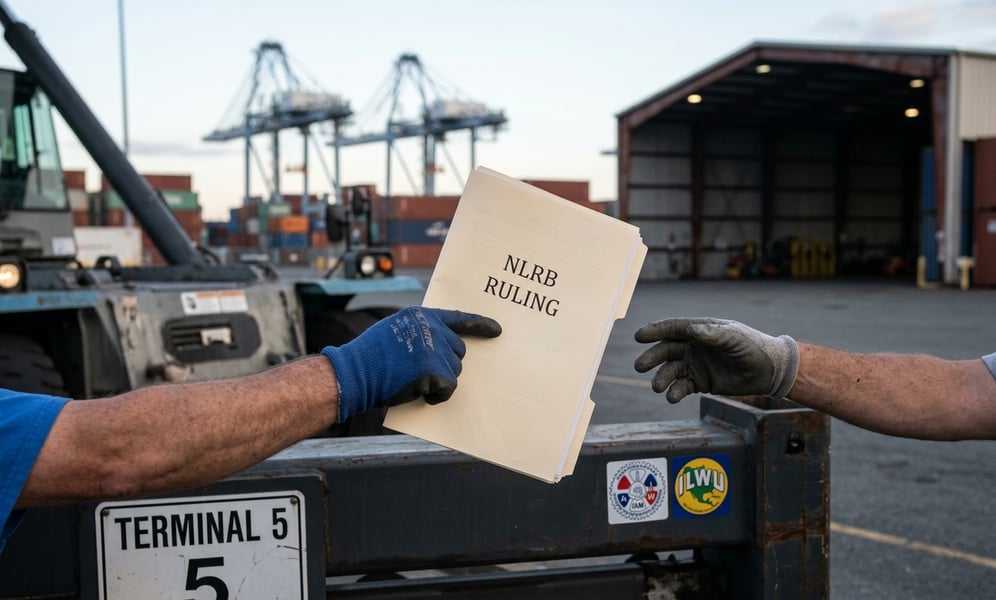
The Ninth Circuit clarified on August 20, 2026, that when two unions want the same jobs and the labor board picks one, arbitration can't relitigate it.
The dispute started at the Port of Seattle. SSA Terminals ran container terminals there and held union contracts with both the International Longshore and Warehouse Union (ILWU) and the International Association of Machinists and Aerospace Workers (IAM). Both agreements covered the same equipment maintenance and repair work - a setup built for conflict.
The conflict arrived in 2019, when SSA reopened Terminal 5 after a year of modernization. Both unions claimed the jobs. SSA gave them to ILWU, and IAM threatened to picket and strike. Stuck between two contracts it couldn't both honor, SSA asked the National Labor Relations Board to settle it - the process Congress created for these "jurisdictional disputes."
After a July 2020 hearing, the Board awarded the work to IAM, pointing to employer preference, skills and training, efficiency, and IAM's prior experience on the equipment. By October, SSA had moved the work to IAM.
ILWU didn't stop there. It filed a grievance claiming SSA broke its contract by not defending ILWU's claim during the Board proceedings. An arbitrator agreed and ordered SSA to pay ILWU for the lost work. IAM and SSA went back to the Board, arguing ILWU was trying to strong-arm SSA into ignoring the Board's award.
An administrative law judge found ILWU had committed an unfair labor practice, and the Board affirmed. ILWU and the Pacific Maritime Association - the employer group that bargains with ILWU - challenged that in court.
Their argument rested on a "work-preservation" defense: the idea that a union can pressure an employer to keep work its members have long done. The court didn't buy it. Once the Board resolves a jurisdictional dispute, the judges held, the losing union can't reopen it by relabeling arbitration as work preservation. That would hand unions an easy way around the system Congress built to end these standoffs.
The court denied the petitions from ILWU and PMA and enforced the Board's order, overruling part of its own 2020 decision along the way.
For any employer bargaining with more than one union - especially where automation creates overlapping claims on the same work - the ruling draws a hard line. The Board's jurisdictional decision is the last word, not the first round of a longer fight.