New report finds some employees retain access to workplace systems despite already departing

Employees are retaining access to their company systems, including workplace applications, despite already leaving the organisation, leaving their employers vulnerable to cybersecurity incidents.
Augmentt, in a new survey of 1,007 employees who left a job in the past three years, found that 44% of employees are still able to access company systems after leaving their jobs.
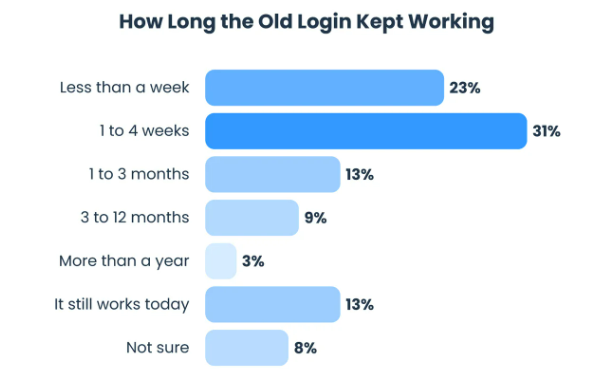
Nearly a third (31%) of employees who retained access said the old login kept working for one to four weeks, the report revealed.
Another three per cent said it worked for more than a year, while 13% said it still works today.
According to the poll, employees who can still access old systems said they could open workplace applications, including at least one Microsoft 365 app (64%). The work apps they could open include:
- Outlook (work email) [48%]
- Other work apps or systems (48%)
- Google Workspace (Gmail, Drive) [38%]
- Teams (33%)
- OneDrive (25%)
- Customer or sales (such as CRM) [23%]
- Slack (21%)
- AI assistants (such as ChatGPT or Claude) [16%]
- SharePoint (11%)
More than a third (37%) of employees also said they are still receiving company emails, meeting invites, Teams alerts, or even shared-file updates after leaving, the report further found.
Are employers aware of retained access?
The majority (64%) of employees who have lingering access to their workplace accounts said they didn't inform their employer that their login still worked.
This leaves many employers in the dark about the potential cybersecurity risk that this could pose, especially as 38% of former staff said their old accounts were still able to access information that they were no longer authorised to see.
Total Communications, a US-based tech firm, warned that employees with lingering access can intentionally cause damage to the organisation.
But the bigger risk than insider threats is cyberattacks, according to Total Communications.
"An inactive but accessible account can be targeted by cybercriminals," an insight from Total Communications in October said.
"Credentials may have been exposed in a previous data breach. A forgotten account might lack MFA (multi-factor authentication) or continue to have permissions that are no longer appropriate."
What can HR leaders do about it?
Augmentt has underscored the need for organisations to urgently close accounts of former employees that are no longer in use.
"Closing accounts should be a part of offboarding, and it's a step that can't wait," it said. "Most former employees who could get back in told no one, so waiting to be told isn't the best option."
Total Communications, in its insight, called for close collaboration between HR leaders and IT teams to ensure that former employees' accounts are no longer accessible after they depart.
"If HR assumes IT knows about an employee's departure, and IT assumes the department manager has already requested access removal, important steps can fall through the cracks. An effective offboarding process requires coordination," it said.
"There should be a clearly defined procedure that identifies who initiates the process, who removes access, which systems need to be reviewed and how completion is verified."
Additional precautions are also appropriate for employees with privileged access, according to Total Communications.
"The process should also account for the timing of access removal, particularly in situations involving sensitive roles or involuntary departures," it added.