Her own doctor said she couldn't work, and her lawyer's brief had a bigger problem
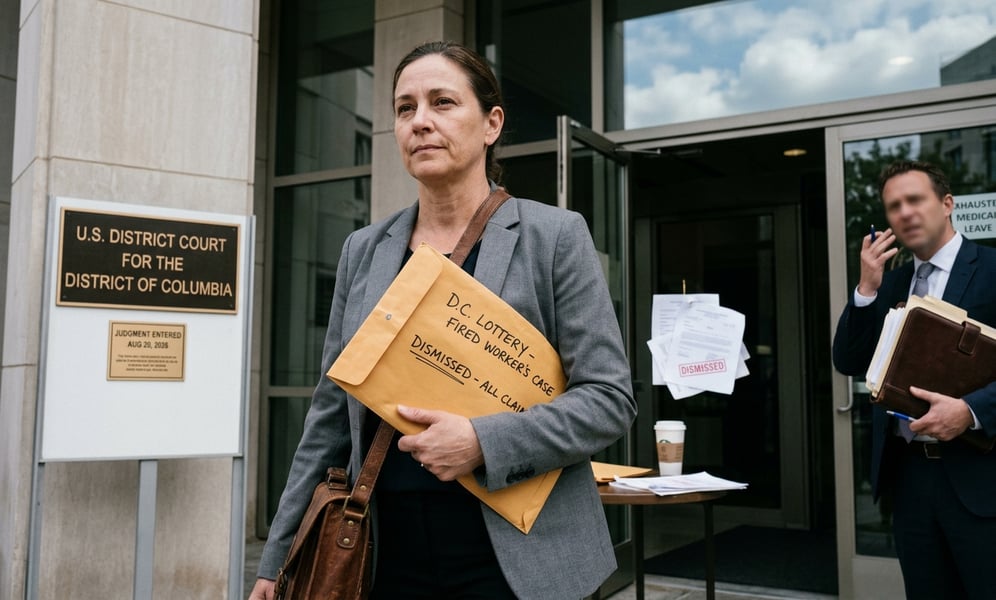
A federal court dismissed a former D.C. Lottery employee's disability, leave and overtime lawsuit, ruling for the employer on every claim.
The US District Court for the District of Columbia granted the District summary judgment on August 20, 2026, ending a suit brought by a web communications specialist fired in May 2023.
The worker joined the D.C. Lottery in November 2017. In 2021 and 2022, she took several rounds of family and medical leave, first for the birth of her child and later to care for her husband. In December 2022, days after receiving a letter of admonishment over her attendance, she requested continuous leave, citing "severe anxiety and depression." The District approved 640 hours through March 31, 2023.
When that leave ran out, she asked to extend it into December 2023, this time citing "debilitating migraines." Her own medical provider certified that she was "unable to perform all job duties/functions" and could not work even with an accommodation. HR told her she had exhausted her statutory leave and denied the extension, offering to consider an alternative accommodation instead.
She did not return to work or take up that offer. On May 30, 2023, the District fired her, stating she "failed to report to work and [was] unable to perform the essential functions of [her] position."
The court rejected each of her claims. On her disability discrimination claims under the D.C. Human Rights Act, it held she was not a "qualified individual," because her provider had confirmed she could not do the job with or without accommodation. Her FMLA and DCFMLA interference claim failed because she pointed to only one work request during leave and showed no resulting harm. Her retaliation claims fell short too: she relied on the timing between her leave, a March 2023 Equal Employment Opportunity Commission charge and her firing, but the court said timing alone could not prove she was fired for exercising her rights.
The court also dismissed her overtime claim under the Fair Labor Standards Act, finding she was an exempt administrative employee and, in any event, could not identify when she worked the "at least 400 overtime hours" she claimed.
In a separate finding, the court said the brief filed on her behalf appeared to be about 75% plagiarized, lifted from ten different cases without attribution. It cited the conduct rule barring "dishonesty, fraud, deceit, or misrepresentation," but said it had looked past the problem and still weighed her arguments.
The decision is a district court ruling and may be subject to appeal.