Three workers were packing up when the ceiling came down. Now a court is weighing in
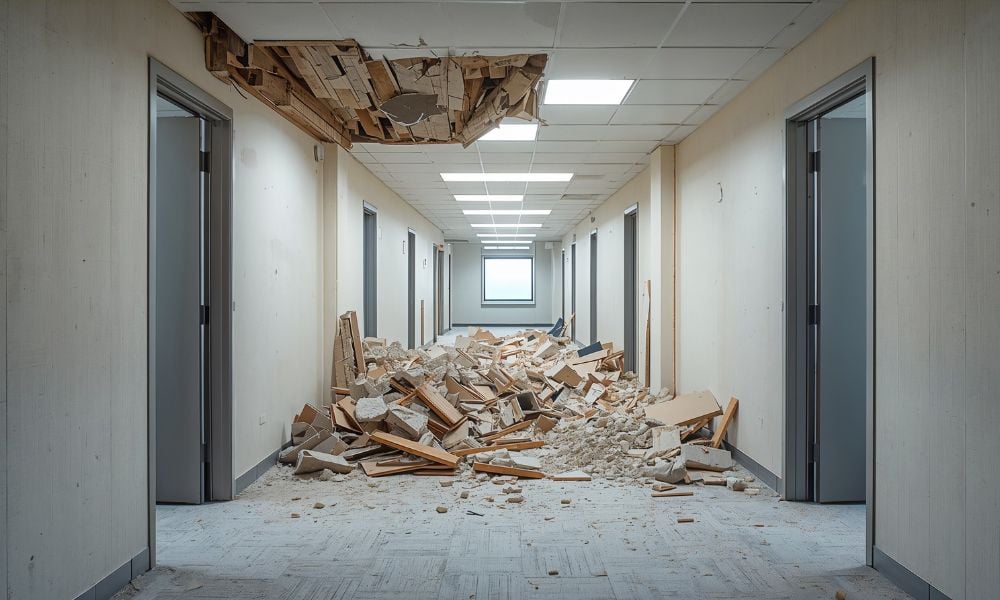
Three workers were dismantling gear on the 40th floor of a Manhattan high-rise when the ceiling above them gave way.
A New York appellate court ruled on November 24, 2026 that most of their workplace safety claims should proceed to trial - overturning a lower court that had thrown them out.
The workers were employed by asbestos abatement contractor ETS Contracting and assigned to a multi-floor gut renovation at 120 Broadway in Manhattan, managed by Silverstein Properties. The building's owners had engaged JRM Construction Management to coordinate the renovation, and JRM hired subcontractors including demolition firm Rite-Way Internal Removal.
Rite-Way finished demolition on the 40th floor on July 11, 2018. The asbestos crew arrived twelve days later. They had completed their work and were disassembling their decontamination unit when the ceiling suddenly collapsed.
All three sued the building owners, Silverstein, JRM, and Rite-Way under New York's Labor Law. The lower court dismissed every claim and denied the workers' own bids for summary judgment.
The Appellate Division, First Department modified those orders.
The court found Rite-Way was not a proper defendant. Its contract covered specific demolition tasks on drawings from JRM, explicitly excluded shoring, and its work finished roughly two weeks before the collapse. Nothing in the record showed Rite-Way strayed from JRM's instructions or owed any ongoing duty to inspect the site.
JRM was another story. Its contract was styled as construction management, but the terms required it to coordinate subcontractors and take reasonable safety precautions for workers on site. No other general contractor was present. JRM could stop work over unsafe conditions. And it was JRM that handed the floor over to the asbestos crew.
The court was unpersuaded by JRM's argument that it bore no responsibility for the asbestos contractor's workers. JRM was responsible for site safety. The defendants' broader claim - that they did not control the site while asbestos work was underway - also fell flat. The court noted ample time existed after demolition and before the handover to inspect and shore the partially demolished ceiling.
The foreseeability question kept most claims alive. Defendants argued there were no visible signs of cracking or sagging and blamed a preexisting construction defect. But the ceiling had been partially torn apart, and large sections of it and other elements had already been removed. Those disputed facts blocked summary judgment on the workers' claims under Labor Law sections 240(1) and 200, and their common-law negligence claims.
One worker won summary judgment on his claim under Labor Law section 241(6), tied to Industrial Code rules on demolition inspections. The court found no evidence inspections actually happened - the witnesses who testified about them had not participated in any.
For safety teams overseeing multi-contractor projects, the takeaway is practical: site-safety obligations do not pause during handovers between trades, and a construction management title will not shield a firm from liability when it controls the site.
The decision is a final appellate order. Several claims remain for trial on the facts.