A new worker-first ranking scores 228 U.S. metros on pay, job security, mobility and quality of life and more

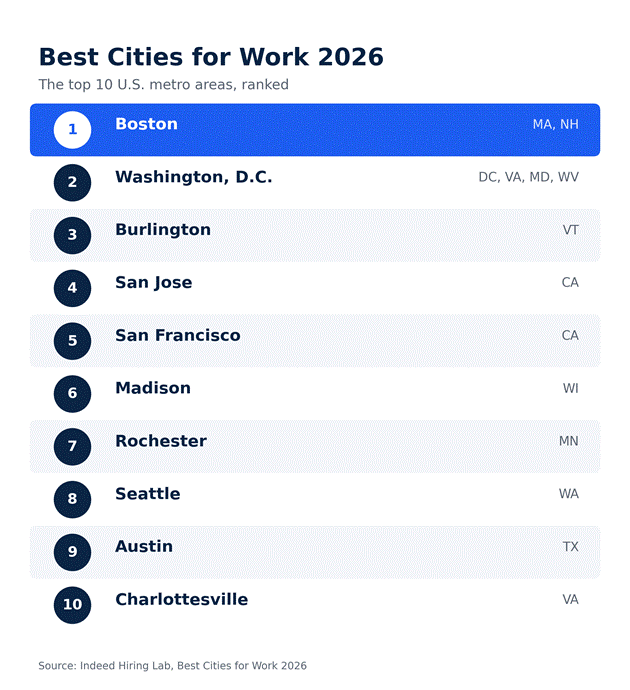
With high wages, long career ladders, and broad economic opportunity, Boston has been named the best American city for work in 2026.
That's according to Indeed's inaugural Best Cities for Work 2026 index, which ranked 228 U.S. metro areas with populations above 200,000 across six categories or “pillars.” Boston claimed the top spot after landing in the top 10 for compensation, job quality and security, career mobility and economic opportunity. Yet it didn't lead in a single one of the six pillars the index measures, and the historic coastal city didn't score low in any of them either.
“In an index built to reward balance across everything a worker needs, the most-balanced metro wins,” Indeed's report said.
The index draws on 40 metrics across those six pillars: job opportunity, compensation, job quality and security, career mobility and dynamism, work-life and flexibility, and economic opportunity, detailed in the full methodology Indeed published.
Kyle M.K., a senior talent strategy advisor at Indeed, the job search platform headquartered in Austin, Texas, said Boston's win came down to broad, consistent performance rather than a standout score anywhere.
“It just scored really well in these key portions of what we're considering a holistic theme,” he said.
Washington, D.C. followed at number two, posting the highest career mobility score in the country, a measure of how much room workers have to advance, whether by switching jobs or moving up where they are, a pattern recent research suggests works in candidates' favor rather than against them. Burlington, Vermont took third on the strength of the nation's top job opportunity score, and San Jose and San Francisco, California rounded out the top five, both standouts for compensation.
Business friendly isn't the same as worker friendly
Indeed's own report makes a similar point at the outset. For most of the last two decades, it argues, rankings that call a metro one of the best places to work have really been measuring where it's cheapest and easiest to run a business. A place can be an excellent city to hire workers from while still being a difficult one to actually work in, and that disconnect is what the index is designed to correct.
Asked what distinguishes a city that's good for business from one that's good for the people working there, Kyle M.K. pointed to stability over raw opportunity.
“What people are looking for, especially in today's economy, is stability and financial security overall,” he said. “When a city provides certain services or social safety nets, like childcare or public transportation where you're not having to rely on car payments and insurance to get around, I think that's what makes a city that much better for a professional over a business.”
Pay isn't the whole story
Four of the five highest-compensation metros in the index, San Jose, Seattle, Washington and San Francisco, are major tech and government hubs. Kyle M.K. said that part of the results tracked with expectations, though who joined them near the top surprised him.
Burlington, Vermont, a small city with none of those metros' paychecks, ranked third nationally not on pay but on how easy it is to actually land a job there, with more openings relative to job seekers than almost anywhere else in the index. The rest of that group, Kyle M.K. said, earned their spots the more expected way: through compensation.
“San Jose is number one when it comes to compensation, and compensation isn't just how much money you're making. It's wage growth, the share of jobs paying $25 or more an hour, and how much of your after-tax pay goes toward your cost of living,” he said.
That same cost-of-living math works in the other direction too. A lower-cost metro like Madison, Wisconsin can make a smaller paycheck stretch further once cost of living is factored in.
“Where you may not be making as much as someone in San Jose, your dollar goes a lot further there,” Kyle M.K. said.
Job opportunity carries equal top billing
Of the six pillars, job opportunity, whether workers can actually find a job in a given metro, is tied with compensation for the most weight in the overall score, at 20% each. Indeed's measure draws on signals similar to what the Bureau of Labor Statistics tracks nationally in its unemployment data, combined with the company's own postings data.
Burlington, Vermont ranked first in the country on that measure.
“For that we're looking at the unemployment rate, job postings per 1,000 residents, and prime-age employment rate, so how many people are in the thick of their career, not just at the end or the very beginning,” Kyle M.K. said.
The index also factors in how exposed a metro's jobs are to AI displacement, a question that carries new weight as some roles turn out to be far closer to automation than others.
Kyle M.K. said the assessment draws on job postings and third-party research to gauge how exposed different worker populations are to automation.
What workers and employers should take from the rankings
Kyle M.K. said the list isn't meant to tell people where to move. It's meant to help them understand the market they're already in, or considering, more fully than a single number like salary can.
“I think of the analogy of a smartphone. You can't just think of salary as the only thing. When you're buying a phone, you look at how good the camera is, but you're not considering the storage for the photos, or the battery to take them. If you're buying for the camera alone and ignoring the processing power, the space and the battery, that's like accepting a job for the salary alone and not considering the environment you'll exist in,” he said.
For employers, Kyle M.K. said the data works as a diagnostic tool, useful in a top-ranked metro or a lower-ranked one.
“The rankings should help employers identify where local conditions may be strengthening or creating friction within their talent strategy. Employers can't control every condition in their region, but they can respond through competitive pay, flexible work arrangements, stronger benefits or career development opportunities,” he said.
Kyle M.K. said location deserves the same attention employers give to culture when they're pitching talent on why to join.
“Location is just as much a part of the employee value proposition as the culture you're trying to sell. Our jobs don't exist in a bubble. It's worth leaning on this list to better understand what's working, or where friction might land, with your own workforce,” Kyle M.K. said.