Canada’s retaliatory tariffs target American steel, appliances and smartphones, raising fresh risks for cross-border employers
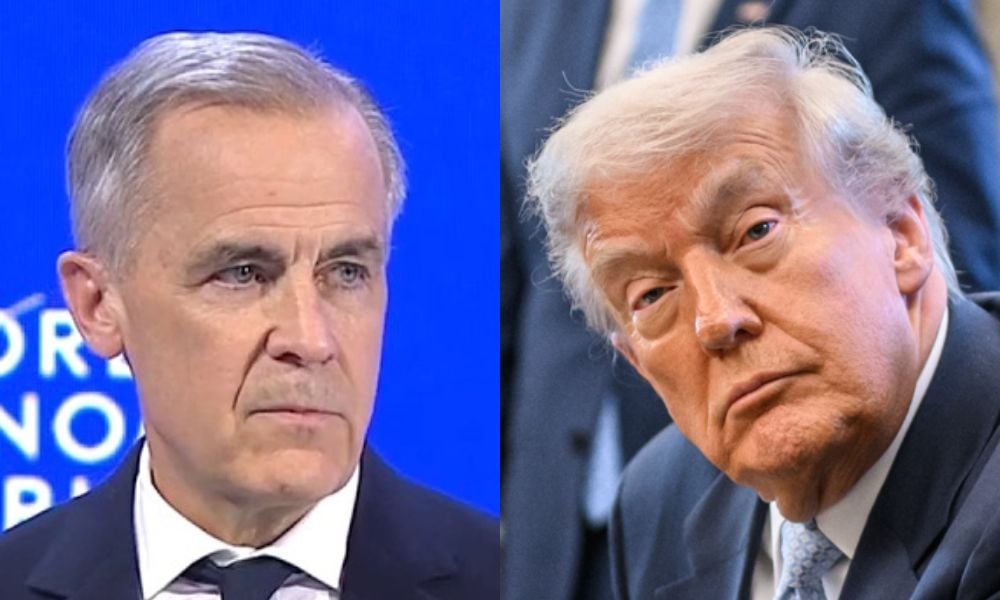
Canadian Prime Minister Mark Carney and U.S. President Donald Trump are shown here in this composite image. (Credit: World Economic Forum, The White House)
Canada announced sweeping retaliatory tariffs Tuesday on more than 700 American products, escalating a trade conflict that's triggering disruptions to cross-border supply chains and workforce planning for companies on both sides of the border.
The new levies will range from 15% to 50% on approximately $20 billion worth of American goods and are set to take effect Sept. 8, 2026, matching in value the U.S. tariffs that hit Canadian exports starting August 22. The most consequential measure is a doubling of duties on American steel and aluminum to 50%.
The list reaches across sectors including smartphones, makeup and perfumes, kitchen appliances, dairy, seafood, paper products, clothing, furniture, plywood and household cutlery. Energy products, including oil, natural gas, potash and critical minerals, are excluded.
Canadian Finance Minister François-Philippe Champagne, speaking alongside Industry Minister Mélanie Joly and Jobs Minister Patty Hajdu in Ottawa, framed the package as targeted industry protection rather than a revenue play.
"Canada must respond, and today we are in a proportionate, targeted, and strategic way," Champagne said.
The announcement raises the urgency of workforce planning for companies with significant exposure to the Canadian market. HRD America has covered how trade uncertainty has been freezing hiring and investment decisions for tariff-exposed companies, with many businesses putting workforce expansion on hold as they await clarity that's proving slow to arrive.
Trade talks collapse, auto tariffs loom
The retaliatory measures followed the collapse of trade talks between Ottawa and Washington, which fell apart Friday evening. Prime Minister Mark Carney suspended negotiations and recalled Canada's trade team, calling the U.S. terms a "bad deal" that Canada couldn't accept. The prime minister made his government's position clear at a press conference Saturday.
"You're at war when you get attacked. We got attacked," Carney said.
Ryan Majerus, a partner in the international trade team at King & Spalding in Washington, D.C., wasn't surprised by what Canada targeted. He said Ottawa had made clear it would match the U.S. tariffs dollar for dollar, and that the products chosen, from seafood to steel to aluminum, reflect a deliberate strategy of targeting politically sensitive goods ahead of the November 2026 midterm elections.
But the collapse could leave lasting damage.
"Given the fact that the negotiations kind of went sideways in the final day," Majerus said. "I think both sides feel like there's like a degree of betrayal in terms of how both sides view this, right or wrong."
Canada buys roughly $272 billion in American goods annually, making it one of the most significant markets for U.S. exporters. Canadian officials told journalists in a background briefing ahead of the announcement that retaliatory rates were set to mirror the corresponding U.S. tariff on the same Canadian export, product by product. The objective, they said, was market protection for Canadian industry, not revenue collection.
The Canada-United States-Mexico Agreement (CUSMA), the trade pact that had insulated much of North American commerce from tariffs, is now under real strain. Its extension deadline passed July 1 without an agreement, pushing it into annual reviews, and the collapse of trade talks has called the agreement's future into question. These latest U.S. tariffs were imposed under Section 338 of the Tariff Act of 1930, a statute not invoked since the 1940s, which the Trump administration cited over what it describes as discriminatory Canadian trade practices, including provincial bans on U.S. alcohol.
Majerus, who previously served as acting assistant secretary for enforcement and compliance at the U.S. Department of Commerce, said the bigger question is what happens to CUSMA.
"I think it's certainly a scenario where we don't see any of this get lifted until after the U.S. midterms," Majerus said.
He'd expected both countries to make only minimal concessions on the Section 338 tariffs and save the harder issues for the broader CUSMA renegotiation.
"There's bad blood on both sides, because it fell apart at the last minute," Majerus said. "The U.S. went a lot further than I thought they would with all the sector-specific relief."
The longer Canada-U.S. talks stay frozen while U.S.-Mexico negotiations continue through formal rounds, he said, the wider the gap grows between the two tracks.
"It could ultimately lead to the U.S. and Mexico agreeing to stuff to revise the agreement, but it only applies between the two and not with Canada," Majerus said.
Majerus said the bad blood between the two countries' leaders is likely to make reconciliation harder in the near term, though he still expects both sides to eventually return to the table given the political and economic pressure to resolve the dispute.
President Trump compounded the pressure Monday by threatening to raise tariffs on all Canadian-made cars and auto parts to 50% beginning January 1, 2027. Canada's auto manufacturing sector exports upward of 90% of its output, most of it bound for American buyers. The threatened increase sent shares of automakers with significant Canadian operations lower, according to Reuters.
As HRD America has reported, Canada's premiers have closed ranks around auto tariff threats from the White House, with Ontario's provincial government warning of severe consequences for North America's most concentrated automotive manufacturing workforce.
What American companies need to watch
The sectors facing the heaviest direct exposure to Canada's retaliatory tariffs are steel, home appliances, paper and pulp, dairy and agricultural equipment. American companies selling into the Canadian market through distribution networks, joint ventures or direct operations will find their competitive position in that market tightening from Sept. 8, 2026.
For companies with product already moving through the supply chain, Majerus said the near-term playbook is straightforward: bring in as much as possible before the September 8 deadline. That's harder for perishable goods.
"The seafood stuff is obviously going to impact states like Maine, and Senator Susan Collins is in a tough reelection bid," Majerus said, pointing to it as an example of how deliberately targeted the list is.
The timing compounds existing pressures. U.S. inflation was running at approximately 3.4% annually as of July 2026, according to Consumer Price Index data, with gas prices running approximately 25% above year-ago levels. A KPMG survey published in March 2026 found that 55% of U.S. business executives planned further price increases within six months as tariff costs moved onto consumers, underscoring that the burden isn't staying at the border.
Majerus said he expects Canada, whose economy is roughly one-twelfth the size of the U.S. economy, to feel more pain from the trade war overall, in part because its own retaliatory tariffs will raise costs for Canadian consumers on goods like toilet paper. He said he doesn't expect U.S. job losses tied to the new Canadian tariffs to approach the scale some economists have projected for Canada, noting much of the labor market impact from earlier rounds of tariffs is already priced into the economy.
Canada's $7.5 billion worker support package suggests Ottawa is prepared to absorb economic pain over the long term, not simply wait out the dispute. For companies tracking whether trade certainty will ever arrive for North American manufacturers and exporters, that posture should factor into planning horizons. Tuesday's announcement suggests the conflict has moved into a new and more direct phase, with autos the most likely next pressure point if talks don't resume before Sept. 8.