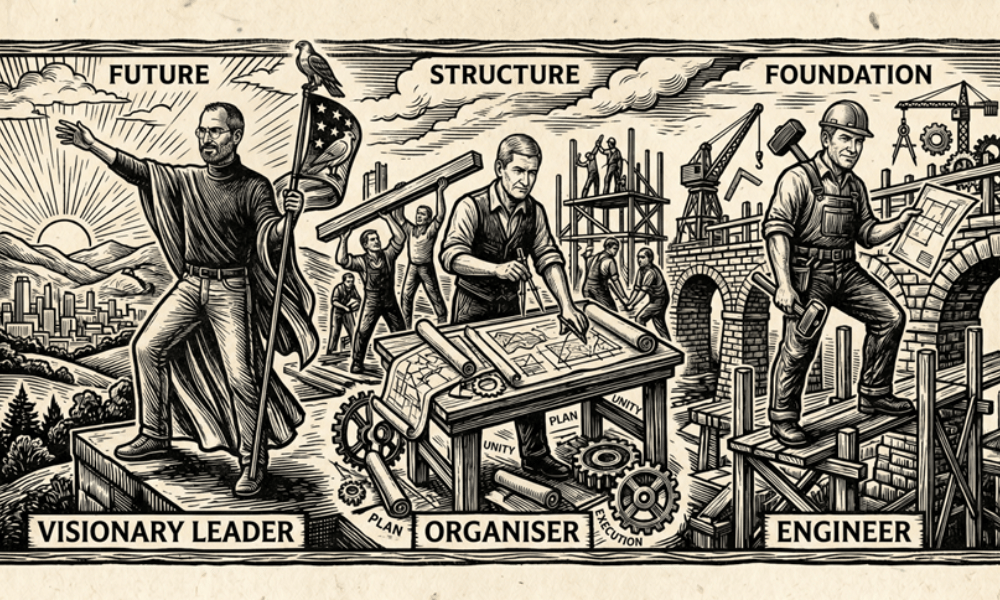
From visionary leader, to methodical leader to a technical insider
On April 20, 2026, Apple confirmed what industry insiders had anticipated for months: Tim Cook, the operations virtuoso who grew Apple into a four-trillion-dollar company over 15 years, will step aside on September 1. His successor is John Ternus — a 51-year-old mechanical engineer who has spent nearly his entire career on Apple's hardware floors, shaping every iPhone, Mac, iPad, and AirPod that has left Cupertino. For HR and people leaders watching the world's most valuable company, the transition is more than a routine CEO handoff. It is a case study in what happens when an engineer takes the helm — and what that means for culture, talent, and management philosophy.
A different kind of CEO lineage
To understand Ternus, it helps to understand who came before him. Steve Jobs was a creative autocrat whose aesthetic obsessions and mercurial management style produced extraordinary products and extraordinary churn in equal measure. Tim Cook, who succeeded Jobs in 2011, brought an operations and supply chain mindset — methodical, process-driven, and internationally minded. He built the systems that allowed Apple to scale without imploding, and he embedded values around privacy, inclusion, and dignity into the company's identity.
Ternus represents a third archetype: the technical insider. He graduated from the University of Pennsylvania with a degree in mechanical engineering, joined Apple's product design team in 2001, and has never left. He became vice president of hardware engineering in 2013, and was elevated to senior vice president — Apple's executive team — in 2021, becoming the youngest member of that team at the time. By the time Cook announced the transition, Ternus already oversaw the development of products responsible for approximately 80 percent of Apple's revenue.
Tim Cook's own characterisation of his successor captures the distinction well: "He has the mind of an engineer, the soul of an innovator, and the heart to lead with integrity and honour." Each of those elements implies a different relationship with people, process, and organisational culture — and each carries specific implications for HR leaders.
What engineers look for in teams
Leaders who rise through technical ranks carry a distinct mental model of how organisations should function. Where a finance or operations executive might default to metrics dashboards and process compliance, an engineer's instinct is to ask: what is broken, and how do we design a better system? This is not merely a stylistic difference — it shapes hiring philosophy, performance evaluation, and how failure is handled.
Current and former Apple employees who spoke to Bloomberg described Ternus as someone who reversed a trend of declining product quality by approaching problems systemically rather than punitively. He reportedly frames failures as evidence of flawed leadership structures rather than individual incompetence — a significant departure from what insiders described as a sometimes cutthroat culture in Apple's hardware division under earlier management.
For HR practitioners, this is a meaningful signal. A CEO who treats failure as a systemic problem tends to invest in psychological safety, process redesign, and leadership development rather than defaulting to quick personnel changes — a cultural posture that research consistently links to higher team performance, particularly in complex, interdependent environments like product engineering.
John Ternus — At a Glance
| Age | 51 |
| Education | B.S. Mechanical Engineering, University of Pennsylvania (1997) |
| Joined Apple | 2001, product design team |
| VP, Hardware Eng. | 2013 |
| SVP, Hardware Eng. | 2021 — youngest member of Apple's executive team |
| CEO effective | September 1, 2026 |
| Revenue scope | Oversaw products responsible for ~80% of Apple's revenue |
| Prior role | Mechanical engineer, Virtual Research Systems |
The proximity principle
One of the more telling details to emerge from profiles of Ternus is that he chose to work alongside his engineering teams in open office environments rather than retreat to the isolated executive spaces that senior Apple leaders typically occupy. Bloomberg described him as "charismatic and well-liked" — rare praise in an organisation not known for celebrating its management layer.
This proximity matters beyond optics. Leaders who physically and socially situate themselves within their teams tend to develop more accurate models of the real work being done, surface problems earlier, and earn the trust that makes difficult conversations easier. Tony Blevins, Apple's procurement chief until 2022, described Ternus as "a very meticulous engineer and a judicious executive" — a combination that suggests someone who holds high standards without using those standards as a weapon against the people around them.
For HR teams, a CEO who models this behaviour creates both an opportunity and an expectation. Middle managers and senior directors will feel implicit pressure to adopt a similar posture, and HR programmes that reward proximity, coaching, and genuine team integration over hierarchical detachment will find themselves in alignment with the cultural direction being set from the top.
The tension with design-led culture
Not every signal from the Ternus era is unambiguously positive for culture. His relationship with Apple's storied industrial design function has reportedly been strained at times. His engineering-first, cost-conscious approach has historically conflicted with the design team's ethos, which under Jony Ive operated with near-total autonomy and an occasional disregard for manufacturing feasibility and cost.
When Ternus was given oversight of the design teams in late 2025, he was granted the title of "executive sponsor" rather than chief design officer — a subtle but significant signal that design was being brought closer to engineering rather than elevated above it. The practical result has been a product lineup focused on functional improvements around battery life, performance, and connectivity rather than the radical aesthetic reinventions that characterised the Ive era.
For HR leaders, cross-functional tension of this kind is a standing challenge. When a new CEO's professional background gives them authority and credibility in one domain, adjacent domains can feel marginalised. Design teams, marketing functions, and commercial teams that thrived under Cook's broader mandate will need careful attention during this transition — both in terms of how they are represented in leadership conversations and how their contributions are recognised and measured.
Three Apple CEO Archetypes
| CEO | Tenure | Background | Management archetype | Cultural legacy |
|---|---|---|---|---|
| Steve Jobs | 1997–2011 | Product visionary / founder | Creative autocrat — high standards enforced through personal authority | Design supremacy; high churn; culture of secrecy and perfectionism |
| Tim Cook | 2011–2026 | Operations / supply chain | Process architect — scaled systems, global partnerships, values-led | Inclusion, privacy, operational discipline; company grew 20x in market cap |
| John Ternus | 2026– | Mechanical / hardware engineering | Technical insider — systemic thinker, team-proximate, quality-first | Early signals: psychological safety, blame-free failure culture, engineering credibility |
A different relationship with AI talent
Apple has been candid about its struggles in artificial intelligence, and a number of senior AI and software leaders departed in the months leading up to this announcement. Ternus inherits a company under genuine competitive pressure — from Google's Gemini ecosystem, from Microsoft's Copilot integration, and from a market expectation that Apple's flagship devices should do dramatically more with AI than they currently do.
His engineering background is both an asset and a risk in this context. On the asset side, Ternus understands at a deep level how AI capabilities must be integrated into physical hardware — the thermal constraints, the on-device processing demands, the memory architecture. On the risk side, pure software and machine learning talent has historically operated with different expectations around autonomy, working structure, and management style than hardware engineers. HR leaders will be watching closely to see whether Ternus can build the cultural bridges needed to attract and retain the AI talent Apple urgently needs, while maintaining the product discipline that has defined his leadership to date.
What this means for HR leaders beyond Apple
The Ternus succession carries lessons that extend well beyond Cupertino. As technology becomes central to virtually every industry, organisations are increasingly promoting technical specialists into senior leadership roles. The engineers, data scientists, and product managers who drive competitive advantage are being asked to manage people, set culture, and lead through ambiguity — tasks for which technical training provides limited preparation.
HR functions have a critical role to play in bridging this gap. Identifying which technical leaders have the interpersonal intelligence, the systems-level thinking about human organisations, and the genuine curiosity about people that Ternus appears to possess — and then investing in developing those capabilities systematically — is one of the most consequential talent interventions available.
Cook pointed to this in his endorsement, describing his successor as someone who leads "with integrity and honour" — language that points not to operational excellence but to character. In a talent market where culture is increasingly a decisive factor in attraction and retention, that is a choice worth studying closely.
What HR Leaders Should Watch
- → Invest in technical leadership pipelines Ternus's rise signals that deep domain expertise is a viable — and valued — path to the top. Succession planning should account for technical talent, not just generalist managers.
- → Reinforce systemic failure culture A CEO who frames failure as a leadership or process problem creates conditions for psychological safety. HR programmes should reflect and reward this posture at every level.
- → Watch for cross-functional marginalisation When a technical leader takes over, design, marketing, and commercial teams can feel subordinated. Active inclusion in strategy discussions and leadership visibility for these functions matters.
- → Proximity as a management norm Ternus's open-office approach signals that accessibility and team integration are valued over hierarchical distance. Consider how internal culture programmes reinforce or undermine this.
- → Bridge the technical/AI talent gap Engineering-first leaders may need HR support to attract and retain software and AI talent, whose cultural expectations often differ significantly from hardware engineering norms.
- → Develop technical leaders' people skills early The broader lesson from this transition: organisations need to identify technical high-potentials and invest in their leadership development long before they reach the senior team.