Canada 'struggling to gain traction,' says BMO economist

HR professionals managing staff on both sides of the border should prepare for two distinct hiring and wage environments through the rest of 2026, as a new BMO Economics outlook shows a resilient U.S. labour market pulling ahead while Canadian job growth narrows sharply to a single sector.
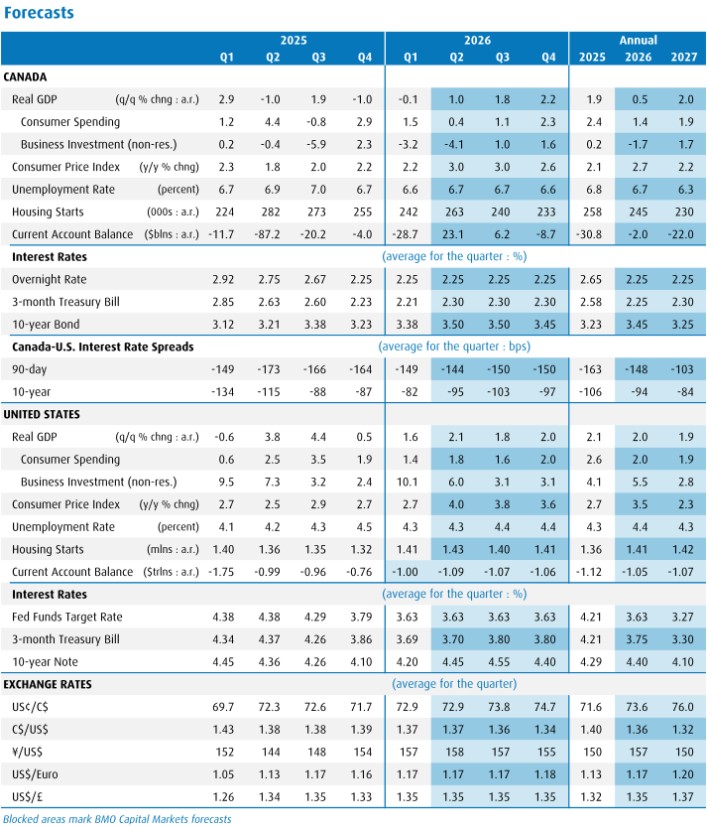
In the report, titled "U.S. Resilience Versus Canadian Fragility", BMO senior economist and director Sal Guatieri writes that the U.S. economy “appears set for another year of solid growth,” while Canada “is struggling to gain traction."
He attributes much of the gap to a bigger push from AI-led investment and a smaller drag from trade uncertainty in the United States.
South of the border, the report describes a U.S. labour market that has regained momentum, with Guatieri writing:
"The expansion has helped the labour market regain its footing. Monthly gains in nonfarm payrolls have averaged 114,000 in the first five months of the year, compared with average losses of 22,000 in the previous five months, and hiring has broadened beyond the health care sector (which continues to punch above its weight due to an aging population).
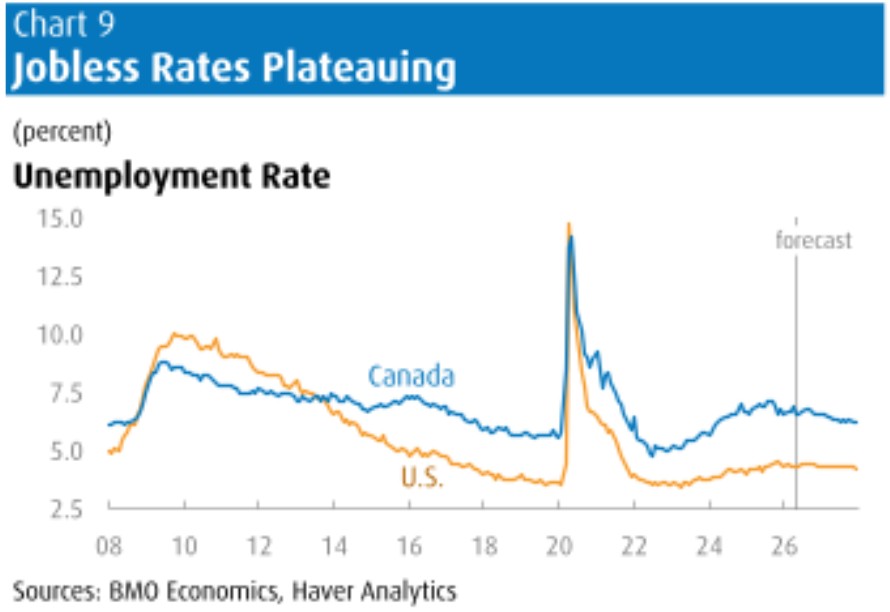
“Meanwhile, layoffs remain subdued, apart from ongoing restructuring in the technology sector that is partly due to AI, according to Challenger. Renewed hiring has stabilized the unemployment rate at 4.3% in the past three months, unchanged from a year ago."
Canada's labour market rebounded sharply in May, adding 88,000 jobs and pushing the unemployment rate down to 6.6%, according to Statistics Canada's latest Labour Force Survey.
“The employment situation showed a nice rebound in May, reversing a weak start to the year. Not only did full-time employment and hours worked jump, but gains were encouragingly broad-based across industries,” Indeed Canada senior economist Brendon Bernard said, according to an emailed statement to HRD.
“Today’s strong numbers are a good reminder of how a brewing trend in the Labour Force Survey can reverse with just one data release. The slide in full-time job growth that started in February has reversed, and the 0.3-point drop in the unemployment rate to 6.6% almost brings it back to where it started the year. This isn’t particularly good news -- the challenges facing Canadian job seekers persist. But the weak momentum that began the year was probably overstated, in part because the fourth quarter of 2025 was surprisingly strong. We’re now back to baseline.”
Canadian gains concentrated in health care
Canada's recovery is fragile and uneven. Real GDP has contracted in three of the past four quarters, and BMO Economics notes that back-to-back declines meet the popular definition of a "technical recession," though the bank stops short of declaring one, citing the C.D. Howe Institute's Business Cycle Council finding that it is "too early to call a recession."
May employment rebounded by 87,800, cutting the unemployment rate to 6.6 per cent from a September peak of 7.1 per cent. The report cautions, however, that the gain "did not fully erase the losses of the prior four months (-112,300)."
For HR teams gauging where talent is actually moving, the concentration is stark. Employment is up 147,000 over the past year, but, as Guatieri writes, "four-fifths of the increase is in health care," leaving hiring momentum thin across other sectors.
Wage costs, rates and trade risk
Wage-cost pressure remains contained for now. Guatieri notes that strong U.S. productivity growth of 2.8 per cent year-over-year in the first quarter has held unit labour costs to just 0.5 per cent, "implying limited cost pressure in labour markets" — a useful signal for compensation planners setting 2026 budgets.
That restraint may be tested, however. BMO Economics reports that annual U.S. CPI inflation jumped to 3.8 per cent in April and would likely exceed 4 per cent in May, which can intensify wage-adjustment requests even where employers' own labour costs look tame.
On monetary policy, BMO Economics expects steady rates from the Bank of Canada, even as Governor Tiff Macklem has warned of potential "consecutive" rate hikes should rising fuel costs spread into broader inflation. Borrowing costs that shape employer investment and hiring therefore remain in flux.
The report flags uncertain U.S. trade policy as "the biggest threat to Canada's economy," noting that Canada could face a new 10 per cent levy, though duty-free treatment for USMCA-compliant goods would soften the blow. A U.S. exit from the trade pact, BMO Economics warns, "would likely lead to a Canadian recession" — an outcome that would reshape staffing needs across trade-exposed manufacturing and construction.
Canada’s economy is poised to slow in 2026 as global instability and rising costs ripple through labour markets, creating new pressures for employers managing wages, hiring and retention. That's according to the latest Economic Outlook from the Organisation for Economic Co-operation and Development (OECD).