One trade is proving the hardest to hire for as AI data center construction grows. HR leaders are turning to schools, apprenticeships and staffing firms

Pay more, poach more, and the electrician shortage is still there.
Contractors cannot pay their way out of the electrician shortage that AI data center construction has deepened, because higher wages only move the same workers between employers. That’s the warning from Macrina Wilkins, director of market insights at the Associated General Contractors of America (AGC) in Arlington, Virginia.
“You can poach and offer competitive wages, but if you literally do not have the number of skilled individuals needed to get a project done, you are just going to have to wait,” Wilkins said.
AGC’s 2026 workforce survey, run with training organization NCCER, measured how hard data centers have pushed on hiring. Among the 28% of respondents that worked on a data center project in the past year, 58% said those projects increased competition for skilled workers, 49% reported more wage pressure and 37% named worker or subcontractor availability as their biggest challenge, AGC reported. The survey drew 1,830 respondents in July and August 2026.
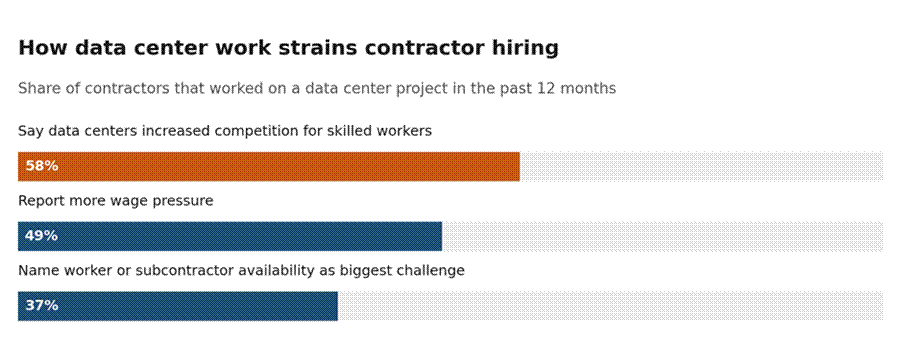 Source: AGC and NCCER 2026 Workforce Survey (July–August 2026, 1,830 respondents)
Why higher pay can't fill the gap
Contractors are already paying more without closing their openings. Eighty-seven percent of firms reported openings for hourly craft positions, and 88% of those said the jobs are as hard or harder to fill than a year ago, AGC reported. Half of respondents said available candidates lack the skills, certificates or licenses they need, even though more than eight in 10 firms raised base pay at least as much as the year before. Pay for trades is drawing wider attention, as HRD reported on jobs that may see big pay bumps.
Wilkins said hiring data shows the same limit. Job postings for certain trades stay open month after month, hiring fluctuates, and layoffs sit at historic lows because contractors hold on to the workers they have. “It’s not something that can simply be fixed by adding more money or poaching from other areas,” she said.
Retirements will widen the shortfall as baby boomers leave the construction trades, she added, which makes retaining current electricians a priority alongside recruiting new ones. For a related look at experienced workers, see HRD’s report on Ford’s gray-beard rehire as a warning for AI-first workforces.
Electricians top the hardest-to-hire list
Among all construction occupations, contractors find electricians hardest to hire, followed by HVAC technicians, pipefitters and welders, Wilkins said. Data center work concentrates that demand. “Those types of projects require such a high number of electricians and individuals that are more technically advanced,” she said, citing the wiring and systems integration the buildings require. Electrical apprenticeships take several years to complete, so contractors cannot train enough electricians within a single project schedule.
Forty-two percent of survey respondents said shortages of their own or subcontractors’ workers delayed projects, the most commonly cited cause of delay, AGC reported. That ties workforce planning directly to project revenue.
Immigration actions are thinning crews
Immigration enforcement is cutting into crews, contractors told AGC. Twenty-nine percent of respondents reported at least one direct or indirect impact in the six months before the survey, AGC said: 12% said workers left or failed to appear because of actual or rumored immigration actions, and 16% said subcontractors lost workers. Firms in the South reported impacts most often, at 42%.
Wilkins estimated that foreign-born workers hold about a third of construction trade jobs. The disruption, she said, ranges from site visits to what she called “a culture of fear or stop and start.”
Where the trained workers will come from
Wilkins urged contractors to recruit through outside staffing firms and build direct relationships with universities, high schools and career and technical education programs. She pointed to Paducah, Kentucky, where local companies, career and technical programs and high schools coordinate so students finish with a high school diploma or GED plus trade training. “Administrators would be excited to hear from a potential employer for their kids,” Wilkins said.
She also recommended financial support for trainees who cannot afford tuition or tools. Forty-eight percent of firms increased engagement with high school, college or career and technical programs last year, and 36% raised training spending, AGC reported. AGC’s data center results by firm type and region show how firms are responding.
Technology companies are starting to fund the same channels, Wilkins said. She cited a Microsoft program that trains electricians as part of the company’s bids for community support of its data center projects, and she expects developers that invest in local training to win project approvals faster.
AI will not close the gap on job sites, she added. Contractors use AI mostly in office tasks such as estimating, while the shortage sits in field labor. For a wider view of how AI is reshaping state job markets, see HRD’s analysis of California as a preview of AI’s effect on state job markets.
The lever remains the number of trained electricians employers help produce, not the wage they offer to lure one from a competitor.