Sentiment analysis can spot a falling team mood but not its cause. Gartner, NYU and Conference Board experts explain when to ask directly

Artificial intelligence (AI) can read the mood in a company’s Slack channels but it cannot say why the mood just soured.
Sentiment analysis of Slack and email can flag a drop in a team’s tone, but it cannot say whether workload, a manager or a reorganization caused it. That gap is why employee listening still needs direct questions, according to Keyia Burton, senior principal analyst at research firm Gartner. She advises pairing passive listening with direct questions employers commit to act on. “It’s one of those things that it’s a both, it’s not an either/or,” Burton said. “Because some of the benefits you get out of it is the asking in and of itself.”
Follow-through is where employers lose. Only 48% of individual contributors have seen positive changes from their feedback, four points lower than in 2025, according to Qualtrics’ 2026 Employee Experience Trends research as cited by employee-experience firm Oak. Perceptyx’s 2026 State of Employee Listening research shows where it falls away: 71% of employees say their organization shares survey results, 59% say it creates action plans and 51% say improvements resulted.
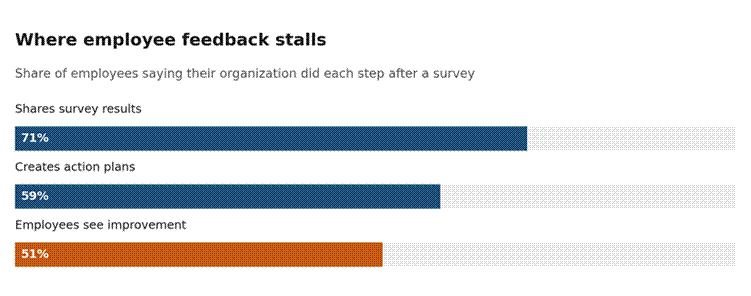
Source: Perceptyx, 2026 State of Employee Listening
What passive data can tell HR
Anna Tavis, chair of the human capital management department at New York University’s School of Professional Studies in New York, says ambient data from collaboration tools will replace much of what surveys do now. Most companies still run surveys, she said, but have started adding “ambient data collection” from communication systems. “Survey collection, which is like one-time snapshot, and all you’re doing is asking people’s opinions, and there’s so much noise in the system, it’s very inaccurate,” she said.
Integrated data also lets employers test an assumption baked into engagement surveys. “Even though people may be engaged, they’re not necessarily productive,” Tavis said. She expects managers to walk into check-ins “with almost like a data dashboard of all of the team,” a shift that fits the wider move toward frequent feedback in performance management. Tavis added that employers, not vendors, carry the risk of those tools. “If something is not going right, the responsibility rests with the company, not with the vendor,” she said. “You can’t blame the vendor.”
The legal risk is real in some states. New York’s electronic monitoring notice law, in force since May 7, 2022, requires employers that monitor email or internet use to give employees prior written notice, and Connecticut and Delaware have similar laws. Whether a Slack analytics tool triggers those rules depends on what it collects.
What only asking can tell HR
Robin Erickson, head of human capital research at The Conference Board in New York, says passive data stops at the pattern. “Employee surveys matter because they ask people to interpret their experience,” she said. “Slack and other networks can identify patterns, but it can’t really tell an organization why those patterns exist.”
Her example is turnover rising from 8% to 10%. Nobody can say whether one poor manager caused the rise until a survey asks employees whether they plan to stay two more years, and why. AI now groups open-ended answers into themes that teams once tallied by hand. “AI does that automatically,” Erickson said.
Surveys also expose perception gaps no activity log records. In The Conference Board’s Reimagined Workplace study [add year, link and share of workers], few workers believed their employer weighed AI-related skills in promotions, and their answers diverged from those of HR leaders, Erickson said. “If the leaders are using AI-related skills for promotion decisions or performance reviews and employees don’t know that, it will definitely create a sense of discontent,” she said. Tying AI-based measures to ratings also invites gaming, as Amazon workers gaming the AI leaderboard that HR built showed. Erickson’s first rule for any survey: “Don’t ask any questions in any surveys about things you’re not willing to change.”
A 2x2 for deciding what to fix
Burton tells clients to use indirect listening wherever possible and to “ask employees very directly when it’s an issue that justifies interruption.” The bar is high. Gartner research found more than 60% of employees say organizational change has them working harder than usual, she said [name Gartner report and date]. Direct questions earn their place when the issue is critical to business strategy, depends on context, will inform a major decision and is realistic to act on.
To sort what employees raise, Burton plots each issue on a 2x2 grid. The horizontal axis is impact on both the business and the employee experience. The vertical axis is the complexity of the fix. Issues on the left half get acknowledged and deferred. The lower right holds visible quick wins with high impact and low effort. The upper right holds bigger bets that need longer strategic planning.
“It’s not about creating a laundry list,” Burton said. Each employer defines impact by what its CEO and board prioritize and by its current talent strategy, and the positions on the grid shift every year.
Ownership sits with the process owner, Burton said, while HR brings the employee evidence and holds leaders accountable for follow-through. When a process crosses functions, she recommends naming one accountable leader. She also warned that the same passive-listening program can build or erode trust depending on how clearly an employer tells staff what it collects and why. Global employers also face rules such as the EU AI Act that differ by region [add official EU source link].
The experts split on how far passive data should go. Tavis expects ambient data to replace much of the survey. Burton and Erickson hold that asking cannot be dropped, and both tie it to follow-through: ask only about what employers are willing to change. “Just gathering more data in and of itself is not enough,” Burton said.