Leadership consultant says poor manager hires cost multiples of recruiting, and stress, thin benches and bigger spans drive the exits

The recruiter’s invoice is the small print when a frontline manager quits.
Manager turnover costs far more than the hire, and the larger bill often goes unquantified, according to Kevin Tamanini, vice president of professional services and customer success at Pittsburgh-based leadership consultancy Development Dimensions International (DDI). The pressure on that seat keeps building: 71% of leaders report a significant rise in stress since stepping into their current role, and 40% of those stressed leaders have considered leaving leadership roles, according to DDI’s Global Leadership Forecast 2025, a survey of 10,796 leaders and 2,185 HR professionals.
“Oftentimes the recruiting costs are what are front and center because they’re there, they’re going to go out and hire a recruiter,” Tamanini said. “What doesn’t always get quantified in the best way is the team that’s hiring, both the hiring manager as well as others that may be involved in the process.”
DDI’s research points to a bigger number. “It’s the succession side of it, and the cost of a poor hire is often multiples higher than the cost of the recruiting process in and of itself,” he said.
HRD first covered DDI’s findings on rising stress among leaders when the forecast launched in January 2025. The same report shows the bench behind today’s managers thinning: the share of high-potential individual contributors who intend to leave climbed from 13% in 2020 to 21% in 2024.
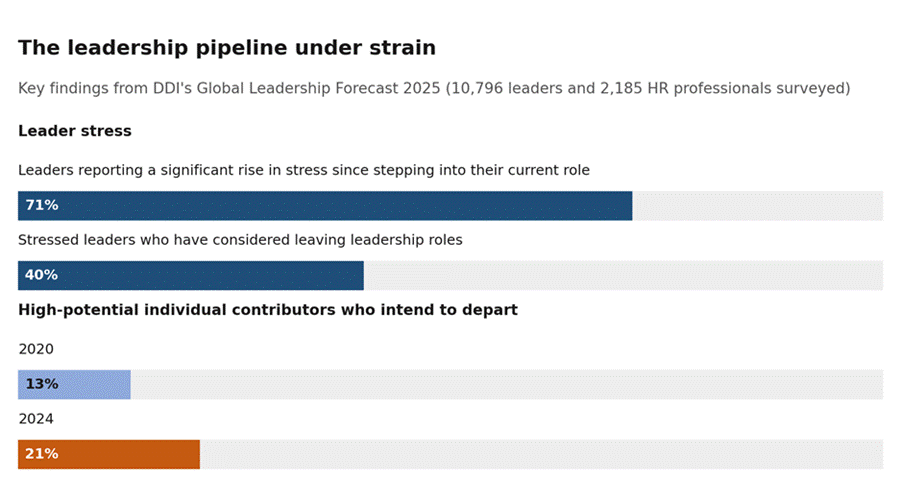
Source: DDI, Global Leadership Forecast 2025 (released Jan. 22, 2025)
Why manager turnover costs more than the hire
Even a strong replacement drains performance, Tamanini said. “If you have someone that then steps into the role that’s highly capable, that’s great, but there’s onboarding time, there’s going to be loss of productivity, there’s going to be impact to the team, there’s going to be acclimation,” he said.
He ranks combined onboarding and organizational performance losses as the single largest cost. Putting a number on it is hard. “Giving a hard number is really difficult because that kind of varies by organization,” he said.
Promotion habits stack the odds against new managers. Many organizations still promote their highest performers instead of their best potential leaders, Tamanini said. Stress climbs further when the job turns out to be bigger than the new manager expected, he said.
The skills gap the next forecast will flag
Tamanini previewed research he said DDI will include in its forthcoming 2027 Global Leadership Forecast: the biggest gaps for people stepping into leadership remain core interpersonal skills, including communication, empathy, building trust and managing conflict. “As an individual contributor, where you’re engaging people, it’s about you doing,” he said. “Now it’s about you using really strong interpersonal skills to guide and lead others and how they need to be effective in their job.”
Organizations often name setting strategy, driving change and leading innovation as their top priorities, he said. “Those are all well and good for the organization, but a frontline leader, especially one that’s new, those are big asks,” Tamanini said. Set that beside the Airbnb CEO’s claim that pure people managers have no future, which HRD reported earlier.
He urges employers to start role design from business need and fit the person to the role. “If you design a role around an individual, then what you’re doing is you’re creating potential points of failure within the organization,” he said. Job descriptions lag, too. “If you look at a current job description for some of these roles, they most likely don’t even include AI or AI use,” he said.
What to measure beyond logins
Most organizations still measure artificial intelligence (AI) adoption by time spent in a platform, Tamanini said. That rewards activity, and Amazon workers gaming an internal AI leaderboard showed the result. “If you just want to use logins, then just get a dashboard. You don’t need anything else,” he said. “But how do you tie that then to time to proficiency within the team?”
He points to outcome data instead: time to proficiency, faster deliverables, shorter service-level agreements (SLAs), customer sentiment and fewer internal handoffs. He does not endorse specific vendors. He tells managers to match tools to pain points, such as project management or customer engagement software, workflow automation such as Microsoft Power Automate, or a Copilot agent linked to team data sources.
Those tools matter most when restructuring widens a manager’s span of control without adding resources, including time. “You might not have time to meet with 15 direct reports every week, but do you have time to meet with 15 direct reports every other week?” Tamanini said. Managers handed more scope without a new way of working face a predictable result. “Ultimately what it’s going to do is lead to burnout unless people figure out a different way of operating,” he said.
Why people leave leaders
“One of the things that we know through research that has not changed over time is that people don’t tend to leave organizations, they tend to leave leaders,” Tamanini said. A poor promotion multiplies the replacement bill. “If you get a bad leader, you might lose that leader, but you’re also going to potentially lose a whole bunch of team members because they want to get away from that individual,” he said.
The push for speed makes it worse, he added: organizations cut the development time new leaders need when they judge it as not driving the business. “We got to make sure that we’re equipping people to be successful versus picking up the pieces when they’re not, after the fact,” Tamanini said.