Employers warned about workforce gaps if hiring continues to slow down

Businesses in the United Kingdom are slowing down on hiring in the wake of artificial intelligence adoption, according to a new report.
A new analysis from McKinsey and Company found a cooling labour market between the three months ending in May 2022 and May 2025, where vacancies fell from 1.3 million to 0.7 million, equivalent to a 43% drop.
It also found that the number of businesses expecting to increase employment has decreased from +2.4% in July 2022 to just +0.2% in July 2025.
The report attributed the hiring slowdown to economic uncertainty stemming from geopolitical tensions, higher interest rates, cautious households, tighter public finances, and rising employee costs.
"However, there are also signs that the advent of AI and LLMs (Large Language Models) is dampening hiring intentions," the analysis said.
"A mix of observed task-level time savings, and the anticipation of significant – albeit uncertain – future productivity gains, especially as the technology and its applications mature, is prompting companies to review their workforce strategies and pause aspects of their recruitment."
Drop in job volumes
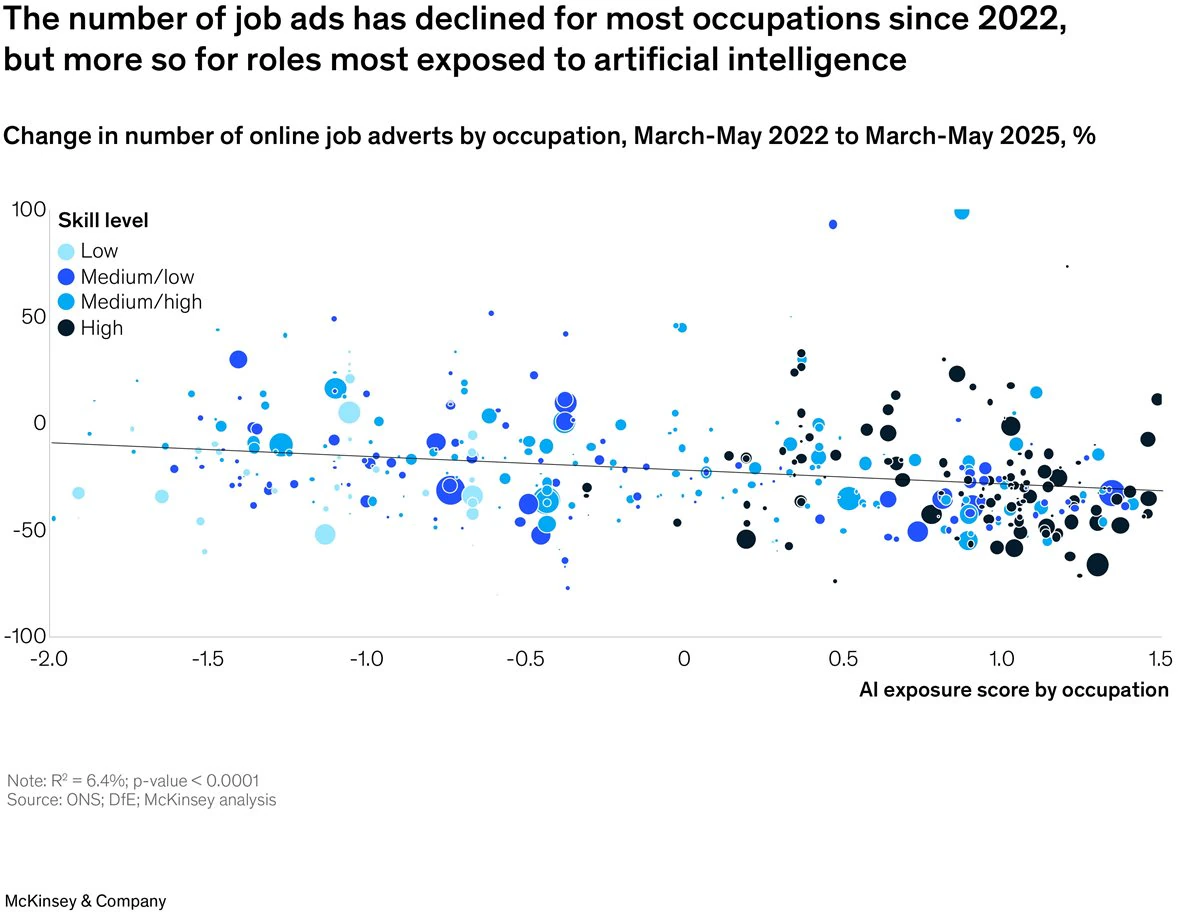
According to the analysis, the volume of online job ads for roles with high exposure to AI and LLMs dropped by 31% since the three months ending in May 2022.
On the other hand, the number of online job ads for roles with low AI exposure has decreased by just 21%.
"Some of the biggest declines were in jobs that have been predicted to have the highest impacts from generative AI," it said. "These include software developers and other IT workers, as well as professionals in data, design, media, research, legal, HR, finance, and business."
AI's impact so far
The AI-influenced slowdown in hiring comes as the report noted that broad-based productivity improvements "remain elusive."
According to the report, among the 92% of global businesses ramping up generative AI investment, only one per cent believe their efforts have reached maturity.
Only around 20% have also reported a tangible impact on enterprise-level earnings.
"This paradox – widespread usage but unrealized gains – reflects a gap between surface-level adoption and deep transformation," the analysis read.
Warning for employers
In the wake of slowing hiring, the analysis warned that organisations risk leaving gaps in their future workforce if entry-level hiring continues to slow.
"Pausing recruitment may seem prudent but risks becoming a missed opportunity to attract the next generation of talent, build capabilities, and strengthen resilience," it read.
"And once that pipeline breaks, it's hard to rebuild."
It urged employers to take a "twin-track approach," which involves focusing first on the deliberate integration of AI into workflows.
"This might mean investing in change management, rethinking job design, reskilling and training, and building the internal capability to continuously adapt," it said.
The second is to keep investing in people, especially early-career talent.
"AI may be causing growing pains now, but its long-term success depends on how people and technology evolve together," it said.