New report finds female-presenting AI agents would get paid less than male-presenting agents
The gender pay gap is no longer just a human problem, as a new study suggests that it also extends to AI agents deployed in the workplace.
Researchers from the University of Limerick in Ireland found that human employees would pay a female-presenting AI agent less than its male-presenting counterpart, despite both agents doing the same work.
The findings reflect real-world analysis of the gender pay gap in workplaces, where women are still earning around 18% less than men globally on average.
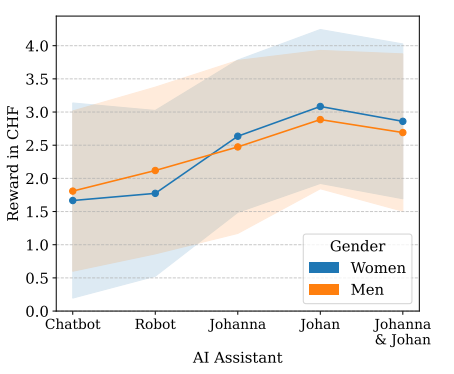
In the study, 189 human participants were asked to collaborate with AI assistants and give them monetary rewards. The assistants shared the same underlying language model but differed in representation, including a 2D text-based chatbot, a desk robot, and two human-like assistants named Johan (male-presenting) and Johanna (female-presenting).
"What is striking about our findings is that the technology behind these AI agents was exactly the same, but people did not treat them in the same way," said Dr Mary Hausfeld, a co-author of the report, in a media release.
Both Johanna and Johan received significantly higher rewards compared with the desk robot, according to the findings.
But between the two human-like assistants, the report found that Johanna was paid 10.25% less than Johan despite completing the same work, and with no significant differences in trust and credit.
"Despite no significant differences in trust and credit, there were significant differences in perceptions of human-likeness and in the monetary reward," the report read.
"Johanna was perceived as less human-like than Johan. Additionally, Johanna was paid significantly less than Johan, with both women and men participants rewarding her less than Johan."
Gender biases in workplaces
Hausfeld said the findings raise important questions as AI agents increasingly become a part of people's working lives.
Data from the HP Work Relationship Index 2026 shows that AI agents are entering the mainstream, with 47% of all workers now using them as part of their work.
"We often think of AI as being neutral, but the way we design and present these systems can activate those same assumptions and biases that exist in our interactions with other people," Hausfeld said.
"As AI agents become more common in the workplace, we need to think carefully about the characteristics we give them and the behaviours those choices may encourage. We don't want to inadvertently reproduce existing inequalities in a new technological setting."
The disparity also came despite the participants saying they had no preference for an AI with female or male attributes.
"While participants articulated fairness-oriented principles and design preferences in interviews, their evaluations and allocation decisions in practice varied with human-likeness and gender cues," the report read.
It underscores the need for "careful attention" to the social consequences when designing AI co-workers.
"From a design perspective, this underscores that embodiment choices for AI coworkers are not merely aesthetic but can meaningfully influence trust, attribution, and economically consequential decisions," the study reported.
"Designing responsible AI coworkers will require not only technical capability but careful attention to the social consequences of how these systems are represented and experienced."