Banks, retailers and governments are calling workers back five days a week. Big tech is split, and the accounting giants are holding to hybrid.

American offices are busier than at any point since the pandemic began, though still far from full.
Last December, occupancy across 10 major metropolitan areas reached a weekly average of 56.3 percent, according to keycard data from Kastle Systems. That was the highest reading since early 2020. On Tuesdays and Wednesdays the buildings fill up. On Fridays, about half the desks sit empty.
But whatever corporate policy is, it’s moving faster than employees are. The Flex Index, which tracks office rules at more than 9,000 American companies, found that required office time rose 12 percent from early 2024 to late 2025. Actual attendance rose 1 to 3 percent.
Wall Street went first
Finance led the push back. Goldman Sachs began recalling employees in 2021. JPMorgan Chase, the nation’s largest bank, ended hybrid work in 2025 for nearly all of its more than 316,000 employees. Truist, the regional lender, required full-time attendance starting in January.
Not every bank has gone that far. BlackRock asks for four days a week, Wells Fargo and Charles Schwab for three, and Citigroup has kept a hybrid model, according to HRD’s tracker of company policies.
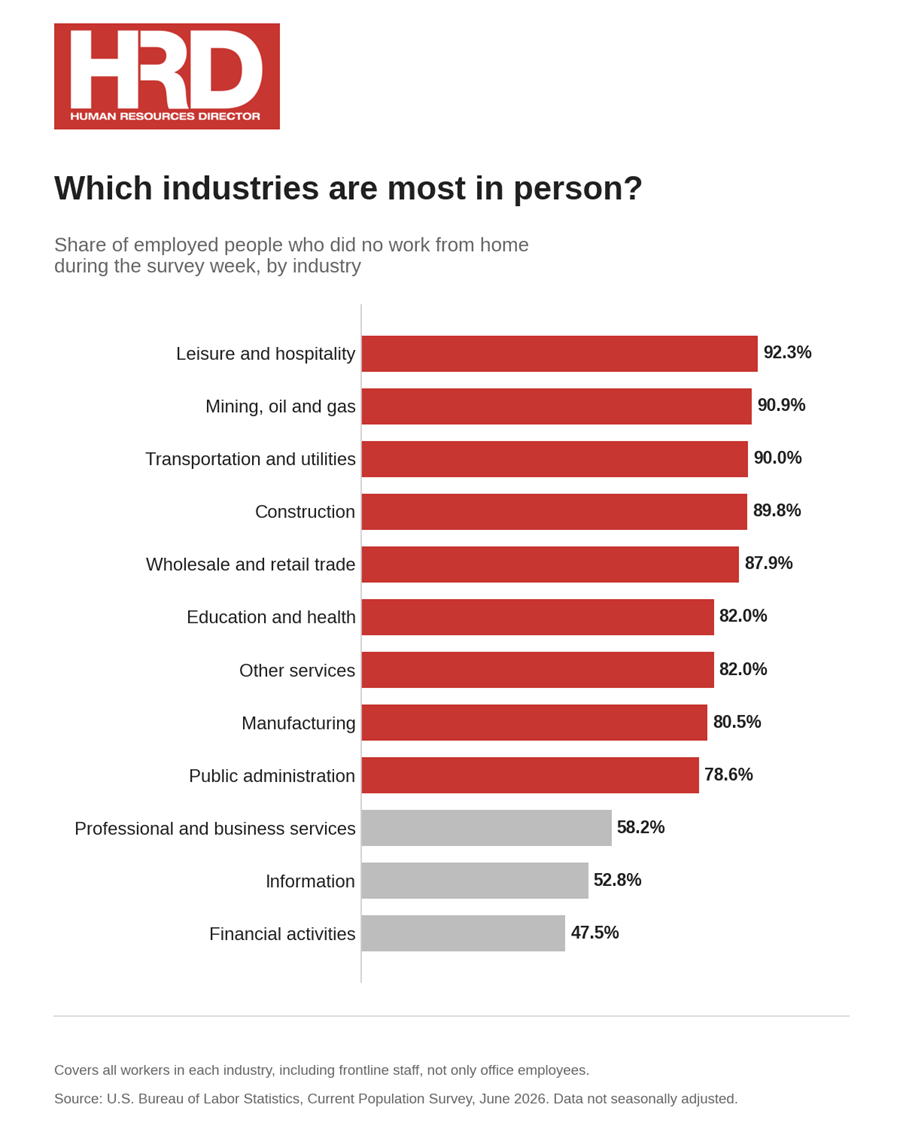
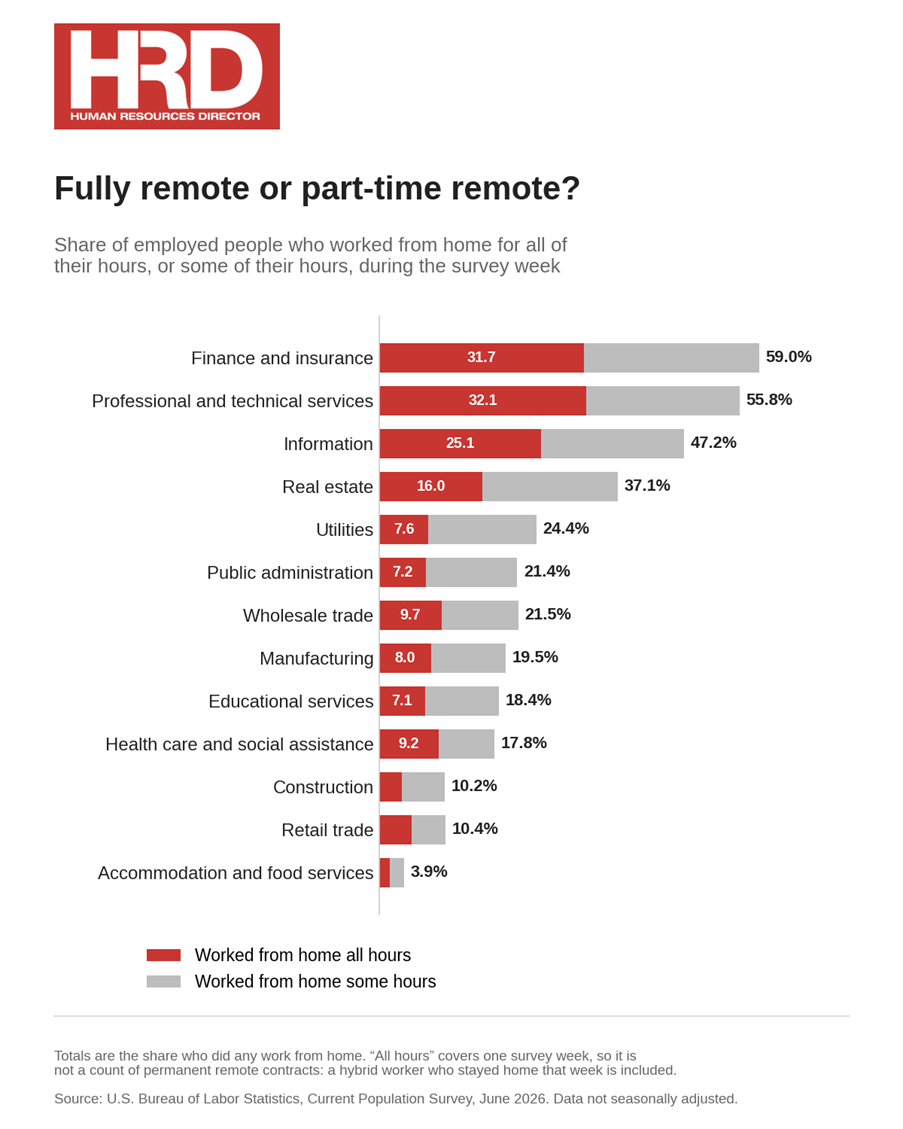
Federal labor data shows how far the finance industry still is from a full return. In June, 52.5 percent of people working in financial activities did some or all of their work from home during the survey week, the Bureau of Labor Statistics reported. That was the highest rate of any major industry. In finance and insurance specifically, the figure was 59 percent.
Big tech is divided
Amazon ordered about 350,000 corporate employees back five days a week in January 2025. Dell, Instagram and TikTok have since done the same. Google, Apple, Microsoft and most of Meta have settled on about three days.
Away from the giants, tech is still the most flexible industry in the country. When the Flex Index last examined the sector, in 2024, it found that only 3 percent of tech companies required full-time attendance. Most of those flexible firms are small.
Retail, manufacturing and media are tightening
Home Depot and the carmaker Stellantis moved corporate staff to five days early this year joining Amazon and Paramount. NBC Universal now requires four days, and The Washington Post has eliminated hybrid and remote roles.
The holdouts
The Big Four accounting firms (Deloitte, EY, KPMG and PwC) have kept hybrid schedules and use flexibility to recruit. Insurers have moved the same way. In 2024 the Flex Index ranked insurance second only to tech for flexibility, with 7 percent of insurers requiring full-time office work.
Read next: People love remote work. Their mental health may not
Governments have moved hardest
Federal agencies were ordered back full time in January 2025. In Canada, Ontario’s public service moved to five days on Jan. 5, and Alberta followed in February.
Size matters in every sector. According to the Flex Index, 29 percent of Fortune 100 companies require full-time attendance and 45 percent require four or five days. Most small companies let employees decide.
Read next: Is full-time WFH working out?
What the research shows
Much of the argument over office attendance rests on surveys asking people how productive they feel. The studies below measured what people actually did.
At the call centers of a Fortune 500 company, remote and on-site employees did identical work. Natalia Emanuel, an economist at the Federal Reserve Bank of New York, and Emma Harrington, an economist at the University of Virginia, found that remote workers answered 12 percent fewer calls per hour before the pandemic. Most of the gap reflected who chose remote jobs. When the centers closed and everyone worked from home, the gap attributable to location shrank to about 4 percent. Remote work also lowered call quality, especially among new hires, and reduced promotions. The study appeared in 2024 in American Economic Journal: Applied Economics.
A working paper presented at Princeton this year looked at whether a small amount of office time helps. Call center agents who otherwise worked from home were brought in for one structured day a month. Over nine months, attrition fell by about half and productivity climbed to 6 percent more calls per hour, with no loss in service quality. The paper has not been peer reviewed.
Nicholas Bloom, a Stanford economist, randomly assigned more than 1,600 employees at Trip.com, a Chinese travel company, to work from home two days a week. Quit rates fell by a third. Performance reviews and promotions were unchanged.
In another study, Dr. Emanuel, Dr. Harrington and Amanda Pallais, a Harvard economist, counted written code reviews among software engineers at a large company. Engineers gave teammates more feedback when they sat in the same building than when they worked across buildings or from home. The effect was strongest for feedback from senior to junior engineers, and for feedback given to and by women.
In a field experiment published in the journal Nature, Melanie Brucks of Columbia and Jonathan Levav of Stanford randomly paired 1,490 engineers at a telecommunications company. Pairs working by video came up with about 20 percent fewer ideas than pairs in the same room. When it came to choosing the best idea, the video pairs did just as well.
Mandates have their own price. Researchers at Baylor University studied 54 large technology and financial firms and found that return-to-office orders raised turnover by an average of 13 to 14 percent, HRD reported. Senior and highly skilled employees were the most likely to leave, and open jobs stayed vacant longer. A University of Pittsburgh study of S&P 500 companies found no significant change in financial performance or market value after mandates took effect.
So, is it time?
For some work, the evidence supports regular office time:
- New hires in training
- Early-career employees learning from senior colleagues
- Teams generating ideas
- Phone-based jobs where coaching makes a difference
None of the studies found that requiring experienced employees to come in five days a week raised their output. The Baylor data suggests that when employers try, the people who leave are often the ones hardest to replace.
That leaves human resources departments with a practical question. They can ask which work gains from being in the same room, then schedule office days around that work.
Read next: How to fight loneliness in the workplace