As healthcare costs continue to rise and care journeys become more fluid, employers have an opportunity to rethink the role of the health plan

For years employers have approached employee health plans with a familiar objective: mitigate costs while preserving choice and minimizing disruption. That playbook is becoming increasingly untenable.
Healthcare costs continue to climb. Employees are dealing with the rising cost of living and increasing personal debt levels. New technologies, care models and direct-to-consumer solutions are also changing how people engage with healthcare. Together, these forces are reshaping the role of the employer-sponsored health plan.
>19K – The average healthcare cost per employee in 2027
The New Realities Changing Employer Health Plans
Three market realities are driving the shift:
- Healthcare cost drivers are changing
- Employees are increasingly making trade-offs at the expense of their own health
- The employer health plan is no longer the sole center of influence in the care journey
Taken together, these realities point to an uncomfortable truth: maintaining the status quo may become one of the most disruptive choices an organization can make.
What’s Driving Increased Healthcare Costs?
Over the last few years, the price of services drove the majority of healthcare cost. Today however, a larger share of healthcare trend is driven not by price alone, but by utilization and treatment mix. Employees are accessing more services, using more complex treatments and interacting with the healthcare system in different ways than they did just a few years ago.
That shift has important implications. When the challenge is utilization and treatment decisions, health plans must also influence how care is accessed, where care is delivered and which treatment options are available.
Healthcare Affordability Is Already Disrupting Employees
Benefit leaders often evaluate change through the lens of potential employee noise and disruption. Will a narrower network create excessive noise? Will plan design changes create confusion? These questions, while reasonable, can obscure a more important one: What if employees are already experiencing significant disruption today under the status quo?
51% of Americans lack access to healthcare or have been unable to pay for quality healthcare
As costs rise, healthcare is often one of the first places individuals make financial trade-offs. Appointments are postponed. Prescriptions go unfilled. Recommended care is delayed. Over time, those decisions can create a cycle of worsening health outcomes and higher costs.
While employers can’t solve every financial challenge employees face, organizations can influence one of the most important financial decisions they make: how they access the healthcare being subsidized on their behalf.
Employees experience healthcare benefits as part of their broader relationship with their employer.
When healthcare becomes difficult to access, afford or navigate, it can diminish the perceived value of the broader employee experience. Employers must consider whether maintaining the status quo is already creating disruption for employees.
The Employee Health Plan Is No Longer the Center of the Care Journey
The healthcare journey is changing. Today, employees move between traditional benefits, virtual care platforms, direct-to-consumer services, specialized pharmacy solutions – and increasingly, AI-powered sources of health information and guidance.
1 in 3 individuals have used an AI chatbot for health information, according to Rock Health
The result is a more fluid healthcare journey. Employers no longer control every touchpoint in the care journey, nor should they expect to. But this evolution doesn’t diminish the importance of the health plan. If anything, it raises the stakes.
As employees gain more options, organizations must become increasingly deliberate about the parts of the journey they influence. The future role of the health plan is to guide employees toward better-value care when meaningful differences in cost, quality and outcomes exist.
A New Employer-Employee Social Contract
Changing realities require a new approach. The path forward builds on the investments employers have already made, while evolving the role both employers and employees play. It starts with a new social contract based on shared accountability.
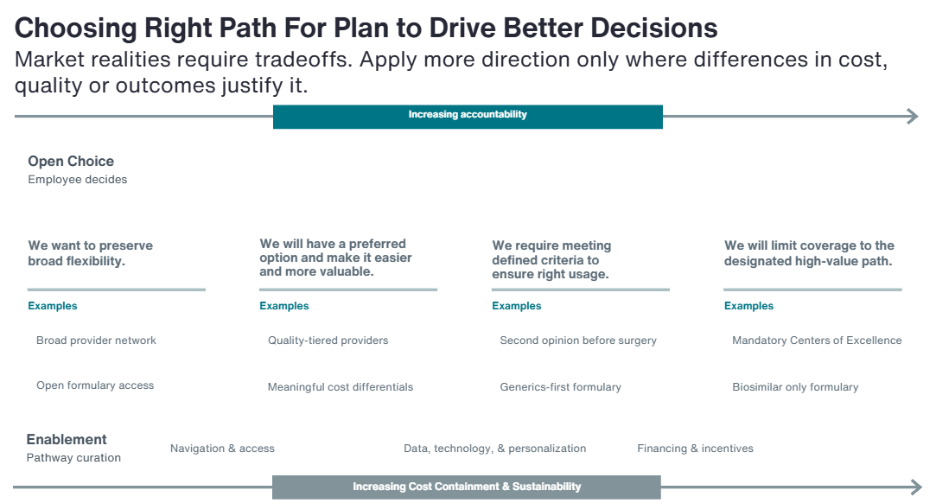
Employers must determine where broad choice continues to make sense and where meaningful differences in cost, quality, and outcomes require greater direction. In some areas, providing access may be enough. In others, employers may need to guide decisions, establish conditions, or require specific care pathways.
But increased accountability comes with an obligation. When organizations expect employees to make better healthcare decisions, they must make those decisions more straightforward. High-value pathways should be easier to access, easier to navigate, and more affordable to use.
In return, employees are expected to engage with those pathways and accept reasonable trade-offs when choosing alternatives. The goal is to align choice, incentives, support and plan design around better outcomes.
Guiding Employees Toward Higher-Value Care
The organizations making the boldest moves today are not attempting to manage every healthcare interaction. They’re focusing on the areas where better decisions can have the greatest impact, including provider networks, high-cost conditions and pharmacy choices.
In these areas, variations in cost, quality and outcomes can be significant. As a result, many employers are moving beyond simply offering access and instead becoming more intentional about guidng decisions.
Some are using incentives to encourage employees toward higher-performing providers. Others are implementing second-opinion programs for complex procedures. Increasingly, organizations are adopting mandatory Centers of Excellence, structured care pathways and more disciplined pharmacy strategies where evidence supports a clear advantage.
The Choice Ahead
Every organization will approach this challenge differently, based on workforce demographics, healthcare trends, culture and priorities. What is universal, however, is the need to rethink long-held assumptions about healthcare strategy.
The organizations that will be most successful in the years ahead are unlikely to be those that simply maintain the status quo. Successful employers will be willing to distinguish between choice and value, between access and outcomes, and between activity and impact. The future of employee healthcare will be defined by who creates the conditions for better decisions.
This article was created in partnership with Aon.