Legal and screening experts warn AI-enabled identity fraud is outpacing recruitment checks in Australian workplaces

Candidate fraud is proving increasingly difficult for HR teams to detect as artificial intelligence, remote hiring and digital onboarding create new opportunities for applicants to misrepresent who they are, according to legal and workforce screening specialists.
Poor hiring decisions – including those linked to fraudulent applications – are estimated to cost Australian small and medium businesses $7.3 billion a year, according to research from Seek. That figure covers the broader cost of a "wrong hire," but industry specialists say candidate fraud, ranging from doctored documents to AI-altered interviews, is becoming a significant contributor.
How AI is changing the shape of candidate fraud
Tania Evans, founder and chief executive officer of workforce screening company WorkPro, said generative AI has widened the scope of what fraudulent candidates can attempt.
"AI, for all its wonderful things, has also created an opportunity for those to impersonate others or create synthetic profiles of themselves," Evans said. She added that WorkPro has observed a shift in the sophistication of the documents being used to support false applications. "We've definitely seen an increase in AI-created documents, identity documents in particular," she said.
Evans said the risk is amplified in remote recruitment, where an employer may never meet a candidate in person. In some cases, she said, the person interviewed, the person who completes an assessment and the person who ultimately starts the job can be three different people.
"One person might turn up for the interview, another completes the assessment, and then another person starts the job," Evans said. The issue has already prompted HRD to detail the warning signs HR teams should watch out for when screening applicants, including multiple submissions from the same device or IP address. A Gartner report cited in that reporting forecast that one in four job candidates globally could be fake by 2028.
The legal risk of getting it wrong
Evans said the consequences for employers who fail to verify a candidate's identity are serious. "It's a criminal offence to hire someone who hasn't gone through the proper hiring process," she said, noting that if an unverified worker is injured on the job, the employer can face a workers' compensation claim "for someone that you didn't even hire."
In extreme cases, she said company directors who repeatedly fail to apply appropriate risk frameworks to hiring "can be liable for that on behalf of their company, which can mean jail time."
Alana Rafter, senior associate at Australian Business Lawyers and Advisors (ABLA) and speaker at the upcoming Employment Law Masterclass, said the simplest way to reduce legal exposure is to complete every check before an offer is made.
"You don't make an offer of employment subject to them providing a licence, passing a work-related test, or a reference check – you make all those inquiries prior to making that offer. It's so simple," Rafter said.
She noted that embedding a term in employment contracts requiring candidates to confirm they hold the qualifications or licences they have claimed adds a further layer of protection, though it should never replace upfront verification.
Building layered checks into the process
Rather than a single check, Rafter and Evans both pointed to a layered approach spanning the job advertisement, application and interview stages. HRD has separately reported on the growing risk of identity fraud in the hiring process, with global research finding only three in five employers conduct identity checks as part of pre-employment screening.
Local research also shows Australian jobseekers are among the most likely in the Asia-Pacific region to pad their CVs, often by shifting job titles or adjusting employment dates to cover gaps.
Why the probation period is HR's strongest safety net
Rafter said that even with strong pre-hire checks, the probation period remains employers' most important tool. "The most important step – and this is the one I will die on this hill for employers – is that they've got to absolutely take charge of the probation period," she said.
She recommends structured check-ins at the two-week, three-month and pre-six-month marks of a standard probation period, rather than allowing it to lapse unmanaged. "There's no rule that says they have to see out the entire probation period," Rafter said.
Once probation ends, she warned, options narrow considerably. "It's very difficult to terminate an employment contract... because of all the risk that can be there, even if there is a problem," she said.
Both experts said the goal is not to treat every applicant with suspicion. As Evans put it, most candidates have nothing to hide – it is the minority attempting to exploit gaps in the process that layered verification is designed to catch.
How confident are HR leaders, really?
HRD conducted a poll on its LinkedIn account asking followers: "Would you know what to do if exposed to candidate fraud in the hiring process?" Sixty per cent of respondents said yes, while 40 per cent said no.
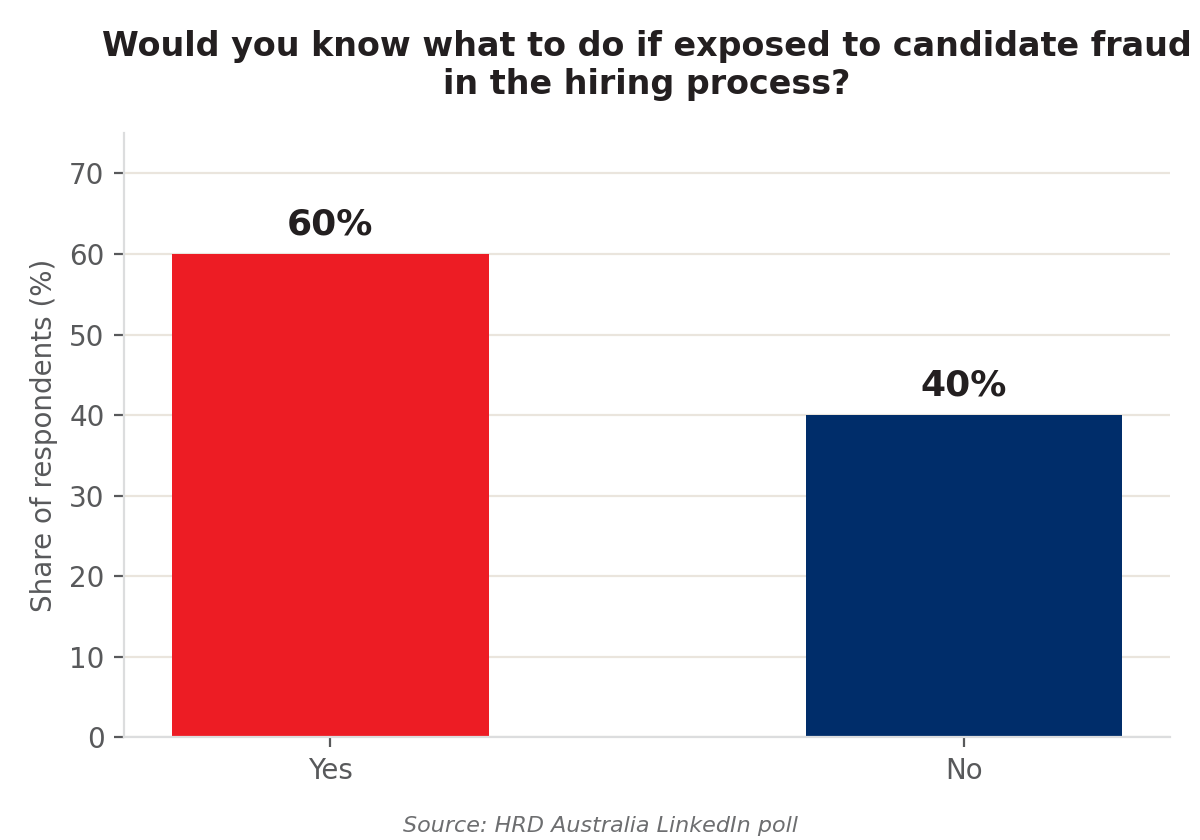
The split is worth sitting with. A majority of respondents said they would know how to respond to candidate fraud, which suggests awareness of the issue has grown as AI-generated resumes, doctored credentials and deepfake interviews have moved from novelty to recurring risk.
But four in ten answering "no" is still a sizeable gap, particularly for an audience of HR professionals who would reasonably be expected to have some form of response plan in place. It points to a divide between organisations that have built fraud detection into their process – background checks, identity verification, structured probation reviews – and those still relying on instinct or a single reference check to catch a dishonest applicant.
That gap also tracks with what Rafter and Evans described as the most common failure point: not a lack of concern about candidate fraud, but a lack of process. Knowing fraud is possible is different from knowing what to do when a discrepancy actually surfaces – whether that's a qualification that doesn't check out, a reference that doesn't add up, or a candidate who looks different on their first day to how they looked in the interview.
The 40 per cent who said "no" are, in effect, the audience Rafter and Evans's advice is aimed at: employers who have not yet turned fraud awareness into a documented plan for their hiring and probation stages.
The path forward for HR
Candidate fraud is no longer confined to a padded CV or an exaggerated job title – it now spans AI-generated documents, synthetic identities and, in some cases, a different person turning up to do the job than the one who was interviewed.
As Evans and Rafter both made clear, the fix is not a single tool or a single check. It is a layered process that starts before the job ad goes live, continues through identity and reference verification, and is backed by a probation period that is actively managed rather than left to expire.
For the four in ten HR leaders who told HRD they wouldn't know what to do if fraud surfaced in their hiring pipeline, that process – built and documented before the next offer is made – is the starting point.
HR leaders wanting to go deeper on the legal side of these issues can hear more from Rafter directly. She will be speaking at the Employment Law Masterclass on 19 August. Register now to lock in your spot.